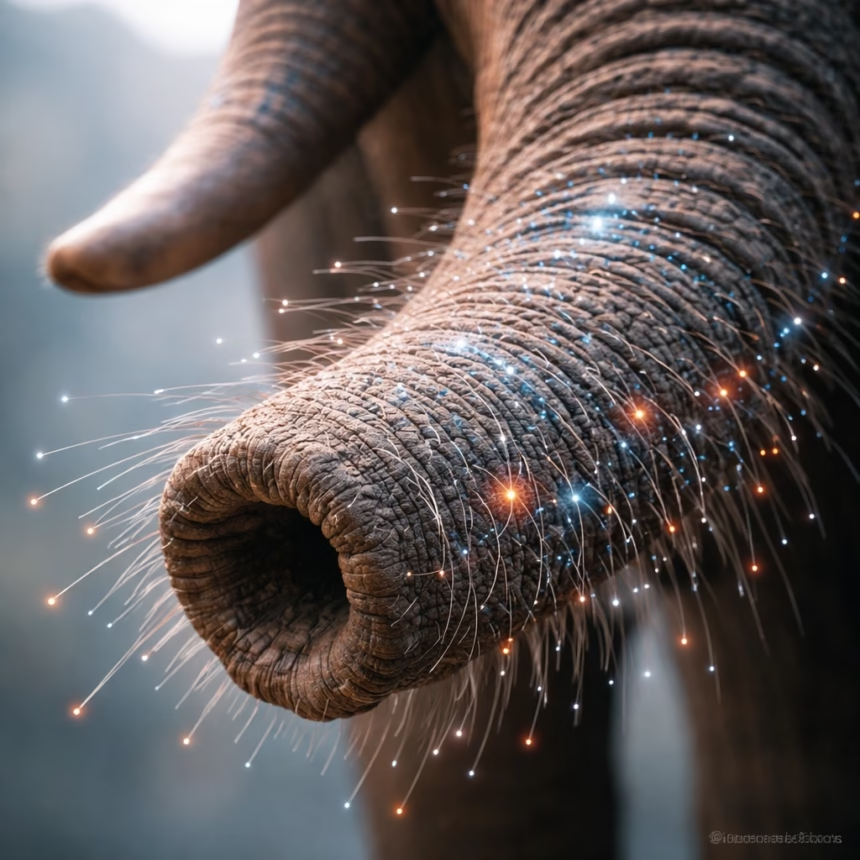
A groundbreaking study has recently unveiled the extraordinary material intelligence embedded within elephant trunk whiskers, revealing the secret behind their unparalleled sense of touch. Conducted by an international team of researchers, this discovery, published in late 2023, promises profound implications for biomimetics, advanced robotics, and prosthetic design, redefining our understanding of biological sensory systems.
Background: The Elephant’s Enigmatic Trunk
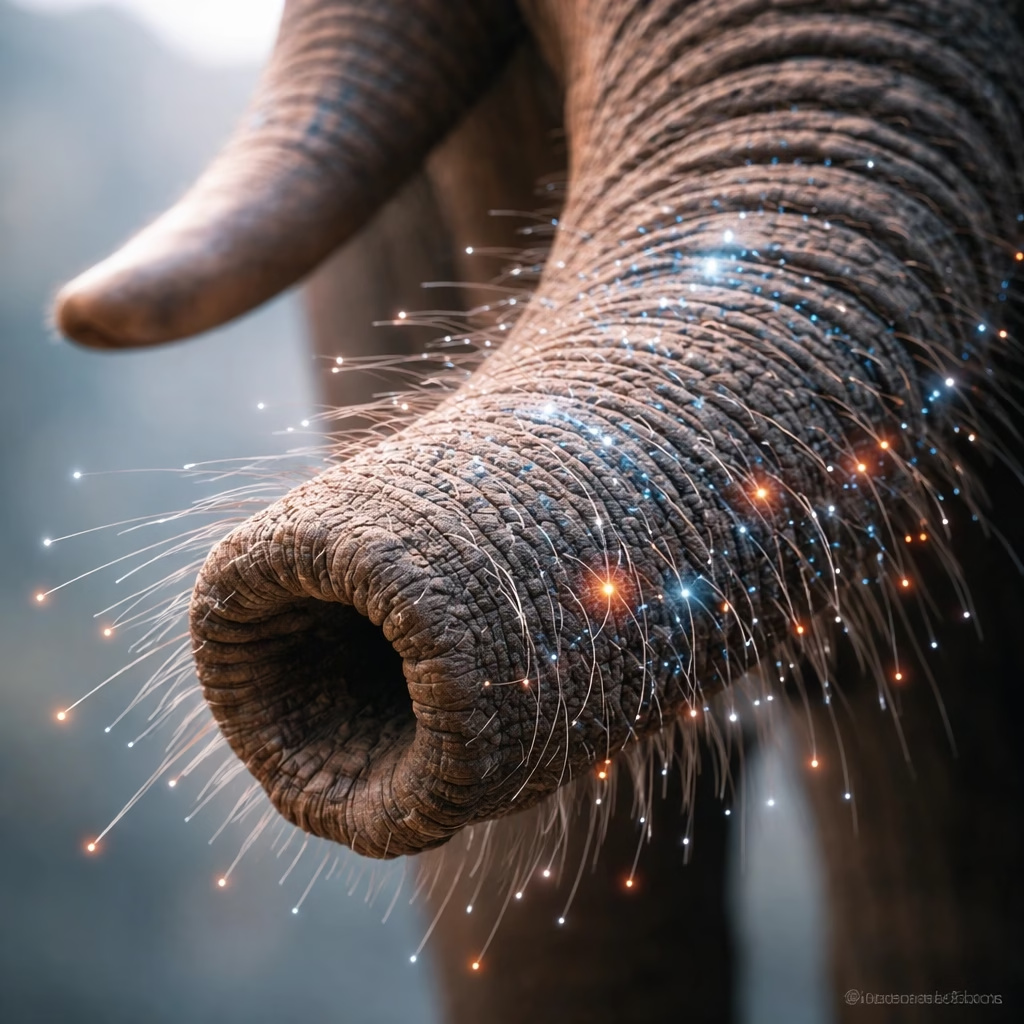
The elephant's trunk is a marvel of natural engineering, serving as a nose, a hand, and a communication tool. This muscular hydrostat, devoid of bone, contains upwards of 40,000 muscles, enabling an astonishing range of motion and dexterity, from uprooting trees to picking up a single blade of grass. For centuries, scientists have marveled at its capabilities, attributing its exquisite sensitivity primarily to a dense network of nerve endings.
While the trunk's general dexterity has been well-documented since early anatomical studies in the 18th and 19th centuries, the specific role of the coarse hairs, often referred to as whiskers or vibrissae, has remained less understood. Unlike the highly sensitive vibrissae of rodents or cats, which are deeply rooted and directly connected to specialized mechanoreceptors, elephant trunk whiskers were historically considered simpler tactile hairs, providing basic contact information. This perception began to shift with more detailed behavioral observations in the late 20th century, hinting at a more complex sensory function.
Key Developments: Unveiling Material Intelligence
The recent breakthrough, spearheaded by researchers at the University of Bristol in the UK and the Max Planck Institute for Intelligent Systems in Germany, focused on the microstructural and biomechanical properties of these seemingly ordinary hairs. Utilizing advanced microscopy, micro-CT scanning, and mechanical testing, the team discovered that elephant trunk whiskers are far more sophisticated than previously thought.
More Read

The study, led by Dr. Michael M. Hoffmann and Professor John H. F. Ehlers, revealed a unique hierarchical structure within the keratinous material of the whiskers. Instead of being uniform, the whiskers exhibit varying densities and arrangements of keratin fibers along their length and cross-section. This architectural variation allows them to respond differently to various stimuli – bending, pressure, and vibration – effectively encoding sensory information through their physical deformation.
Specifically, the researchers identified distinct zones: a stiffer base for anchoring and general pressure sensing, transitioning to a more compliant, flexible tip designed to detect subtle vibrations and texture variations. This gradient in material properties means the whisker itself acts as a sophisticated mechanical filter and amplifier, transmitting precise sensory data to nerve endings located at its base, rather than solely relying on direct contact with the skin.
This "material intelligence" suggests that the whiskers are not just passive conduits for touch but active participants in the sensory process, processing information mechanically before it even reaches the nervous system. The findings challenge conventional views of biological sensing, where nerve endings are typically considered the sole transducers of external stimuli.
More Read

Impact: From Biomimetics to Conservation
The implications of this discovery are far-reaching, impacting several critical fields. For biomimetics and robotics, the revelation of material intelligence in elephant whiskers offers a novel paradigm for designing highly sensitive tactile sensors. Engineers can now explore creating robotic "whiskers" with tunable mechanical properties, enabling robots to perceive their environment with unprecedented detail, far beyond current haptic feedback systems.
This advancement could revolutionize areas requiring fine manipulation and sensory perception, such as surgical robotics, where instruments could gain an "intelligent touch" to distinguish tissue types. In exploration and search-and-rescue robotics, machines equipped with such sensors could navigate complex, unknown environments, detecting subtle changes in terrain or objects without direct visual input. The development of advanced prosthetics could also benefit, providing users with a more natural and nuanced sense of touch.
Beyond technology, this research deepens our understanding of elephant biology and behavior. A more comprehensive grasp of their sensory world can inform conservation efforts, helping to create environments that better cater to their intricate needs and improve their welfare in captive settings. It highlights the profound evolutionary adaptations that allow these majestic creatures to thrive in diverse and challenging habitats, underscoring the importance of protecting them.
What Next: Future Research and Milestones
The discovery of material intelligence in elephant trunk whiskers opens numerous avenues for future research. Scientists plan to investigate the precise neurological pathways that interpret the mechanical signals generated by these sophisticated whiskers. Understanding how the brain processes this pre-filtered information will be crucial for fully replicating the elephant's sensory capabilities in artificial systems.
Further studies will also focus on comparative anatomy, examining if similar material intelligence exists in the vibrissae of other highly tactile animals, such as seals or manatees, which navigate complex underwater environments. This comparative approach could reveal universal principles of biological sensory design.
In the realm of engineering, the immediate next steps involve developing prototype robotic whiskers incorporating these material intelligence principles. Researchers aim to create proof-of-concept sensors that can differentiate textures, detect subtle air currents, and identify objects with varying stiffness, mimicking the elephant's extraordinary abilities. Initial prototypes are expected within the next two to three years, with potential integration into specialized robotic applications within five to ten years. This research is set to redefine the future of robotic touch, inspired by one of nature's most impressive sensory organs.