Ring Mystery Solved? Violent Moon Smash Created Saturn's Iconic Halo
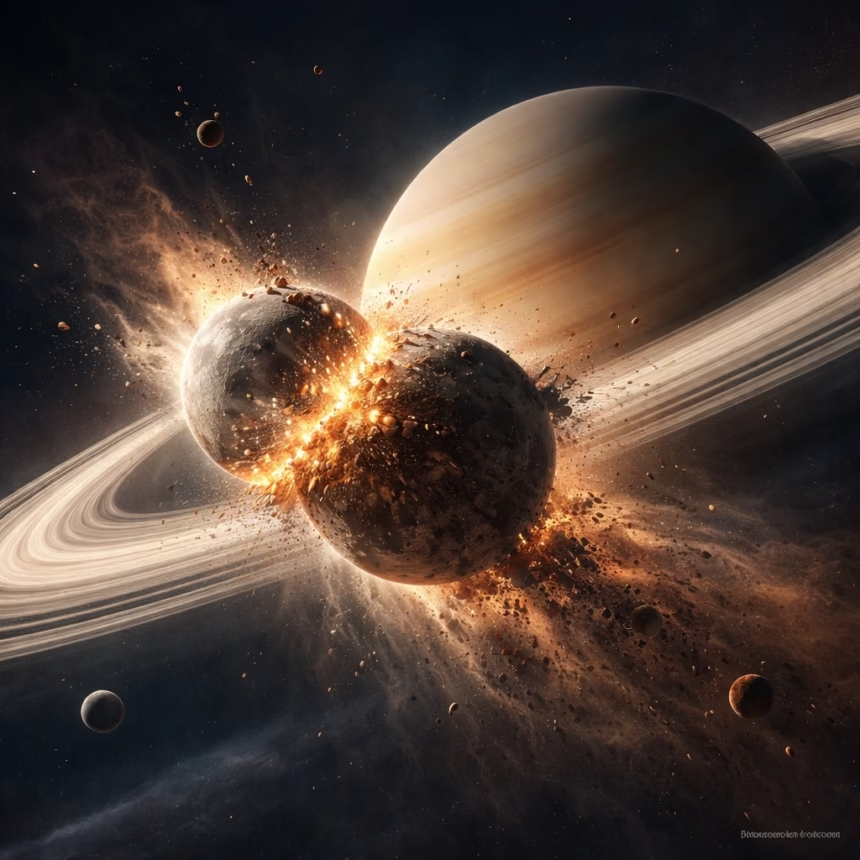
A groundbreaking new study suggests Saturn’s majestic ring system, one of the solar system’s most iconic features, may have originated from a violent collision between two icy moons approximately 100 million years ago. This dramatic cosmic event, occurring long after Saturn itself formed, offers a compelling explanation for the rings' youthful appearance and unique composition.
Background: Saturn’s Enduring Enigma
For centuries, Saturn's rings have captivated astronomers and the public alike, yet their precise origin has remained one of planetary science's most enduring mysteries. Early telescopic observations revealed their grandeur, but it was not until the Voyager missions in the late 20th century, and more recently NASA's Cassini spacecraft, that scientists began to truly grasp their complexity.
Prior theories about the rings' formation ranged from the gravitational capture of passing comets or asteroids to the breakup of a single, larger moon. However, these models often struggled to fully explain key characteristics observed by modern probes.
More Read

The Cassini Legacy
The Cassini-Huygens mission, a collaborative effort between NASA, ESA, and ASI, orbited Saturn from 2004 to 2017, providing an unprecedented wealth of data. Its instruments meticulously measured the rings' mass, composition, and dynamics. This data revealed that the rings are predominantly composed of incredibly pure water ice, with only a small fraction of rocky material, and are surprisingly thin, spanning hundreds of thousands of kilometers but only tens of meters thick.
Crucially, Cassini's "Grand Finale" dives through the gap between Saturn and its innermost ring provided direct measurements of the rings' mass. This mass, combined with models of their evolution, strongly suggested a relatively young age for the rings—on the order of tens to hundreds of millions of years—rather than forming concurrently with Saturn 4.5 billion years ago. This "young rings" hypothesis presented a significant challenge to existing formation theories.
Key Developments: The ‘Chrysalis’ Hypothesis
The new study, led by Dr. Jack Wisdom and his team at the Massachusetts Institute of Technology (MIT), introduces a sophisticated model that addresses many of the lingering questions about Saturn's rings. Their research proposes the existence of a hypothetical icy moon, which they've named "Chrysalis," that once orbited Saturn.

A Moon Destined for Destruction
According to the model, Chrysalis was an icy moon roughly the size of Saturn's current moon Iapetus, or perhaps slightly smaller. Its orbit was stable for billions of years, but approximately 100 million years ago, a critical shift occurred. The researchers suggest that Chrysalis entered a gravitational resonance with Neptune, a phenomenon where the gravitational pull of one celestial body periodically amplifies the influence of another.
This resonance caused Chrysalis's orbit to become unstable and highly eccentric. As its orbit stretched and became more elliptical, the moon ventured closer to Saturn and its existing inner moons, such as Titan and Iapetus. The intense gravitational forces from these close encounters, combined with Saturn's own tidal stresses, would have exerted immense strain on Chrysalis.
Simulating a Cosmic Cataclysm
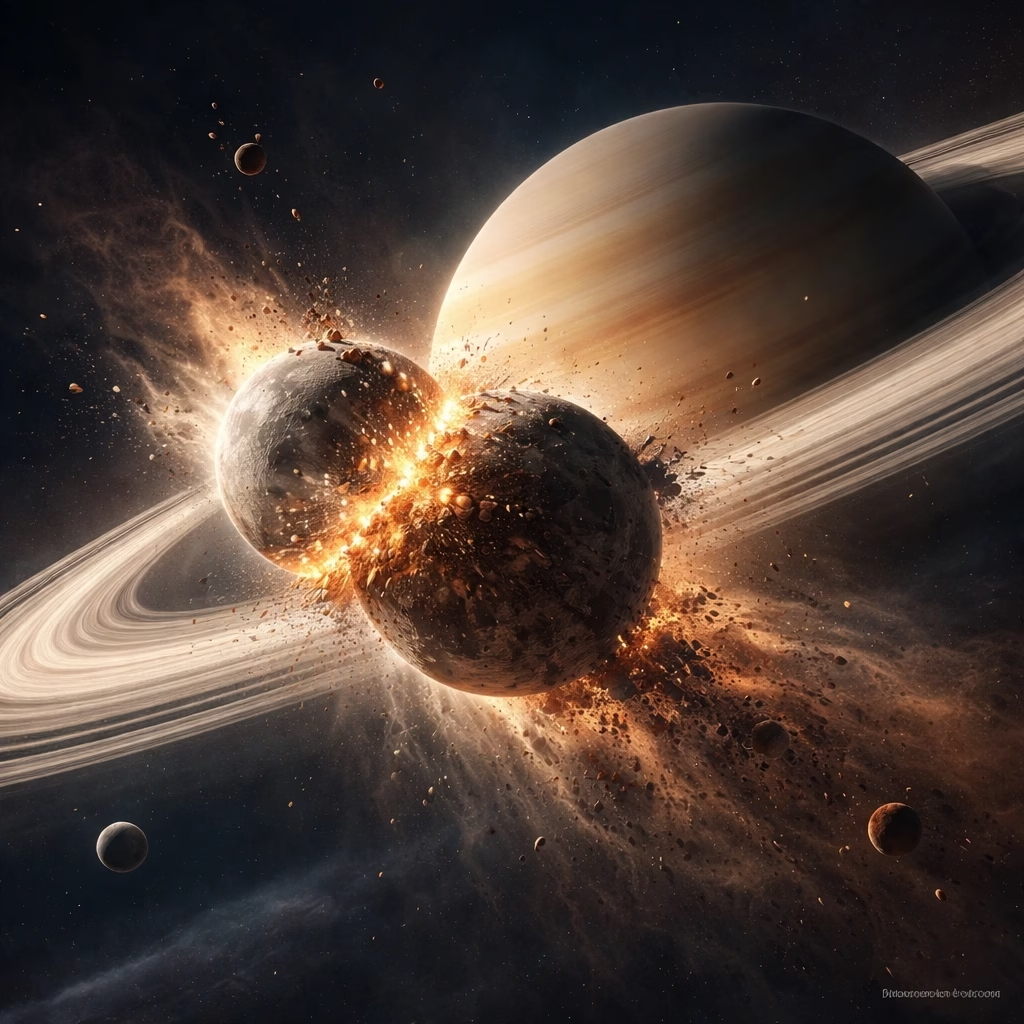
Using advanced computer simulations, the MIT team modeled the orbital mechanics and the subsequent fragmentation process. They found that Chrysalis would have been torn apart by Saturn's powerful tidal forces, shattering into countless icy fragments. These fragments, ranging from microscopic dust particles to kilometer-sized chunks, would have then spread out around Saturn's equator, gradually forming the broad, flat ring system observed today.
The simulations demonstrate that the vast majority of the icy material from Chrysalis would have remained in orbit, forming the rings, while a smaller, rocky core might have plunged into Saturn's atmosphere, leaving behind the nearly pure ice rings.
Explaining Saturn’s Tilt
Beyond explaining the rings' age and composition, the "Chrysalis" theory also offers a compelling explanation for another long-standing mystery: Saturn's axial tilt. Saturn is tilted by about 26.7 degrees relative to its orbit around the Sun. Previously, scientists believed this tilt was caused by a gravitational resonance with Neptune, similar to the one proposed for Chrysalis.
However, recent precise measurements from Cassini indicated that Saturn's tilt is slowly drifting out of this resonance. The new study suggests that it was the loss of Chrysalis, rather than Saturn itself, that was responsible for the initial strong resonance with Neptune. The moon's destruction would have removed the mechanism holding Saturn in that strong resonance, allowing the planet's tilt to evolve to its current state.
More Read

Impact: Redefining Planetary Formation
This new understanding of Saturn's rings represents a significant paradigm shift in planetary science. It moves away from the idea that ring systems are necessarily primordial features, co-forming with their parent planets, and instead suggests they can be relatively young and dynamically active phenomena.
Implications for Our Solar System
For our own solar system, the "Chrysalis" hypothesis deepens our appreciation for the complex interplay of gravitational forces and orbital dynamics that shape planetary systems over billions of years. It highlights that even seemingly stable configurations can undergo dramatic, cataclysmic changes. This understanding could inform future studies of other gas giants, such as Jupiter, Uranus, and Neptune, which also possess ring systems, albeit much fainter ones.
Beyond Our Planetary Neighborhood
The implications extend beyond our solar system. As exoplanet discoveries continue to proliferate, astronomers are increasingly detecting and characterizing ring systems around distant exoplanets. The "Chrysalis" model provides a new framework for understanding the diverse origins and evolutionary paths of these extrasolar rings, potentially guiding observations and theoretical models for planetary systems far from Earth.
This research underscores the dynamic nature of planetary environments, where even massive celestial bodies can experience profound transformations driven by subtle gravitational interactions over vast stretches of cosmic time.
What Next: Further Exploration and Validation
While the "Chrysalis" hypothesis offers a robust and elegant solution to many of Saturn's ring mysteries, scientific inquiry is an ongoing process. The next steps will involve further scrutiny, refinement, and validation of the model.
Refining the Models
Researchers will continue to refine the sophisticated computer simulations, exploring variations in Chrysalis's initial size, composition, and orbital parameters. More detailed models of the fragmentation process and the subsequent dispersal and accretion of ring particles will be developed to ensure consistency with all available Cassini data.
Seeking Observational Evidence
Although Chrysalis itself is long gone, scientists will be looking for any subtle observational evidence that might further support the theory. This could involve re-analyzing existing Cassini data with the new hypothesis in mind, searching for specific signatures in the rings or Saturn's moons that might be remnants or consequences of the proposed cataclysm.
Challenging the Hypothesis
The scientific community will undoubtedly engage in rigorous peer review and attempts to challenge the "Chrysalis" model. Alternative scenarios or modifications to the existing theory may emerge as other researchers test its limits and explore different interpretations of the data. This critical evaluation is a cornerstone of the scientific method, ultimately leading to a more complete and accurate understanding.
Though no immediate missions are planned specifically to re-examine Saturn's rings, this new research will undoubtedly influence the scientific objectives and instrument designs for future missions to gas giants, ensuring that the next generation of probes can gather data that will further illuminate the complex and dynamic history of ring systems across the universe.