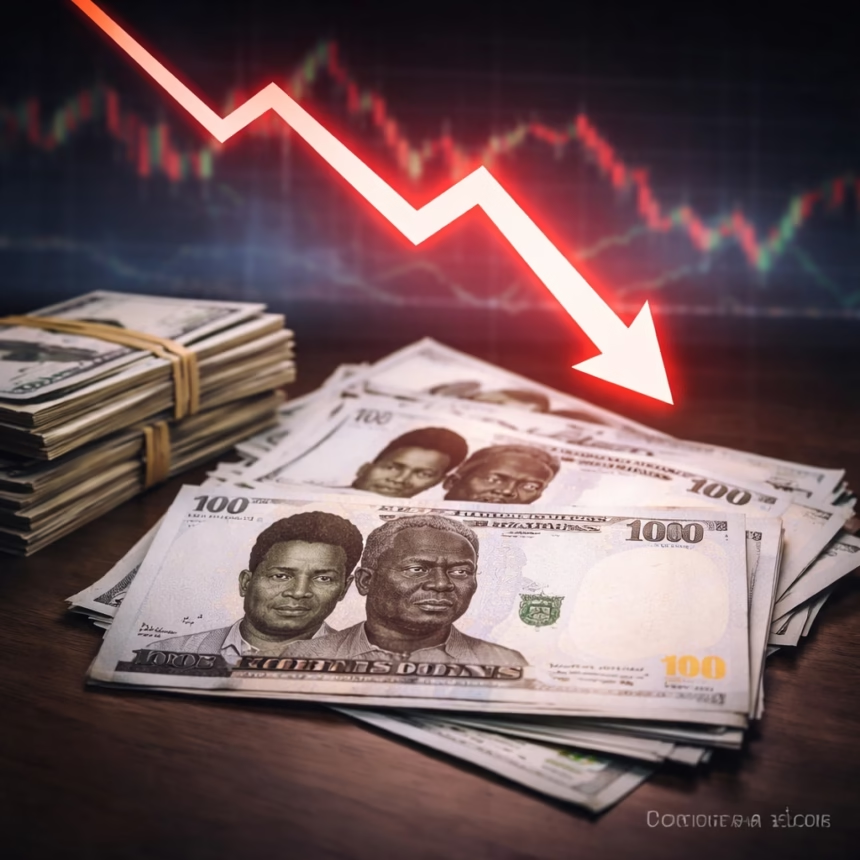
Naira's Shocking Plunge: Is Nigeria's Economy Headed for a Tipping Point?
The Nigerian Naira has continued its significant depreciation against the US dollar in the official foreign exchange market, reaching new historic lows. This persistent weakening of the national currency, observed particularly throughout late 2023 and early 2024, is sending ripples across Nigeria's economic landscape, raising profound concerns among businesses and citizens alike.
Background: A Journey Towards Market Liberalization
Nigeria historically maintained a multi-tiered foreign exchange system with various official rates and a parallel market, where the Central Bank of Nigeria (CBN) heavily intervened to manage the Naira's value, often leading to an overvalued official rate.
The Pre-Unification Era: Controlled Stability and Speculation
Before mid-2023, the market was fragmented into multiple windows, including the Investors’ and Exporters’ (I&E) window, often called NAFEX. This structure, while offering some stability, fueled arbitrage, created a significant backlog of unmet dollar demand, and often forced businesses to the more expensive parallel market.
Tinubu’s Bold Reforms: Unification and Floating
A pivotal shift occurred on June 14, 2023, when President Bola Ahmed Tinubu’s administration announced the unification of all exchange rate windows into the Nigerian Autonomous Foreign Exchange Market (NAFEM). This move signaled a departure from direct CBN intervention and a commitment to a more market-driven exchange rate, allowing the Naira to float more freely.
More Read

Following unification, the Naira’s value against the dollar in the official market plummeted from approximately N460-N470 per dollar to trade around N750-N800 per dollar almost overnight. This initial shock was attributed to the immediate clearing of pent-up demand, market adjustments, and a general scarcity of dollar liquidity.
Key Developments: The Naira’s Continued Slide
Despite the initial adjustment, the Naira's depreciation has not abated. Throughout the latter half of 2023 and into the first quarter of 2024, the currency has continued its downward trajectory, consistently hitting new record lows against the US dollar in the NAFEM window.
NAFEM’s New Reality: Unprecedented Lows
By late January and early February 2024, the Naira had breached significant psychological barriers, trading well above N1,400 per dollar in the official market, at times even exceeding N1,600 and N1,700 per dollar on the NAFEM window. This level of depreciation is unprecedented, far surpassing rates observed in previous volatile periods.
More Read

The gap between the official NAFEM rate and the parallel market rate, which had significantly narrowed post-unification, began to widen again as dollar scarcity persisted. Demand for foreign currency continues to outstrip supply, fueling speculative activities and further pressuring the Naira.
CBN’s Intervention Arsenal: Battling Scarcity and Speculation
The Central Bank of Nigeria, under Governor Olayemi Cardoso, has implemented measures to stabilize the currency and boost dollar liquidity. In February 2024, the Monetary Policy Committee (MPC) delivered a significant interest rate hike, raising the Monetary Policy Rate (MPR) by 400 basis points to 22.75%, the highest in over two decades. Another substantial hike followed in March 2024, increasing the MPR by 200 basis points to 24.75%.
These aggressive rate hikes aim to curb inflation, attract foreign portfolio investment (FPI) through higher yields, and reduce speculative dollar demand. The CBN has also cleared a substantial portion of its verified foreign exchange backlog, estimated at over $2 billion, particularly for airlines and manufacturers, to restore confidence and improve market supply.
Furthermore, the CBN issued circulars targeting speculative practices, restricting banks from holding excessive foreign currency positions and requiring international money transfer operators (IMTOs) to pay remittances in Naira to beneficiaries, channeling more dollars into the official market.
Underlying Factors: A Complex Web of Challenges
Several factors contribute to the Naira’s persistent depreciation. Low crude oil production, Nigeria’s primary source of foreign exchange, remains a major constraint due to theft, vandalism, and underinvestment. Reduced foreign direct investment (FDI) and foreign portfolio investment (FPI) also limit dollar inflows.
Nigeria’s high import dependency, particularly for refined petroleum products, food, and industrial raw materials, creates a constant, robust demand for dollars. This structural imbalance, coupled with a lack of diversified export base, puts immense pressure on the foreign exchange market. Speculative activities, capital flight, and global economic uncertainties further exacerbate the situation.

Impact: Far-Reaching Consequences for the Nation
The Naira's sustained depreciation has profound and widespread implications across various sectors of the Nigerian economy, affecting businesses, consumers, and the government.
Inflationary Pressures Mount
The most immediate impact is soaring inflation. With a significant portion of goods and services either imported or reliant on imported inputs, a weaker Naira directly translates to higher prices. The National Bureau of Statistics (NBS) reported headline inflation reaching 31.70% in February 2024, with food inflation even higher at 37.92%. This erodes the purchasing power of average Nigerians, making basic necessities increasingly unaffordable.
Businesses Under Strain
Nigerian businesses, particularly in manufacturing, pharmaceuticals, and technology, face exponentially higher costs for imported raw materials, machinery, and spare parts. Many pass these costs to consumers, leading to reduced sales, or absorb them, resulting in thinner profit margins. Some businesses face scaling down, layoffs, or even closure due to prohibitive FX costs.
The energy sector is also severely impacted, as Nigeria imports virtually all refined petroleum products. A weaker Naira means higher landing costs for petrol and diesel, leading to increased pump prices and higher operational costs for businesses reliant on generators due to unreliable grid power.
Public Sector Woes
The government faces significant challenges. The cost of servicing foreign currency-denominated debts rises sharply with a depreciating Naira, straining the national budget. Attracting foreign direct investment (FDI) becomes more difficult when currency volatility introduces an additional layer of risk for international investors.
This depreciation also complicates economic planning and budgeting, creating uncertainty and fiscal instability as dollar-denominated revenues clash with Naira-based expenditures.
What Next: The Path to Stability and Economic Recovery
The immediate outlook for the Naira remains challenging, with experts anticipating continued volatility in the short term. The effectiveness of the CBN's recent monetary policy tightening and liquidity management measures will be crucial in determining the currency's trajectory.
Sustained Policy Action and Structural Reforms
The Central Bank has indicated its commitment to a market-reflective exchange rate and to implementing measures that enhance dollar liquidity, including attracting foreign portfolio investment and addressing FX backlogs. However, monetary policy alone may not suffice.
The government’s fiscal policies and structural reforms are equally vital. Efforts to boost non-oil exports, improve crude oil production, attract sustainable FDI by enhancing the ease of doing business, and reduce import dependency through local production initiatives are essential. The full operation of the Dangote Refinery, supplying refined petroleum products domestically, is expected to significantly reduce demand for dollars for fuel imports, potentially offering some relief.
Expert Outlook and Key Indicators to Watch
Economists and financial analysts are closely monitoring several key indicators: Nigeria’s foreign reserves, crude oil production volumes, and global oil prices. The impact of the CBN’s interest rate hikes on inflation and capital inflows will also be keenly observed. While some analysts foresee potential Naira stabilization later in 2024 if policies yield results, others caution that significant structural reforms are needed to address fundamental imbalances.
The journey towards a stable Naira is intertwined with broader economic reforms aimed at diversifying the economy, enhancing productivity, and creating a more attractive environment for investment. The coming months will be pivotal in determining whether Nigeria can navigate this unprecedented currency crisis and lay the groundwork for sustainable economic growth.