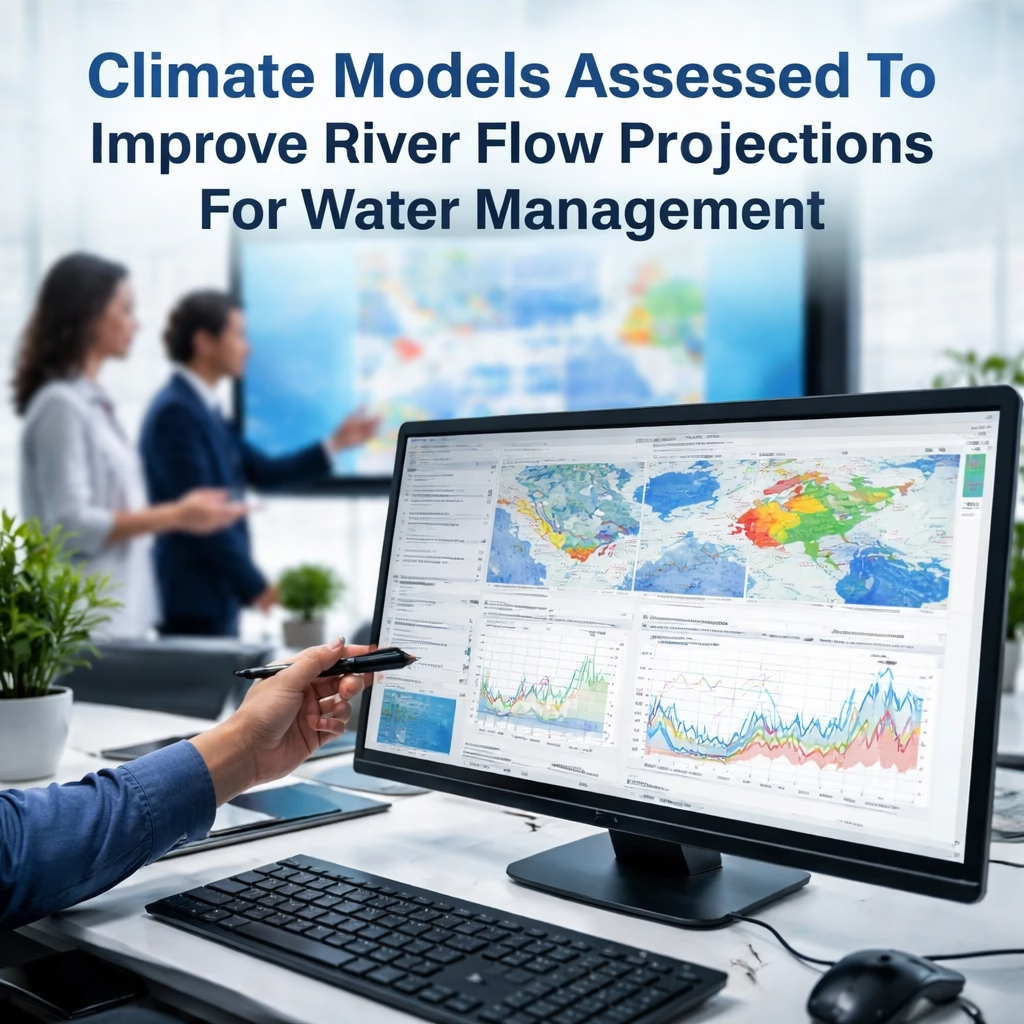
A groundbreaking global initiative is underway to rigorously assess and refine climate models, aiming to dramatically enhance the accuracy of river flow projections. This critical scientific endeavor, unfolding across leading research institutions worldwide, promises to revolutionize water management strategies for decades to come, addressing both flood risks and water scarcity.
Background: The Growing Imperative for Precision
For decades, water resource managers have grappled with inherent uncertainties in predicting river flows. Traditional hydrological models, reliant on historical climate data, are increasingly unreliable due to accelerating climate change. This has led to significant challenges in managing water for agriculture, energy, municipal supply, and flood control, underscoring the urgent need for more accurate forecasting.
Early global climate models (GCMs) provided broad insights but lacked the spatial resolution for specific river basin management. Their simplified hydrology often limited utility, even with downscaling. The Intergovernmental Panel on Climate Change (IPCC) reports consistently highlight increasing extreme weather events—from prolonged droughts in the American West to devastating floods in Southeast Asia—spurring concerted international efforts by organizations like the World Meteorological Organization (WMO) to improve local water management predictions.
Key Developments: A New Era of Predictive Power
A significant leap in climate modeling capabilities has been achieved with the latest generation of models, notably those contributing to the Coupled Model Intercomparison Project Phase 6 (CMIP6). These advanced models boast higher spatial resolutions and more sophisticated representations of physical processes, allowing for a nuanced simulation of precipitation, temperature, and atmospheric circulation patterns that directly influence river flows.
Crucially, recent efforts refine hydrological components, integrating detailed physics for snowmelt, soil moisture dynamics, evapotranspiration rates, and groundwater interactions. Accurate depiction of snowpack in regions like the Himalayas or the Sierra Nevada is paramount for downstream water availability. The burgeoning field of artificial intelligence (AI) and machine learning (ML) is leveraged to identify complex patterns, optimize model parameters, and develop hybrid models, leading to unprecedented accuracy in short-to-medium range forecasts.
More Read

The integration of real-time observational data through advanced data assimilation techniques further sharpens projections. Satellite imagery, ground sensors, and in-situ measurements continuously feed into models, correcting biases. While global models provide context, regional climate models (RCMs) and sophisticated downscaling are essential for translating projections into actionable insights at the river basin level, such as for the Mekong, Colorado, or Rhine River Basins, ensuring local topographical features are accurately represented.
Far-Reaching Impact: Securing Water for All
The direct beneficiaries of these enhanced projections are water resource managers and utility companies. More accurate foresight into future river flows enables informed decisions regarding reservoir operations, water allocations, and infrastructure planning. This translates to optimized hydropower generation and more efficient irrigation schedules, particularly vital for the agricultural sector in arid and semi-arid regions, reducing crop losses and enhancing food security.
For urban centers and disaster management agencies, improved river flow projections are a game-changer. Early and accurate flood warnings allow for timely evacuations and deployment of protective measures, potentially saving lives and billions in property damage. Conversely, better drought predictions enable proactive water conservation and the development of alternative water sources, bolstering urban resilience against prolonged scarcity.
More Read

Beyond human systems, ecosystems and biodiversity benefit from more precise hydrological data, enabling better management of environmental flows crucial for aquatic habitats, migratory species, and overall ecological health. Economically, these advancements reduce risks associated with water extremes, stabilize agricultural yields, and provide greater certainty for industrial and energy sectors, fostering sustainable economic development.
What Next: Towards a Water-Secure Future
Immediate next steps involve rigorous validation and integration of new model assessments into operational forecasting systems. Research institutions are collaborating with national meteorological and hydrological services to transition these cutting-edge models into practical tools for daily, seasonal, and multi-year projections. Crucially, widespread dissemination of these improved projections and associated capacity building for water managers globally will ensure decision-makers understand and effectively apply the new data.
On a broader scale, enhanced projections are expected to inform national and international water policies, guiding investment in infrastructure, shaping transboundary water agreements, and strengthening climate adaptation strategies. Continued international cooperation, facilitated by bodies like the WMO and UN-Water, will be essential to share best practices and ensure equitable access to these vital scientific advancements. The ultimate goal is a more resilient and water-secure future for communities worldwide, adapting effectively to the profound hydrological shifts driven by climate change.