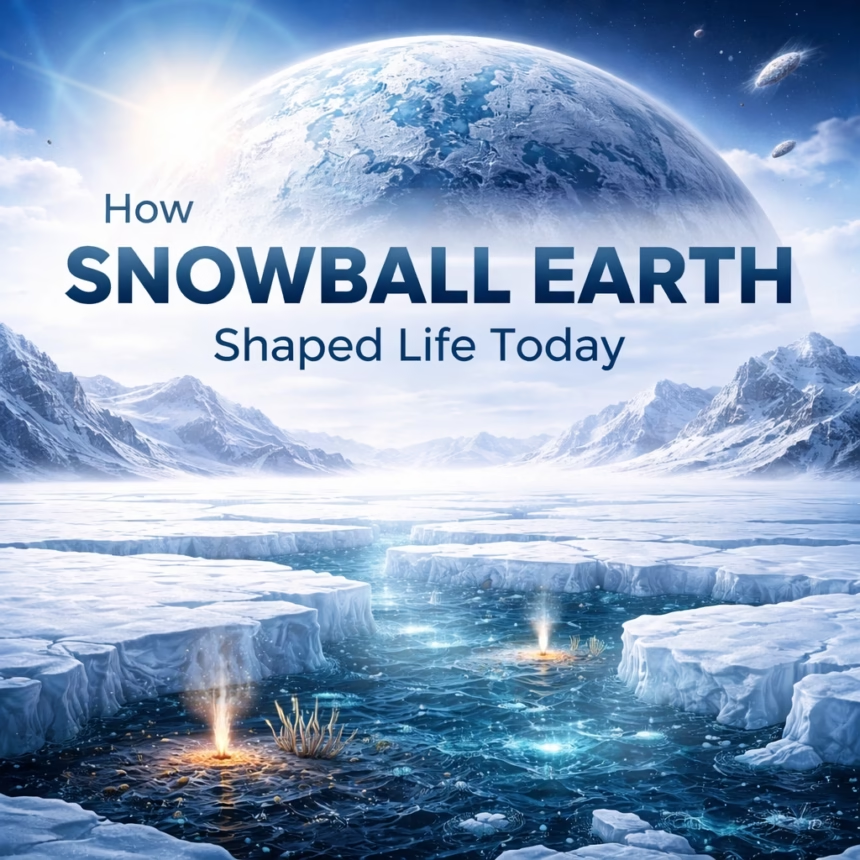
Between 720 and 635 million years ago, Earth endured a series of cataclysmic glaciations, transforming into a planet almost entirely encased in ice – a phenomenon dubbed "Snowball Earth." This extreme climatic event, occurring during the Cryogenian period, profoundly reshaped our planet's chemistry and biology, setting the stage for the emergence of complex life forms that define today's ecosystems. Scientists are increasingly uncovering the intricate ways this ancient deep freeze acted as an evolutionary crucible.
Background: A Planet of Ice
The concept of Snowball Earth describes a period when glacial ice sheets extended from the poles to the equator, potentially covering the entire planet's surface and oceans in a layer kilometers thick. Geological evidence for this radical climate state was first gathered from ancient rock formations found across diverse continents, including Namibia, Australia, and Svalbard. These deposits, known as tillites, contain characteristic features like dropstones and striations, indicating glacial activity. Crucially, their paleomagnetic signatures suggest they formed at equatorial latitudes, a strong indicator of global glaciation.
Two major Snowball Earth events are widely recognized: the Sturtian glaciation, lasting from approximately 717 to 660 million years ago, and the Marinoan glaciation, which occurred between 650 and 635 million years ago. A third, less extensive Gaskiers glaciation followed around 580 million years ago.
The primary trigger for these glaciations is believed to be a combination of factors. The supercontinent Rodinia, positioned largely in tropical latitudes, would have enhanced silicate weathering, a process that draws carbon dioxide (CO2) from the atmosphere. As CO2 levels plummeted, the planet cooled. This initial cooling then triggered a runaway albedo effect: as ice expanded, it reflected more sunlight, leading to further cooling and more ice formation, culminating in global glaciation.
The end of these icy epochs was equally dramatic. Volcanic activity, continuing unchecked beneath the vast ice sheets, slowly released massive amounts of CO2 into the atmosphere. With no oceans or land surfaces to absorb it, CO2 accumulated, creating a super-greenhouse effect. This eventually melted the ice, leading to rapid deglaciation and a subsequent period of extreme warmth and heavy rainfall, which further eroded continental crusts.
More Read

Key Developments: Unraveling the Icy Enigma
Recent advancements in geological dating and geochemical analysis have significantly refined our understanding of Snowball Earth. Scientists now employ high-precision uranium-lead dating of zircons found within glacial deposits to pinpoint the exact timing and duration of these events, offering a clearer timeline for associated biological changes. For instance, new dates have precisely bracketed the Sturtian and Marinoan glaciations, allowing for more accurate correlation with fossil records.
Geochemical signatures in ancient sediments provide crucial insights into ocean chemistry during these periods. Studies of carbon isotopes (δ13C) show extreme negative excursions during and immediately after the glaciations, indicating massive disruptions to the global carbon cycle. The presence of banded iron formations (BIFs) in post-glacial sediments suggests widespread anoxia in deep oceans, followed by a surge of oxygenation as the ice retreated and nutrient-rich waters mixed.
A key debate revolves around whether Earth was a "hard snowball" with a completely frozen ocean, or a "slushball" with areas of thin ice or open water, particularly near the equator or over volcanic hotspots. Evidence for localized melt ponds or refugia under thinner ice, potentially sustained by hydrothermal activity, is critical for understanding how life survived. Microfossil discoveries in post-glacial cap carbonates and within glacial deposits themselves offer tantalizing clues about microbial communities that persisted through the deep freeze.

Sophisticated climate models, integrating geological and biological data, continue to simulate the extent and dynamics of these glaciations. These models help researchers understand the thresholds for runaway glaciation and deglaciation, and how atmospheric and oceanic circulation might have operated under such extreme conditions. Furthermore, molecular clock studies, which estimate the divergence times of different life forms based on genetic mutations, are increasingly aligning with the geological timeline, suggesting that key evolutionary innovations occurred immediately before, during, or after these events.
Impact: The Evolutionary Crucible
The Snowball Earth events exerted immense pressure on early life, fundamentally shaping its trajectory. The extreme cold and isolation created an unparalleled environmental filter, leading to genetic bottlenecks and driving rapid evolutionary change among the surviving organisms.
Survival and Refugia
How life survived remains a central question. Hypotheses include the existence of "refugia" – pockets of liquid water in areas of thin ice, around volcanic vents on the ocean floor, or in subglacial lakes. These isolated environments would have provided sanctuaries for microbial life, including early eukaryotes. Evidence for phototrophic organisms in post-glacial sediments suggests that some light-dependent life forms managed to persist, perhaps in these limited open-water zones.
Post-Glacial Nutrient Pulses and Oxygenation
The aftermath of Snowball Earth was characterized by an unprecedented influx of nutrients into the oceans. The massive weathering of exposed continental rocks during deglaciation, fueled by a super-greenhouse atmosphere and acid rain, flushed vast quantities of phosphorus, iron, and other essential elements into the global ocean. This nutrient enrichment, combined with the subsequent oxygenation of deep ocean waters, fueled a massive boom in primary productivity.
This surge in oxygen is particularly significant. While the Great Oxygenation Event occurred much earlier, Snowball Earth's end led to a major increase in atmospheric and oceanic oxygen levels, creating conditions suitable for more complex, energy-intensive life forms.
The Rise of Eukaryotes and Multicellularity
The Cryogenian period, encompassing Snowball Earth, is a critical juncture for the evolution of eukaryotes – organisms with complex cells containing a nucleus. Molecular clock estimates suggest significant diversification of eukaryotic lineages either before or immediately after these glaciations. The environmental stress may have driven innovations in cellular structure, metabolism, and genetic regulation.
More Read

Crucially, the Ediacaran biota, the earliest known complex multicellular life forms, appeared shortly after the Marinoan glaciation, around 635 million years ago. These enigmatic organisms, ranging from simple fronds to disc-like structures, represent a significant step towards macroscopic life. The theory posits that the dramatic environmental shifts and subsequent resource abundance following Snowball Earth provided the ecological niche and evolutionary impetus for multicellularity to thrive.
The connection to the Cambrian explosion, a rapid diversification of animal life around 541 million years ago, is also profound. While separated by tens of millions of years, the Snowball Earth events are seen as a "reset button" that eliminated many ancestral lineages, leaving ecological space and driving the genetic innovations necessary for the subsequent Cambrian burst of animal forms with skeletons and complex body plans.
What Next: Future Milestones in Research
The study of Snowball Earth remains a vibrant, interdisciplinary field. Future research aims to achieve even greater precision in dating glacial events and post-glacial deposits, further refining the timeline of co-occurring biological innovations. Advanced geochemical techniques will continue to probe ancient sediments for more detailed information on ocean chemistry, nutrient cycles, and oxygen levels during and after the glaciations.
A significant focus will be on identifying and characterizing more "refugia" environments, both through geological evidence and sophisticated climate modeling, to understand how diverse microbial ecosystems managed to persist through such extreme conditions. Researchers are also working to connect specific genetic innovations observed in modern organisms to the environmental stresses of Snowball Earth, potentially identifying ancient genes that were critical for adaptation and survival.
Further exploration of the links between Snowball Earth and the evolution of multicellularity and animal life will involve integrating paleontological discoveries with genomic data. Understanding how environmental pressures drive genetic changes that lead to novel body plans and ecological strategies is a frontier of research. Ultimately, the lessons learned from Earth's ancient deep freezes may also inform our understanding of planetary habitability, offering insights into the potential for life on other celestial bodies that may have experienced similar "snowball" phases.