Global gold prices experienced a notable downturn this week, reflecting a broader shift in investor sentiment. This decline occurred amidst intensified diplomatic efforts in Vienna, where negotiations aimed at reviving the Joint Comprehensive Plan of Action (JCPOA) between the United States and Iran have entered a critical phase. The confluence of these events signals a complex interplay between geopolitics and financial markets.
Background: Gold, Sanctions, and the JCPOA’s Tumultuous History
Gold has long served as a traditional safe-haven asset, attracting investors during periods of economic uncertainty, high inflation, and geopolitical instability. Its value often rises when global tensions escalate, offering a perceived hedge against market volatility. Conversely, signs of de-escalation or improved economic outlooks can diminish its appeal.
The diplomatic backdrop for the current market movements is the Joint Comprehensive Plan of Action, a landmark nuclear agreement signed in July 2015. This accord involved Iran and the P5+1 nations—China, France, Germany, Russia, the United Kingdom, and the United States—plus the European Union. Under the JCPOA, Iran agreed to significant restrictions on its nuclear program in exchange for the lifting of international sanctions, particularly those impacting its oil exports and financial sector.
The agreement, hailed by many as a diplomatic triumph, faced severe challenges in May 2018 when the Trump administration unilaterally withdrew the United States from the deal. Washington subsequently reimposed a sweeping array of sanctions on Tehran, targeting its oil sales, banking system, and other key economic sectors. This "maximum pressure" campaign aimed to compel Iran to negotiate a new, broader agreement addressing its ballistic missile program and regional activities.
In response to the U.S. withdrawal and the reimposition of sanctions, Iran gradually began to roll back its commitments under the JCPOA starting in 2019. Tehran exceeded limits on uranium enrichment levels, increased its stockpile of enriched uranium, and restricted international inspectors' access to certain nuclear facilities. These actions raised alarms among international observers and signatories to the original deal.
More Read

Upon taking office in January 2021, the Biden administration expressed its intent to rejoin the JCPOA, provided Iran returned to full compliance with its nuclear obligations. Indirect talks between the U.S. and Iran, facilitated by European mediators, commenced in Vienna in April 2021. These negotiations have progressed through multiple challenging rounds, frequently stalling over key disagreements, but have recently shown renewed momentum.
Key Developments: Price Slump and Diplomatic Surge
The past few days have witnessed a notable retreat in gold prices. On Tuesday, February 20th, spot gold fell by approximately 1.8%, marking its lowest level in two weeks and dropping below the critical $1,880 per ounce threshold. This decline followed a period where the precious metal had shown resilience, hovering near multi-month highs.
Factors Driving Gold’s Decline
Several interconnected factors are contributing to gold's recent downturn:
More Read

Reduced Geopolitical Risk Perception: The primary driver appears to be the growing optimism surrounding the U.S.-Iran nuclear talks. A successful conclusion to these negotiations is widely perceived as a de-escalation of tensions in the Middle East, diminishing gold's traditional appeal as a safe haven.
* Hawkish Central Bank Stance: Expectations of more aggressive interest rate hikes by the U.S. Federal Reserve are also weighing on gold. Higher interest rates increase the opportunity cost of holding non-yielding assets like gold, making interest-bearing investments more attractive.
* Strengthening U.S. Dollar: The prospect of rising U.S. interest rates has bolstered the U.S. dollar. A stronger dollar makes dollar-denominated gold more expensive for holders of other currencies, thereby reducing demand.
* Optimistic Economic Outlook: Despite ongoing inflationary concerns, some investors are increasingly optimistic about global economic recovery. A robust economic environment typically reduces the demand for safe-haven assets.
Progress in Vienna
Concurrently, reports from Vienna indicate significant progress in the talks to restore the JCPOA. European Union coordinator Enrique Mora, a central figure in the negotiations at the Palais Coburg, recently stated that a deal is "within reach." U.S. Special Envoy for Iran Robert Malley and Iran's chief negotiator Ali Bagheri Kani have also engaged in intensive discussions, with some sources suggesting a draft text is nearing completion.
Key areas of progress include the scope of sanctions relief, particularly those related to Iran's oil exports and financial sector. Negotiators are also reportedly making headway on the sequence of steps for both sides to return to compliance.
However, significant sticking points remain. These include Iranian demands for guarantees that a future U.S. administration will not unilaterally withdraw from the deal again, the verification mechanisms for Iran's nuclear program, and the precise timing and extent of sanctions relief. Iran also seeks the removal of the Islamic Revolutionary Guard Corps (IRGC) from the U.S. list of foreign terrorist organizations, a contentious issue for Washington.
Impact: A Ripple Effect Across Global Sectors
The potential revival of the JCPOA and the associated shift in gold prices carry far-reaching implications for various stakeholders and global markets.
Gold Investors
For investors holding gold bullion, gold exchange-traded funds (ETFs), or shares in gold mining companies, the immediate impact has been negative. Short-term losses are evident, and further declines could materialize if a deal is formally announced. The long-term outlook for gold will depend on the evolution of inflation, central bank monetary policies, and broader economic stability, rather than solely on the Iran situation.

Oil Markets and Energy Security
Perhaps one of the most significant impacts could be felt in the global oil markets. A successful deal would likely lead to the lifting of sanctions on Iranian oil exports, potentially allowing an additional 1 to 2 million barrels per day of Iranian crude to enter the market within months. This influx of supply could exert downward pressure on global oil prices, which have recently been elevated due to supply concerns and geopolitical tensions elsewhere.
Lower oil prices would benefit consumer nations by reducing energy costs and potentially easing inflationary pressures. For oil-producing nations, particularly members of OPEC+, increased Iranian output could complicate efforts to manage global supply and maintain price stability.
Regional Stability in the Middle East
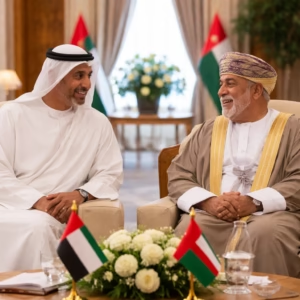
The prospect of a revived JCPOA deeply affects regional dynamics in the Middle East. Countries like Israel, Saudi Arabia, and the United Arab Emirates have expressed strong concerns about Iran's nuclear ambitions and its regional activities, including support for various proxy groups. While some may view a deal as a pragmatic step to contain Iran's nuclear program, others fear it could embolden Tehran by providing economic relief without sufficiently addressing its broader regional conduct.
Iranian Economy
For Iran, the lifting of sanctions would be a significant economic boon. It would enable the country to access billions of dollars in frozen assets, dramatically increase its oil exports, and attract much-needed foreign investment. This economic relief could alleviate domestic hardships, improve living standards, and potentially stabilize the Iranian rial. However, the benefits would depend on effective economic management and integration into the global financial system.
What Next: The Road to Ratification and Beyond
The coming days and weeks are critical for the fate of the JCPOA. Negotiators are reportedly working towards a rapid conclusion, with some sources suggesting a deal could be finalized by early March.
Timeline for a Potential Agreement
Should a political agreement be reached in Vienna, several steps would follow. Both the U.S. and Iranian governments would need to review and formally approve the terms. In the U.S., the Biden administration would face the challenge of securing domestic support, potentially facing opposition from some members of Congress. In Iran, the ultimate approval rests with Supreme Leader Ayatollah Ali Khamenei, whose assent is crucial given the influence of hardliners.
Implementation Challenges
Even if a deal is struck, its implementation will present considerable challenges. The International Atomic Energy Agency (IAEA) would play a vital role in verifying Iran's compliance with its nuclear commitments. The phased lifting of sanctions would require careful coordination and monitoring. Trust-building measures would be essential for both sides, given the history of mistrust and past breaches.
Potential Pitfalls
The negotiations remain fragile, and a deal could still collapse at the eleventh hour. Remaining disagreements, particularly regarding guarantees for future U.S. compliance or the IRGC's status, could derail progress. External actors, including regional adversaries of Iran, could also attempt to influence or disrupt the process.
Future of Gold Prices
In the immediate future, gold prices are likely to remain highly sensitive to news regarding the Iran talks. A definitive agreement would likely exert further downward pressure on gold, as geopolitical risk premiums diminish. Conversely, if the talks falter or collapse, gold could quickly rebound, reclaiming its safe-haven appeal. Beyond the Iran context, gold's trajectory will continue to be shaped by global inflation rates, central bank monetary policies, and the overall health of the global economy.