
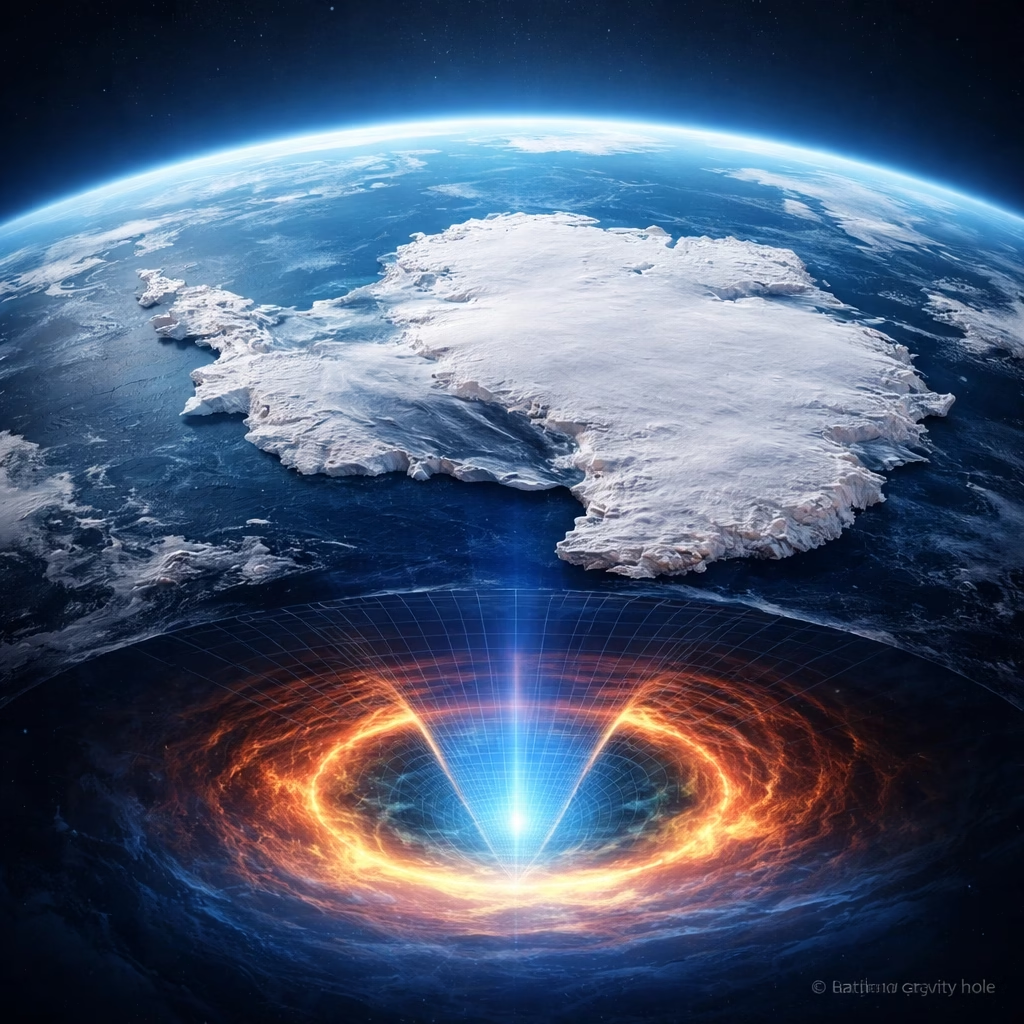
Antarctica, Earth's southernmost continent, has long been known to harbor the planet's most intense gravitational anomaly – a colossal "gravity hole" where the pull of gravity deviates significantly from the global average. Now, a groundbreaking international study has finally revealed the deep geological processes responsible for this enigmatic phenomenon, offering unprecedented insights into Earth's dynamic interior.
Background: A Continent’s Gravitational Mystery
For decades, scientists have observed that the gravitational field over Antarctica is not uniform. Satellite missions, particularly the GRACE (Gravity Recovery and Climate Experiment) and GRACE-FO (Follow-On) missions, have meticulously mapped Earth’s gravity field, revealing a pronounced “gravity low” over parts of the continent, specifically West Antarctica, and a “gravity high” over others. These anomalies indicate variations in the distribution of mass beneath the surface. A “gravity hole” or gravity anomaly refers to regions where the gravitational pull is either stronger or weaker than the theoretical average for a perfectly smooth, homogeneous Earth.
Early observations, dating back to the late 20th century, hinted at the sheer scale of Antarctica's gravitational quirks. Researchers initially attributed some of these variations to the immense weight of the ice sheet itself, which depresses the Earth's crust. However, the magnitude and specific patterns of the anomalies suggested a deeper, more fundamental geological cause, indicating that the planet's mantle—the layer of solid rock between the crust and the outer core—played a crucial role. Understanding these deep-seated forces is vital for comprehending the long-term evolution of continents and the mechanics of plate tectonics.
Key Developments: Unraveling the Mantle’s Influence
A recent study, published this year by a collaborative team of geophysicists from institutions including the German Research Centre for Geosciences (GFZ) and the University of Bristol, has pinpointed the primary driver behind Antarctica’s extreme gravity anomaly. Utilizing advanced seismic imaging techniques and sophisticated computational models, the researchers peered deep into the Earth’s mantle, revealing a complex interplay of geological forces.
More Read

The core of the discovery lies in understanding mantle convection—the slow churning of Earth's interior where hot, less dense material rises and cooler, denser material sinks. This process is the engine of plate tectonics, driving the movement of continents across the planet's surface. The study revealed an unusually dense, cold structure within the lower mantle beneath Antarctica, extending thousands of kilometers deep. This massive, cold anomaly acts like a gravitational anchor, pulling down on the crust above and creating the observed strong gravity high.
The Role of Ancient Subduction
The researchers linked this deep mantle structure to the ancient geological history of the supercontinent Gondwana. Millions of years ago, before its breakup, various oceanic plates subducted (sank) beneath the landmass that would eventually become Antarctica. As these cold, dense oceanic slabs plunged into the mantle, they remained largely intact, accumulating and sinking further into the deep Earth over geological timescales. The study’s models indicate that these remnants of ancient subducted plates have now coalesced into a colossal, unusually dense body within the lower mantle, directly beneath parts of Antarctica.
This accumulated cold material significantly increases the mass density in that specific region of the mantle. According to the laws of gravity, a greater concentration of mass exerts a stronger gravitational pull. The sheer size and density of this ancient slab graveyard are what make Antarctica's gravity anomaly so pronounced, distinguishing it from other, less intense anomalies found elsewhere on Earth. The research employed seismic tomography, similar to a CT scan for the Earth, to map these density variations with unprecedented detail, confirming the presence and extent of these deep, cold structures.
More Read

Impact: Reshaping Our View of Earth’s Interior
The implications of this discovery are far-reaching, fundamentally altering our understanding of Earth’s deep interior and the long-term evolution of continents.
Refining Mantle Dynamics
This research provides crucial empirical evidence for how deeply ancient geological events can influence current geophysical phenomena. It demonstrates that remnants of subducted plates can persist in the lower mantle for hundreds of millions of years, maintaining their density contrast and significantly impacting the planet’s gravity field. This challenges some previous models that suggested more rapid assimilation or heating of subducted material within the mantle.
Improving Geoid Models
Accurate knowledge of Earth’s gravity field, or geoid, is essential for a multitude of applications. Satellite navigation systems, precise measurements of sea level rise, and studies of ice sheet mass balance all rely on highly accurate geoid models. By understanding the deep mantle contributions to Antarctica’s gravity anomaly, scientists can refine these models, leading to more precise measurements and better predictions for critical environmental processes, particularly in the polar regions.
Understanding Continental Stability
While Antarctica is largely tectonically stable today, understanding the deep mantle structures beneath it offers insights into its past geological activity and potential future stability. The presence of such a massive, cold anomaly suggests a long history of deep-seated stability, contrasting with more tectonically active regions driven by shallow mantle processes. This also provides context for the relatively low levels of volcanism observed across much of the continent.
What Next: Future Explorations and Refinements
The new understanding of Antarctica’s gravity anomaly opens several avenues for future research and exploration.
Enhanced Seismic Imaging
Scientists will continue to refine seismic imaging techniques, aiming for even higher resolution maps of the deep mantle. This could involve deploying more seismic stations across Antarctica, a challenging endeavor given the harsh environment, or developing new computational algorithms to process existing data more effectively. Higher resolution imaging could reveal finer details of the ancient subducted slabs and their interaction with the surrounding mantle.

Integrated Earth Models
The findings will be integrated into more comprehensive Earth models that combine seismic data, gravity measurements, and geodynamic simulations. These integrated models will provide a holistic view of Earth’s interior, from the crust to the core-mantle boundary, allowing scientists to simulate the planet’s evolution over geological timescales with greater accuracy. This could lead to a better understanding of how supercontinents assemble and break apart, and how these processes influence deep Earth dynamics.
New Satellite Missions
Future generations of gravity-sensing satellites, potentially offering enhanced spatial and temporal resolution, could further refine our understanding of subtle changes in Earth’s gravity field. These missions could track ongoing mass changes more accurately, distinguishing between surface processes (like ice melt) and deeper mantle dynamics, and providing a more dynamic picture of the planet’s gravitational landscape.
The mystery of Antarctica's extreme gravity anomaly has been largely solved, revealing a profound connection between ancient plate tectonics and the deep structure of our planet. This discovery underscores the dynamic nature of Earth's interior and its lasting influence on the surface features we observe today.