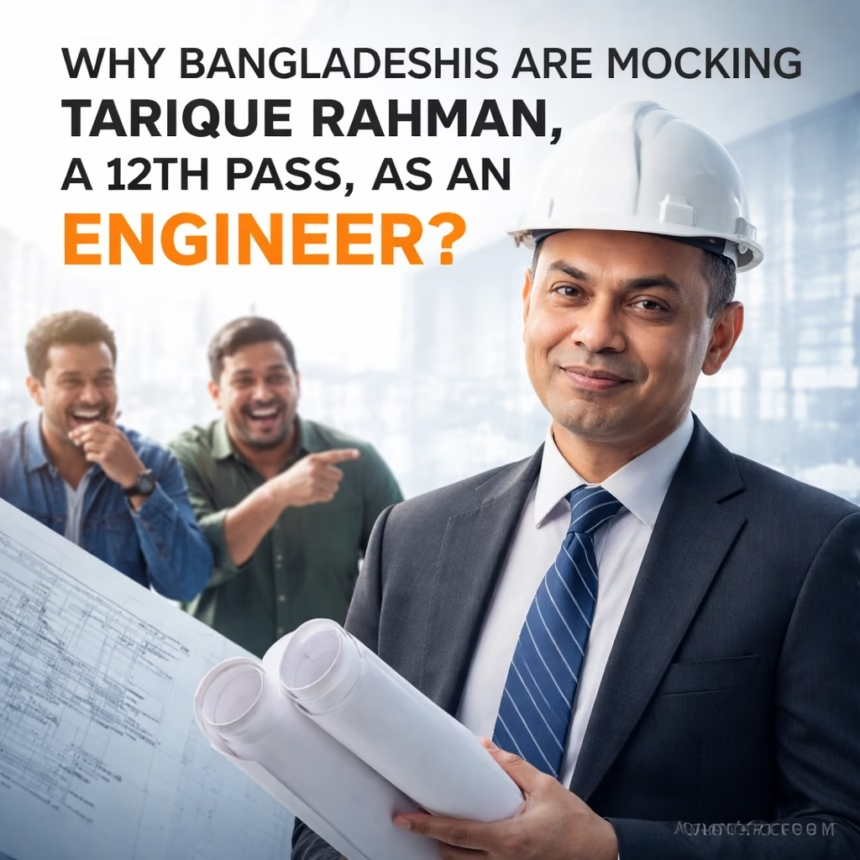
Across Bangladesh and within its global diaspora, a peculiar form of political satire has gained significant traction online. Tarique Rahman, the acting chairman of the Bangladesh Nationalist Party (BNP), is frequently and sarcastically referred to as an "engineer" by his detractors. This ironic moniker, widely circulated on social media platforms, highlights a deep-seated political rivalry and a public fascination with the educational background of political figures, particularly given Rahman's known academic qualification as a 12th pass. The phenomenon has intensified in recent years, particularly around national elections and significant political events, transforming online spaces into battlegrounds for public perception.
A Legacy of Power and Controversy: Tarique Rahman’s Background
Tarique Rahman's lineage places him at the heart of Bangladesh's political narrative. He is the son of two pivotal figures: Ziaur Rahman, a former President and founder of the Bangladesh Nationalist Party (BNP), and Khaleda Zia, a three-time former Prime Minister and chairperson of the BNP. This powerful family background set the stage for his entry into national politics.
Son of a President, Heir Apparent
Born on November 20, 1967, Tarique Rahman's early political involvement began in the grassroots, particularly in Bogura, his mother's constituency. He gradually ascended through the ranks of the BNP, eventually becoming its Senior Vice Chairman and, following his mother's incapacitation, the acting chairman. His trajectory was marked by both fervent support and intense opposition, a common feature in Bangladesh's polarized political landscape.
Educational Attainment vs. Public Perception
Rahman's formal education concluded with his Higher Secondary Certificate (HSC), equivalent to a 12th pass in Bangladesh's education system. Despite this, his political roles have consistently placed him in positions of significant influence and decision-making. The sarcastic "engineer" title directly contrasts his actual academic record with the perceived gravitas or technical expertise often associated with the engineering profession. This disparity forms the core of the online mockery, tapping into public expectations about the qualifications of national leaders.
Political Exile and Legal Battles
Since 2008, Tarique Rahman has resided in London, United Kingdom, having left Bangladesh following his arrest during the caretaker government's tenure. His departure was amidst a flurry of allegations, including corruption and involvement in the infamous August 21, 2004, grenade attack on an Awami League rally. He has since been convicted in absentia in several cases, including money laundering and the grenade attack case, further complicating his political standing and fueling narratives used by his opponents. His continued leadership of the BNP from abroad presents unique challenges for the party and its strategies.

The Genesis of the “Engineer” Mockery
The sarcastic labeling of Tarique Rahman as an "engineer" did not emerge in a vacuum. It is deeply rooted in the country's fierce political rivalry and the evolving dynamics of digital communication.
Roots in Political Rivalry
Bangladesh's political arena is characterized by an enduring and often acrimonious rivalry between the Awami League and the BNP. Both parties frequently employ various tactics, including satire and ridicule, to undermine their opponents. The "engineer" moniker is a prime example of such a tactic, designed to question Rahman's competence and suitability for leadership by highlighting a perceived lack of formal qualifications relative to his aspirations. It weaponizes his educational background against his political ambitions.
The “Engineering” of Public Perception
While the precise origin of the "engineer" title remains somewhat anecdotal, it likely emerged from a combination of political jabs and online humor. It could have been a sarcastic commentary on perceived attempts to "engineer" political outcomes, or a direct taunt regarding his educational background in contrast to the high-stakes political roles he occupies. The irony of calling a 12th pass individual an "engineer" quickly resonated with a segment of the public, particularly those critical of Rahman or aligned with rival political factions. It serves as a shorthand to imply a disconnect between his actual qualifications and the demands of his leadership position, or to mock any perceived grandiosity in his political rhetoric.

Social Media as a Catalyst
The proliferation of social media platforms like Facebook, YouTube, and various messaging apps has been instrumental in the spread and popularization of the "engineer" meme. Memes, short video clips, and satirical posts featuring this title rapidly go viral, reaching a vast audience. Hashtags and shared content amplify the mockery, creating echo chambers where such narratives are reinforced among like-minded individuals. Social media's low barrier to entry for content creation allows for continuous innovation in how the satire is presented, ensuring its longevity and widespread recognition.
Impact on Political Discourse and Public Opinion
The "engineer" mockery, while seemingly lighthearted, carries significant weight in the highly charged political environment of Bangladesh, influencing public perception and discourse.
Undermining Credibility and Authority
The primary aim of such political satire is often to undermine the credibility and authority of the target. By consistently referring to Tarique Rahman as an "engineer" in a sarcastic tone, detractors seek to paint him as unqualified, unsuited for leadership, or even intellectually dishonest. This form of psychological warfare can erode public trust and diminish his standing among potential voters and the broader populace. It casts doubt on his capacity to lead a major political party and potentially a nation.
Fueling Polarization
The "engineer" meme, like many other forms of political satire in Bangladesh, contributes to the already deep political polarization. For opponents of the BNP, it serves as a rallying point, a shared inside joke that reinforces their collective disdain or criticism. For BNP supporters, however, it is often viewed as disrespectful, baseless propaganda, and an unfair personal attack. This dichotomy further entrenches existing political divides, making constructive dialogue more challenging and often leading to heated exchanges online and offline.
Public Perception of Education and Leadership
The mockery also taps into a broader societal value placed on formal education as a prerequisite for leadership. In many societies, including Bangladesh, advanced degrees are often seen as indicators of competence, intellect, and suitability for high office. By highlighting Rahman's 12th-pass qualification through sarcastic contrast, the "engineer" meme implicitly questions whether he possesses the necessary intellectual rigor or educational foundation to lead effectively, resonating with those who believe leaders should have strong academic credentials.
More Read

BNP’s Response and Counter-Narratives
The Bangladesh Nationalist Party and its supporters have largely dismissed the "engineer" mockery as malicious propaganda orchestrated by political adversaries. They often counter by emphasizing Rahman's practical political experience, his family legacy, and his commitment to the party's ideals. Efforts are made to reframe his image, focusing on his leadership qualities and political acumen rather than his formal educational background. However, combating a viral online narrative with traditional political messaging can be an uphill battle in the age of social media.
Beyond the Mockery: What Lies Ahead?
The "engineer" narrative, while a symptom of current political dynamics, also offers insights into the future of opposition leadership and political communication in Bangladesh.
The Future of Opposition Leadership
Tarique Rahman continues to lead the BNP as its acting chairman from London, a situation that presents unique challenges for an opposition party in Bangladesh. His physical absence from the country means that much of his political engagement and strategic direction must occur remotely. The "engineer" mockery, alongside other criticisms, further complicates his efforts to mobilize support and project an image of strong, present leadership, especially with upcoming elections on the horizon.
The Evolving Landscape of Political Satire
The prevalence and sophistication of online political mockery, as exemplified by the "engineer" narrative, are likely to increase in Bangladesh. As digital literacy grows and internet access expands, social media will continue to be a primary battleground for shaping public opinion. Future political campaigns will increasingly need to contend with, and perhaps even strategically utilize, memes, viral content, and satirical narratives to connect with voters, particularly the younger demographic.
Upcoming Elections and the “Engineer” Narrative
As Bangladesh approaches future general elections, the "engineer" narrative is expected to resurface, potentially playing a role in digital campaigns aimed at influencing voter perception. Political parties and their affiliates will likely leverage such narratives to sway public opinion, making the online space a critical domain for electoral success. The ability of parties to counter or effectively utilize such digital narratives will be a significant factor in their performance.
A Call for Substance Over Sarcasm?
The widespread mockery of Tarique Rahman as an "engineer" highlights a broader debate within Bangladesh's political discourse: the balance between substantive policy discussions and personal attacks or satirical jabs. While satire can be a powerful tool for critique, its overuse or focus on personal characteristics rather than policy issues can detract from meaningful political engagement. Moving forward, the challenge for all political actors will be to navigate this complex digital landscape, striving for a discourse that informs and engages, while still acknowledging the undeniable power of viral political humor.