
Senator Cleitinho Azevedo (Republicanos-MG) recently saw his request to re-enter the electoral race for Minas Gerais denied by his own party, marking a significant turn in the state's political landscape. The decision comes weeks after the senator had publicly announced his withdrawal from contention, creating a complex scenario for the upcoming elections. This latest development underscores the intricate dynamics of party loyalty and strategic planning in Brazilian politics.
Background to the Political Volte-Face
Cleitinho Azevedo, a prominent figure known for his strong social media presence and conservative views, was elected Senator for Minas Gerais in 2018. His political trajectory has been marked by a direct communication style and a focus on issues like public safety and anti-corruption. Initially, Senator Azevedo had been a potential candidate for governor of Minas Gerais, generating considerable speculation within the Republicanos party and among the broader electorate.

However, in early July, the senator made a surprising announcement: he would not seek any office in the upcoming October elections. Citing a desire to focus on his current mandate and personal reasons, Cleitinho's withdrawal left a void and forced the Republicanos to recalibrate its strategy in a crucial state like Minas Gerais. Party leaders, including national president Marcos Pereira, publicly acknowledged and respected his decision, moving forward with alternative plans for candidacies.
The initial withdrawal was perceived by many as a strategic move to avoid a potentially difficult gubernatorial race, or perhaps to consolidate his position for a future bid. It also allowed the party to explore other alliances and solidify support for different candidates across the state, particularly for federal and state deputy positions, and potentially another name for the Senate.

Key Developments: A Swift Reversal and Firm Rejection
The political scene in Minas Gerais was once again stirred this past week when Senator Cleitinho Azevedo communicated his renewed interest in running for office. Sources close to the senator indicated he sought to either pursue re-election to the Senate or, failing that, contest a seat as a federal deputy. This abrupt change of heart, coming just weeks before the final registration deadlines, caught many by surprise.
The Republicanos party, however, was quick to issue a definitive response. In a statement released on Tuesday, August 2nd, the party's national leadership, in consultation with the state executive committee in Minas Gerais, formally denied Cleitinho's request. The party cited several reasons for its decision, primarily emphasizing that its electoral strategy for Minas Gerais had already been consolidated based on the senator's initial withdrawal.
"Our party's electoral strategy for Minas Gerais was meticulously constructed and finalized after Senator Cleitinho's initial decision not to run," stated a party spokesperson. "At this advanced stage, with alliances forged and candidacies defined, it is simply not feasible to alter our plans without jeopardizing the entire slate and our commitments to other candidates." The party highlighted the advanced stage of negotiations and the internal deadlines that had already passed for such significant changes.

Party officials also pointed to the importance of respecting internal processes and the stability of electoral planning. They underscored that reversing such a fundamental decision at the eleventh hour would create instability and unfairness for other candidates who had stepped forward to fill the void left by Cleitinho's initial withdrawal. The denial was firm, leaving little room for negotiation or appeal.
Impact on the Political Landscape
The Republicanos' rejection of Cleitinho's comeback bid carries significant implications for various stakeholders. For Cleitinho Azevedo himself, the decision leaves him without a clear path to electoral contention in 2022. This could potentially damage his political standing, raising questions about his commitment and strategic acumen. His public image, built on decisive action, might suffer from this perceived indecision and the public rejection by his own party. It also forces him into a period of political reflection, potentially impacting his future within the Republicanos or even leading him to consider other party affiliations down the line.
For the Republicanos party, the situation, while seemingly resolved, might expose underlying tensions. While the party maintained a unified front in its denial, the episode highlights the challenges of managing prominent, independent-minded politicians. The firm stance taken by the national leadership reinforces party discipline but could also alienate a significant political asset. On the electoral front, the party must now fully commit to the slate of candidates it has already assembled, hoping that the controversy surrounding Cleitinho does not detract from its overall campaign efforts in Minas Gerais.
The broader political landscape in Minas Gerais is also affected. The initial withdrawal and subsequent attempted return of a high-profile figure like Cleitinho injected a degree of uncertainty into an already competitive environment. His absence from the ballot, whether for governor or senator, reconfigures the dynamics for other candidates vying for those positions. Parties that might have feared his candidacy can now breathe a sigh of relief, while those who might have sought an alliance with him must now adjust their strategies. Voters, too, might experience a sense of confusion or disillusionment regarding the fluidity of political commitments.
What Next for Cleitinho and Republicanos?
With the door to a 2022 candidacy firmly shut by his party, Senator Cleitinho Azevedo's immediate political future is uncertain. He is expected to fulfill the remainder of his Senate term, which concludes in early 2023. Beyond that, his options appear limited for the current electoral cycle. He could potentially explore independent political activism, focus on his social media presence, or even consider a sabbatical from electoral politics. The relationship with Republicanos will be closely watched, as this public disagreement could strain ties.
For the Republicanos party, the focus now shifts entirely to executing its established electoral strategy in Minas Gerais. This includes rallying support for its gubernatorial candidate (if applicable), its Senate slate, and its candidates for federal and state deputy. The party will likely emphasize unity and the strength of its current ticket, seeking to move past the controversy and project stability. The coming weeks will be critical as parties finalize their campaign plans and officially register their candidates ahead of the mid-August deadline.
More Read
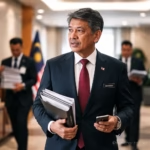
The episode serves as a stark reminder of the complexities inherent in political maneuvering, where personal aspirations often collide with party strategy, deadlines, and the delicate balance of alliances. The political season in Minas Gerais, already vibrant, has certainly become more intriguing with this unexpected turn of events.