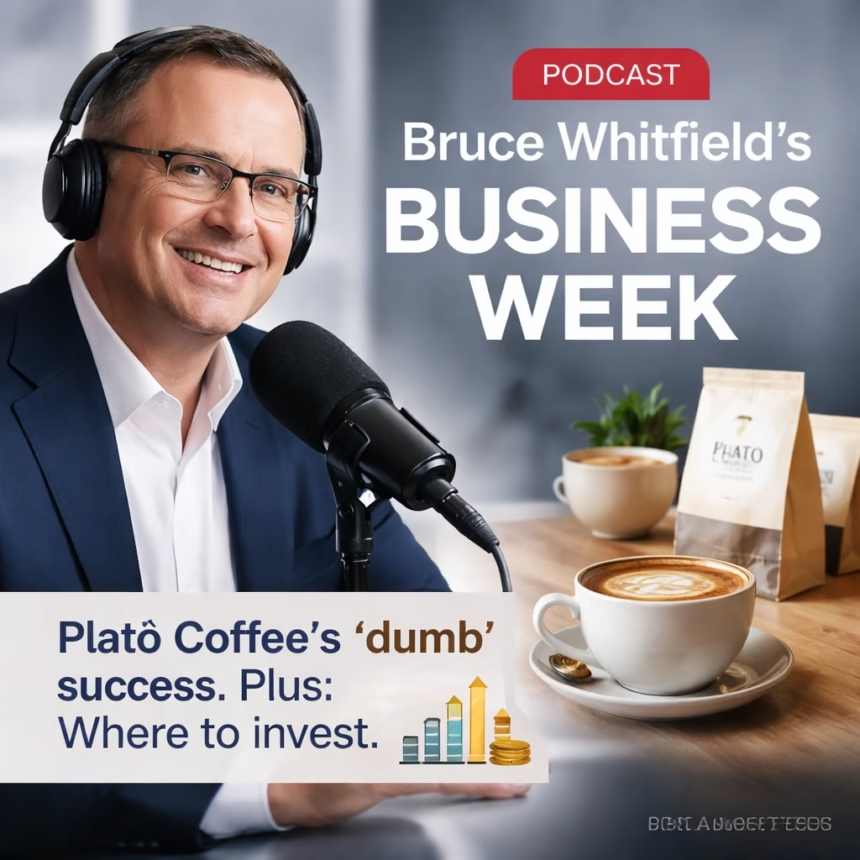
The recent broadcast of Bruce Whitfield's Business Week podcast delved into the surprising success of Platō Coffee, a chain whose seemingly simplistic approach has defied conventional wisdom, alongside a segment offering crucial insights into current investment opportunities. The discussion, aired last Thursday, highlighted how an unconventional business model can yield significant returns, prompting a re-evaluation of market strategies and investor priorities.
Background: The Unassuming Rise of Platō Coffee
Platō Coffee, founded in 2017 by entrepreneur Alex "Lex" Vanderwalt in a small Johannesburg suburb, began with a philosophy many in the artisanal coffee scene dismissed as overly simplistic. Vanderwalt's vision was to offer a consistently good, quick, and affordable cup of coffee, eschewing complex menus, elaborate latte art, and high-end experiential aesthetics. The initial outlet, a modest kiosk in Sandton, focused on just four core beverages: espresso, Americano, latte, and cappuccino, all served in standard sizes with minimal customization options.
This "dumb" strategy, as some industry observers initially dubbed it, prioritised speed and volume over perceived sophistication. Platō invested heavily in efficient, high-capacity espresso machines and streamlined staff training to ensure rapid service and uniform product quality across all locations. Marketing was minimal, relying instead on high foot traffic locations and word-of-mouth generated by its competitive pricing and reliable product. Within two years, Platō had quietly expanded to 15 locations across Gauteng, attracting a loyal customer base of busy professionals and students seeking convenience and value.
Key Developments: Scaling Simplicity into a National Footprint
Over the past three years, Platō Coffee has accelerated its expansion, demonstrating remarkable resilience even during challenging economic periods. The chain now boasts over 180 outlets nationwide, with a significant presence in major urban centres like Cape Town, Durban, and Pretoria, alongside its Gauteng strongholds. This growth has been fueled by a disciplined approach to site selection, often targeting transport hubs, university campuses, and large office parks where speed and accessibility are paramount.
The operational model remains largely unchanged, a testament to its effectiveness. Each Platō store maintains a lean staff complement, benefiting from highly standardised procedures that minimise training time and operational costs. The company has subtly integrated technology, primarily through efficient point-of-sale systems and a basic mobile ordering app that streamlines transactions without adding complexity. This focus on operational excellence allows Platō to maintain its attractive price point, often significantly lower than competitors offering comparable quality.

Customer feedback consistently highlights the brand's reliability and convenience. In an increasingly complex world, Platō's straightforward offering has resonated with a broad demographic. Industry analysts, initially sceptical, now point to Platō as a case study in market disruption, proving that sometimes the most effective strategy is the one that strips away unnecessary layers and focuses on core customer needs.

Impact: Redefining Retail and Informing Investment Strategies
Platō Coffee's trajectory has sent ripples through the coffee retail sector, forcing established chains to re-evaluate their own value propositions and operational efficiencies. Its success challenges the long-held belief that premium pricing and elaborate experiences are the only paths to growth in the competitive coffee market.

Disrupting the Coffee Landscape
Platō's impact extends beyond its own balance sheet. Competitors are increasingly observed experimenting with simplified menus, express service formats, and more competitive pricing in response. The brand has effectively carved out a significant segment of the market, demonstrating that a large portion of consumers prioritises speed, consistency, and affordability over artisanal flair. This shift has implications for suppliers, real estate developers, and even urban planning, as retailers adapt to changing consumer demands.
Whitfield’s Investment Insights
Bruce Whitfield, during his Business Week segment, used Platō Coffee's narrative as a springboard for broader investment discussions. He highlighted that the "dumb" success of Platō underscores a fundamental investment principle: identifying businesses with clear value propositions, strong operational execution, and a deep understanding of their target market, regardless of perceived industry trends.
Whitfield and his panel of experts then pivoted to the broader investment landscape, offering guidance on where smart money is currently being deployed. They emphasised the importance of diversification in volatile markets, advocating for a balanced portfolio that includes resilient sectors. Specific recommendations included:
Technology and Innovation: Continued growth in areas like artificial intelligence, cybersecurity, and renewable energy infrastructure, despite recent market corrections.
* Consumer Staples: Companies providing essential goods and services demonstrate defensive qualities during economic uncertainty.
* Infrastructure Development: Long-term projects in both traditional and green infrastructure offer stability and growth potential.
* Emerging Markets: Select opportunities in regions demonstrating strong demographic trends and economic reforms, with a caveat for increased risk.
The panel also cautioned against speculative investments, advising a focus on companies with strong fundamentals, healthy balance sheets, and proven management teams. The discussion stressed the importance of understanding macroeconomic factors such as inflation, interest rate hikes, and global supply chain disruptions when making investment decisions.
What Next: The Future Brew and Market Movements
For Platō Coffee, the immediate future involves continued strategic expansion, particularly into smaller towns and high-density residential areas previously underserved by quality, affordable coffee options. The company is exploring limited product diversification, potentially introducing a select few complementary items like simple pastries, but vows to maintain its core focus on coffee and operational simplicity. The primary challenge will be to sustain its high standards of consistency and service quality as it grows, fending off new competitors who might seek to replicate its successful model.
More Read

On the investment front, Bruce Whitfield’s Business Week anticipates a period of continued market volatility, driven by global economic uncertainties. Investors are advised to remain agile, conducting thorough due diligence and aligning their portfolios with long-term strategic goals rather than reacting to short-term fluctuations. The experts predict that companies demonstrating adaptability, strong governance, and a clear understanding of their customer base – much like Platō Coffee – will be best positioned for sustained growth. The ongoing discussions around interest rates and inflation will continue to shape market sentiment, making informed decision-making more crucial than ever for investors navigating the complex financial landscape.