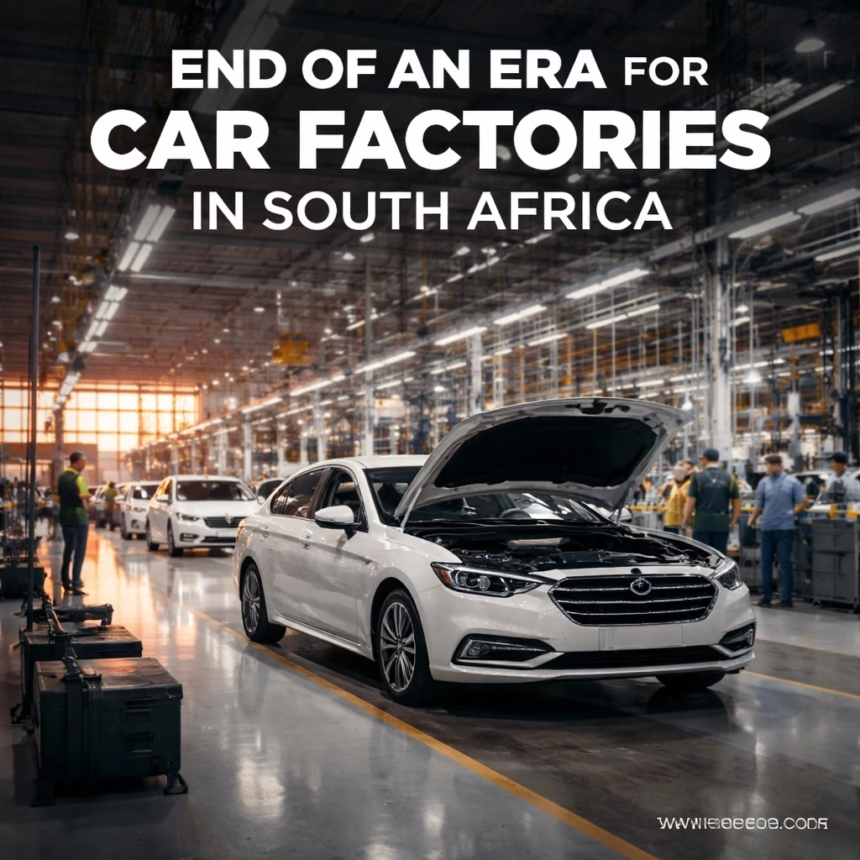
South Africa's long-standing legacy as a hub for automotive manufacturing is undergoing a profound transformation. Decades of robust factory operations, once a cornerstone of industrial employment and economic growth, are now giving way to a more uncertain future. This shift, marked by factory closures and strategic reconfigurations, signals the twilight of a significant era for the nation's industrial landscape, particularly impacting key industrial zones like Nelson Mandela Bay and Tshwane.
A Legacy Forged in Steel: Background of South Africa’s Automotive Industry
The South African automotive industry boasts a rich history, dating back to the early 20th century. Ford established its first assembly plant in Port Elizabeth (now Gqeberha) in 1923, followed by General Motors in 1926. This period laid the groundwork for a sector that would become a vital pillar of the economy.
During the apartheid era, international sanctions and a strong push for import substitution fostered a protected market. This environment necessitated high local content requirements, compelling manufacturers like Volkswagen, Mercedes-Benz, BMW, Nissan, and Toyota to establish comprehensive manufacturing operations, including engine and component production, beyond mere assembly. This isolation, while challenging, inadvertently built a deep industrial base.
Post-1994, South Africa’s re-integration into the global economy brought both opportunities and fierce competition. To attract and retain investment, the government introduced the Motor Industry Development Programme (MIDP) in 1995, evolving into the Automotive Production and Development Programme (APDP) in 2013, and subsequently the SA Automotive Masterplan 2035 (SAAM2035). These policies aimed to boost production volumes, increase local content, and drive exports, successfully positioning the industry as a major contributor to GDP, employment, and foreign exchange earnings. At its peak, the sector contributed over 6% to the national GDP and employed hundreds of thousands directly and indirectly.
Shifting Gears: Key Developments Reshaping the Landscape
Recent years have seen a series of pivotal developments that underscore the changing nature of South Africa's automotive sector. These shifts highlight a global trend towards consolidation, efficiency, and the looming transition to electric vehicles (EVs).

General Motors’ Departure and its Ripple Effects
A significant turning point occurred in 2017 when General Motors (GM) announced its complete withdrawal from South Africa. After nearly a century of operations, the decision to sell its local manufacturing facility in Struandale, Gqeberha, to Isuzu Motors, and cease production of Chevrolet vehicles, sent shockwaves through the industry. While Isuzu continued its truck and bakkie assembly, GM's exit was a stark reminder of the global pressures on multinational corporations to rationalize their portfolios and exit less profitable markets.
Ford’s Strategic Realignment
Ford Motor Company, a long-standing fixture, has also undertaken significant restructuring. While it has committed substantial investment, including R15.8 billion in 2021 for its Silverton plant in Pretoria to produce the new Ranger and Everest models, its engine plant in Struandale has seen changes in scope. The focus has increasingly shifted towards high-volume assembly of specific models, with less emphasis on full-scale engine or component manufacturing for a diverse range of vehicles. This strategy, while securing some jobs, reflects a move away from the comprehensive local production model of previous decades.
Nissan and BMW Adjustments
Nissan has similarly faced challenges, with reports of scaling back certain production lines and models at its Rosslyn plant near Pretoria, consolidating operations to focus on key regional demand. BMW, another premium manufacturer, moved production of its iconic 3 Series sedan from its Rosslyn plant to Mexico in 2018. While BMW has since invested R4.2 billion to prepare Rosslyn for the production of the new BMW X3 plug-in hybrid model from 2024, the initial shift symbolized a global reallocation of manufacturing capabilities, moving away from South Africa for certain high-volume segments.

The Global EV Imperative
Perhaps the most profound driver of change is the global transition to electric vehicles. As major markets like Europe and the UK announce timelines for banning internal combustion engine (ICE) vehicle sales, South African factories, traditionally geared for ICE production, face an existential threat. The cost and complexity of retooling facilities, retraining workforces, and establishing local battery and EV component supply chains are immense, posing a significant hurdle for an industry already navigating other challenges.
The Human and Economic Toll: Impact on South Africa
The evolving automotive landscape has profound repercussions across South Africa, affecting employment, regional economies, and the nation's industrial capabilities.
Job Losses and Skills Erosion
The most immediate and visible impact is on employment. Factory closures, production line rationalizations, and the shift towards more automated processes have led to job losses, both direct and indirect. Thousands of workers, many with highly specialized manufacturing skills, have been affected. This extends beyond the assembly lines to the vast network of component suppliers, logistics companies, and service providers that depend on the automotive sector. The erosion of these specialized manufacturing skills poses a long-term challenge for South Africa's industrial base.
Regional Economic Strain
Regions heavily reliant on the automotive industry, such as Nelson Mandela Bay (Gqeberha) in the Eastern Cape and Tshwane (Pretoria) in Gauteng, face significant economic strain. These cities have built entire ecosystems around car manufacturing, from housing and retail to educational institutions. Reduced factory output or closures can devastate local economies, leading to business failures, increased unemployment rates, and social instability. The Eastern Cape, in particular, has seen its industrial heartland challenged by these shifts.
Supply Chain Disruption
South Africa's automotive supply chain comprises hundreds of component manufacturers producing everything from wiring harnesses and catalytic converters to seating and exhaust systems. As vehicle models are discontinued, production volumes shift, or local content requirements become less stringent, these suppliers face reduced demand. Many lack the capital or technological know-how to pivot quickly to EV component production, risking widespread closures and further job losses within the broader manufacturing ecosystem.
Economic Contribution and Exports
The automotive sector is a major contributor to South Africa's GDP and its export earnings, particularly to Europe. A decline in manufacturing output or a failure to adapt to EV production could significantly impact the national economy, potentially widening the trade deficit and reducing government revenue from taxes and duties. Maintaining a competitive export base is crucial for the industry's survival.
More Read

The Road Ahead: What Next for South Africa’s Automotive Industry
Despite the challenges, South Africa's automotive industry is not without hope. The path forward involves strategic adaptation, significant investment, and concerted efforts to embrace the future of mobility.
Remaining OEM Commitments
Key original equipment manufacturers (OEMs) like Volkswagen, Toyota, BMW, and Mercedes-Benz continue to operate substantial plants in South Africa, demonstrating a commitment to their presence, albeit with evolving strategies. Volkswagen's plant in Kariega (Uitenhage) remains a major producer of the Polo hatchback for both local and international markets. Toyota's facility in Prospecton, Durban, is a cornerstone, having recently invested R2.6 billion to produce the Corolla Cross hybrid, a significant step towards new energy vehicles. Mercedes-Benz has invested R3 billion into its East London plant to produce the C-Class, primarily for right-hand drive markets, and BMW's Rosslyn plant is gearing up for EV production.
The EV Transition: A Critical Pivot
The most crucial "what next" is the successful transition to electric vehicle manufacturing. The government's South African Automotive Masterplan 2035 (SAAM2035) aims to facilitate this, with a target to have 100% of new vehicles sold in South Africa be EVs by 2035. However, policy clarity, incentive structures, and infrastructure development are still evolving.
Investment and Infrastructure
Future milestones include substantial investments by OEMs in EV production lines and related technologies. This requires not only capital but also a robust energy supply, efficient logistics, and a skilled workforce capable of handling EV manufacturing. The development of local battery production or sourcing of key EV components will be critical to maintaining local content and competitiveness. Without these, South Africa risks becoming merely an assembly point for imported EV kits.
Challenges and Opportunities
The road ahead is fraught with challenges, including high electricity costs, unreliable power supply, port inefficiencies, and intense global competition for EV investments. However, opportunities exist in leveraging existing manufacturing capabilities, developing niche markets, and potentially becoming a regional hub for EV production for the African continent. Collaborative efforts between government, industry, and labour will be essential to navigate this complex transition and secure a viable future for South Africa's automotive sector in the global economy. The next decade will define whether the country can successfully pivot from an "end of an era" to the dawn of a new, electrified one.