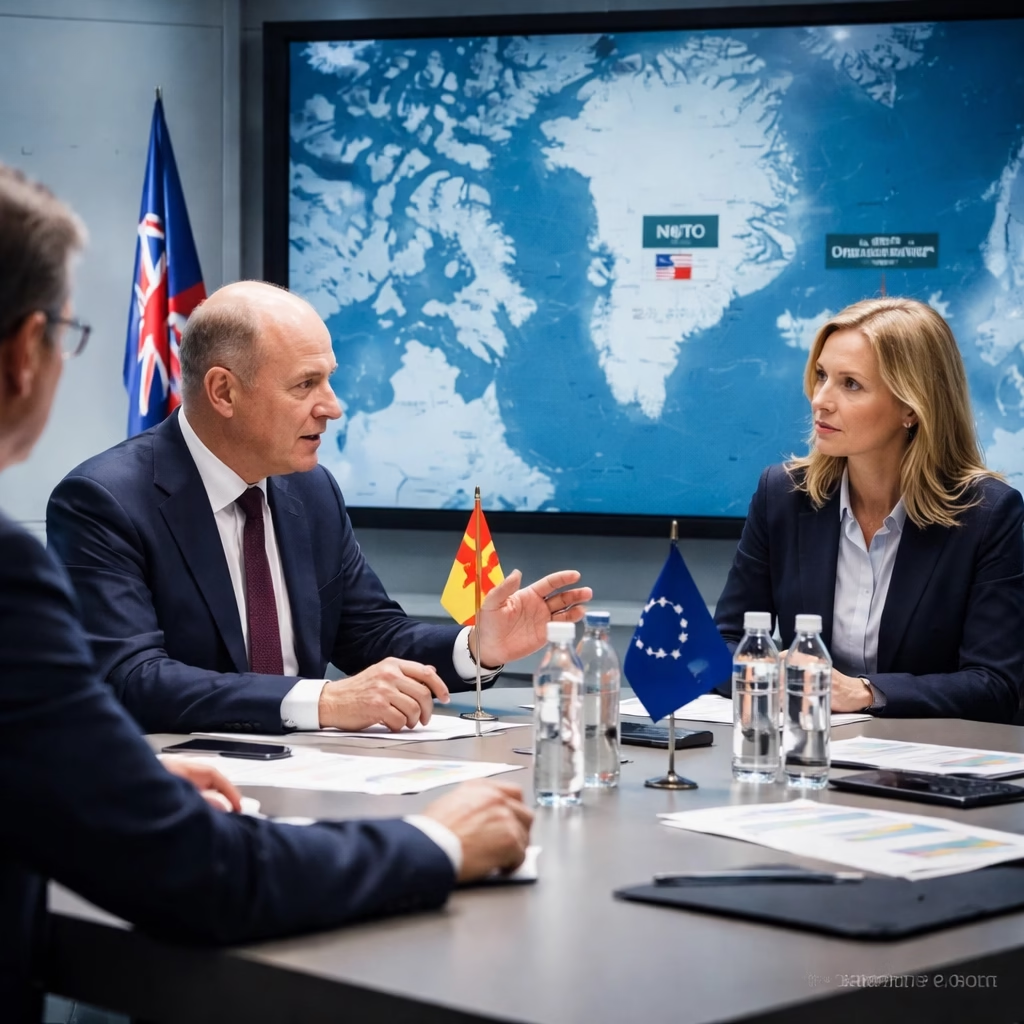
Officials from the United Kingdom and Germany have reportedly engaged in urgent consultations regarding the future deployment and role of NATO forces in Greenland. These high-level discussions, taking place in London and Berlin over the past weeks, follow revelations that former U.S. President Donald Trump had, during his tenure, asked American special forces to plan a potential invasion of the vast autonomous Danish territory. The unexpected directive has prompted a significant re-evaluation of Arctic security among key transatlantic allies.
Background: Greenland’s Strategic Significance and Trump’s Prior Interest
Greenland, the world's largest island, is an autonomous territory within the Kingdom of Denmark. Its strategic location, bridging the North Atlantic and the Arctic Ocean, has long made it a point of geopolitical interest. The island hosts the U.S. Thule Air Base, a critical component of North American aerospace defense and early warning systems.
Former President Trump's interest in Greenland first became public in August 2019 when reports surfaced that he had discussed the possibility of the United States purchasing the territory from Denmark. The idea was met with firm rejection from Copenhagen, with Danish Prime Minister Mette Frederiksen calling the suggestion "absurd."
However, recent reports indicate that Trump's interest went beyond a mere purchase offer. According to sources familiar with the matter, the former president had privately instructed U.S. Special Operations Command to develop plans for a potential military operation to seize Greenland. This directive, though never acted upon, underscores the perceived strategic value of the island and has now resurfaced as a significant concern for European allies.
The Arctic region itself is witnessing an accelerating geopolitical competition. Melting ice caps are opening new shipping lanes, such as the Northern Sea Route and the Northwest Passage, which could significantly alter global trade. The region also holds vast untapped natural resources, including oil, gas, and rare earth minerals. Russia has been steadily increasing its military presence in its Arctic territories, while China has declared itself a "near-Arctic state" and is expanding its economic and scientific influence through its "Polar Silk Road" initiative. NATO has increasingly acknowledged the Arctic as a vital area for collective security, emphasizing freedom of navigation and responsible governance.

Key Developments: Allied Scramble for Arctic Strategy
The revelations about Trump's invasion planning have galvanized London and Berlin, leading to intensified discussions about bolstering NATO's presence and strategy in the Arctic. Both the UK and Germany, while not Arctic nations themselves, are key NATO members with significant naval and air capabilities, and a vested interest in regional stability.
UK and German Consultations
Discussions between British and German defense and foreign ministry officials have reportedly focused on several key areas. These include enhanced intelligence sharing regarding Arctic developments, the potential for increased joint military exercises in the High North, and the feasibility of investing in dual-use infrastructure in Greenland that could support both civilian and military operations. The overarching goal is to present a more unified and robust allied front in the face of evolving threats and ensure the security of critical sea lanes.
Sources suggest that the talks have explored options such as more frequent naval patrols by NATO vessels, increased air surveillance capabilities over Greenland's vast expanse, and the establishment of logistics hubs to support sustained operations. The aim is to enhance deterrence against any potential aggressor and secure access to the region for allied nations.
Denmark’s Position and U.S. Stance
Denmark, as the sovereign power over Greenland, remains central to any discussions concerning the island's defense. Copenhagen has consistently reaffirmed its sovereignty while expressing openness to allied cooperation within the established NATO framework for collective defense. Any significant increase in foreign military presence would require careful consultation with both the Danish government and Greenland's autonomous administration, Naalakkersuisut. Greenlanders themselves have a strong desire for self-determination and have voiced concerns about becoming a pawn in great power politics.
The current U.S. administration under President Joe Biden has not directly commented on the specifics of former President Trump's alleged invasion plan. However, the Biden administration has consistently reaffirmed its commitment to Arctic security, emphasizing international cooperation, diplomatic engagement, and addressing climate change as core pillars of its Arctic policy. The U.S. maintains a robust defense relationship with Denmark and a significant military footprint in Greenland through Thule Air Base.
Broader NATO Response
The renewed focus on Greenland is expected to feed into broader NATO discussions on its Arctic strategy. The alliance has been adapting to new security challenges, including hybrid warfare and increased military activity by Russia. Enhancing capabilities in the High North, ensuring interoperability among allied forces, and maintaining a credible deterrence posture are paramount for NATO's collective defense. The discussions between London and Berlin could serve as a blueprint for wider allied engagement in the region.
Impact: Geopolitical Ripple Effects
The intensified focus on Greenland and the Arctic carries significant implications for various stakeholders, from local communities to global powers.
Impact on Greenland and Denmark
For Greenland's population of approximately 56,000, increased military presence could bring both opportunities and challenges. While potential infrastructure investments and job creation might be welcomed, there are significant concerns about the environmental impact of increased military activity in a fragile ecosystem and the potential erosion of cultural heritage. The delicate balance between economic development, environmental protection, and cultural preservation is a constant priority for the Greenlandic government. Denmark faces the complex task of balancing its sovereign responsibilities with its NATO alliance commitments, ensuring that any defense enhancements respect Greenlandic autonomy and serve broader allied interests.
More Read

NATO Cohesion and Strategic Focus
For NATO, the discussions test alliance cohesion and its ability to adapt to rapid geopolitical shifts. The need for a unified and comprehensive Arctic strategy is more pressing than ever. Resource allocation, burden-sharing, and diplomatic coordination will be critical to effectively addressing the region's challenges. The renewed focus on the Arctic could also lead to a reprioritization of defense spending and strategic planning across the alliance.
Reactions from Russia and China
Increased NATO activity around Greenland is likely to be viewed with suspicion by Russia, which already perceives Western military expansion as a threat. Moscow could respond by further militarizing its own Arctic territories or increasing its naval and air patrols in the region, potentially leading to a dangerous cycle of escalation. China, with its growing economic and strategic interests in the Arctic, will also be closely monitoring developments, assessing the implications for its "Polar Silk Road" ambitions and access to new shipping routes.
What Next: Anticipated Milestones and Future Trajectories
The ongoing discussions between the UK and Germany are likely just the initial phase of a broader allied re-evaluation of Arctic security. Several key milestones and developments can be anticipated in the coming months and years.
Further high-level consultations are expected to continue, involving not only the UK and Germany but also Denmark and other Arctic NATO members such as Canada, Norway, and the United States. These discussions will aim to consolidate a common understanding of threats and opportunities in the High North and formulate a coordinated response.
The issue of Arctic security is almost certainly to feature prominently at upcoming NATO ministerial meetings and summits. Allies may seek to develop a more detailed and publicly articulated Arctic strategy, potentially outlining specific defense plans, investment priorities, and frameworks for international cooperation.
There is a strong possibility of new defense agreements or enhanced bilateral/multilateral deployments in the region. This could involve upgrades to existing infrastructure in Greenland, such as ports and airfields, to accommodate larger military assets or support more frequent exercises. Investment in advanced surveillance and reconnaissance capabilities will also be crucial.
Diplomatic efforts will continue to play a vital role, aiming to manage tensions with non-allied Arctic stakeholders like Russia while asserting the right to freedom of navigation and responsible resource management. The balance between deterrence and de-escalation will be a constant challenge.
From Greenland's perspective, the increased international attention will inevitably spark further domestic political discourse on the island's future. Debates surrounding the extent of foreign military presence, the balance between security and environmental protection, and the path towards greater self-determination will continue to shape the political landscape. The long-term trajectory of the Arctic will depend on a complex interplay of geopolitical ambition, climate change impacts, and the decisions made by nations seeking to secure their interests in this rapidly transforming region.