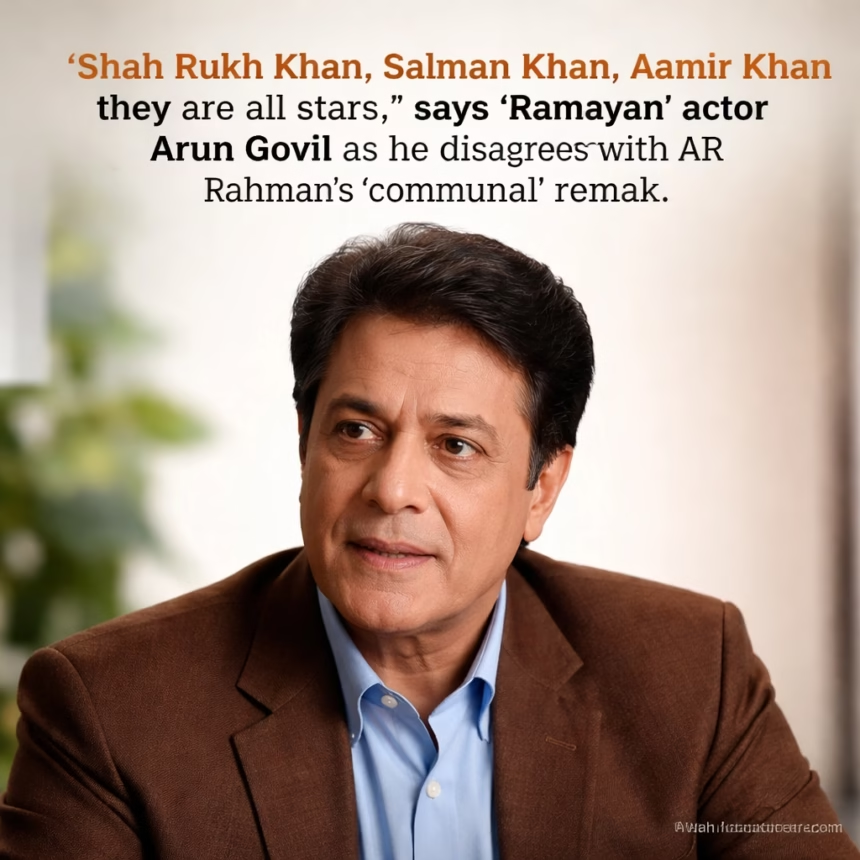
Arun Govil Rejects AR Rahman's 'Communal' Remark: "Shah Rukh, Salman, Aamir Khan Are All Stars"
Arun Govil Rejects AR Rahman's 'Communal' Remark: "Shah Rukh, Salman, Aamir Khan Are All Stars"
Veteran actor Arun Govil, revered for his portrayal of Lord Ram in the iconic 1987 television series 'Ramayan', has publicly disagreed with Oscar-winning music composer AR Rahman's recent remarks. Govil challenged the perceived communal undertones of Rahman's comments regarding the Hindi film industry, specifically championing the universal stardom of Shah Rukh Khan, Salman Khan, and Aamir Khan. The actor's statement, made during a recent media interaction, has reignited discussions about religious identity and meritocracy within Bollywood.
Background to the Controversy
The core of the controversy traces back to statements made by AR Rahman in July 2020. At that time, Rahman claimed a "gang" in Bollywood was actively working against him, spreading "false rumours" and hindering his opportunities to secure work. While Rahman did not explicitly use the term "communal," his comments were widely interpreted by sections of the media and public as suggesting a systematic bias within the industry. This interpretation fueled a broader debate about the alleged existence of lobbies and potential discrimination based on factors beyond artistic merit in the Hindi film fraternity.
Rahman, a globally celebrated musician with an impressive array of accolades including two Academy Awards, two Grammy Awards, and numerous other international and national honors, had spoken about feeling sidelined in Bollywood despite his international success. His original statement, "I don't say no to good movies, but I think there is a gang, which is spreading some false rumours about me, which is why I am not getting offers," sparked significant discourse. He later clarified that his remarks pertained to a "misunderstanding" and were not directed against any specific individual. However, the perception of communal bias, particularly within ongoing discussions about nepotism and power structures in Bollywood, persisted in certain public narratives.
More Read

Arun Govil, on the other hand, achieved national recognition through 'Ramayan', a television series that broke viewership records and became a cultural phenomenon in India. His portrayal of Lord Ram earned him immense respect and a unique standing in public consciousness, lending significant weight to his statements on cultural and social issues. Govil's career spans several decades, and he has maintained a respected public profile. His entry into politics, joining the Bharatiya Janata Party (BJP) in 2021, further contextualizes his public statements within a broader sociopolitical landscape. The "Khan trio"—Shah Rukh Khan, Salman Khan, and Aamir Khan—represent an unparalleled era of superstardom in Indian cinema, dominating box office collections and popular culture for over three decades, with their appeal largely transcending religious affiliations among millions of fans globally.
Key Developments in the Debate
Arun Govil's direct rebuttal emerged during a recent media interaction where he was questioned about Rahman's earlier remarks and their communal interpretations. Govil unequivocally stated, "Shah Rukh Khan, Salman Khan, Aamir Khan they are all stars. What is communal in it?" He challenged the very notion of attaching communal labels to the success of these actors, asserting that their stardom is a direct outcome of their extraordinary talent, relentless hard work, and profound connection with audiences, entirely independent of their religious backgrounds.
"Their talent, their hard work, their dedication, their passion, their commitment, their performance, their fan following, all these things make them stars. What is communal in it? What is Hindu-Muslim in it?" Govil asserted. His comments underscored a meritocratic perspective on the film industry, arguing that attributing religious identity to their success or failure was an unnecessary and divisive approach. Govil's statements effectively countered the narrative that communal factors dictate success or hinder opportunities for individuals at the pinnacle of Bollywood.
More Read

This forceful statement by Govil has resonated across various platforms, particularly on social media, where discussions about Bollywood's internal dynamics and external perceptions frequently unfold. His remarks are widely seen as a direct counter-narrative to the idea that religious identity plays a significant role in determining stardom or opportunities at the highest echelons of the industry. The timing of Govil's intervention also coincides with a period of heightened scrutiny on the Indian film industry regarding issues of diversity, representation, and the perceived influence of various groups.
Impact of the Statements
The immediate impact of Arun Govil's statement has been to intensify the ongoing public discourse surrounding communalism and meritocracy within the Indian entertainment industry.
For the Khans—Shah Rukh, Salman, and Aamir—who have not directly commented on this specific exchange, Govil's defense reinforces their image as universal stars whose appeal transcends religious boundaries. This perception is largely held by their vast fan bases and serves as a powerful counter-argument to any claims of communal bias at the pinnacle of stardom.
For AR Rahman, Govil's comments implicitly challenge the basis of the "communal" interpretation of Rahman's earlier remarks. This brings Rahman's past statements back under public scrutiny, prompting a re-evaluation of the context and intent behind his words from 2020. While Rahman himself clarified his statements were about a "misunderstanding," the communal angle, once introduced into public discourse, often tends to linger.
For Arun Govil, his clear stance has positioned him as a vocal advocate for secularism and meritocracy within the film industry. His statements are likely to be welcomed by those who champion a non-sectarian approach to evaluating talent and success in Bollywood. It also reinforces his public image as a figure who articulates his views on matters of national interest, leveraging the respect he commands from his iconic role.
For the Indian Film Industry itself, this debate underscores the internal and external pressures on Bollywood to address perceptions of favoritism, discrimination, and communal divides. It highlights the industry's ongoing struggle to present a unified, inclusive front amidst diverse viewpoints and political currents. Such discussions often lead to introspection within the industry about how it manages its talent, promotes inclusivity, and communicates with the public.

The public discourse is also significantly affected, as the exchange between Govil and the perceived implications of Rahman's comments fuels wider societal conversations about secularism, religious harmony, and the role of cultural figures in shaping public opinion. It provides substantial fodder for debates on social media, news channels, and in daily conversations about the nature of Indian society and its entertainment landscape.
What Lies Ahead
The recent remarks by Arun Govil are expected to sustain the conversation around communalism and merit in the Indian film industry for the foreseeable future.
It remains to be seen if AR Rahman or his representatives will issue any further statements or clarifications in light of Govil's direct challenge. Other prominent figures within Bollywood might also weigh in, either supporting Govil's perspective or offering alternative viewpoints, potentially broadening the scope of the debate.
Media outlets are likely to continue exploring the nuances of this discussion, inviting industry experts, cultural commentators, and social analysts to share their insights. This could lead to deeper investigations into the historical and contemporary dynamics of power, representation, and religious identity within Bollywood.
The public's perception of both Govil and Rahman, as well as the broader film industry, could be further shaped by how this dialogue evolves. Govil's firm stance may solidify his image as a voice of reason against perceived divisive narratives, while Rahman's earlier comments will continue to be interpreted through various lenses.

While immediate policy changes might not occur, such public debates often prompt internal discussions within film bodies, production houses, and talent agencies about fostering a more inclusive and merit-based environment. There might be a renewed emphasis on promoting talent irrespective of background. Given Arun Govil's political affiliations and the sensitive nature of communal discussions in India, the debate could also take on political dimensions, with various political factions using it to further their narratives regarding secularism, minority rights, and national identity. The discussion is poised to remain a significant topic in cultural and social commentary.