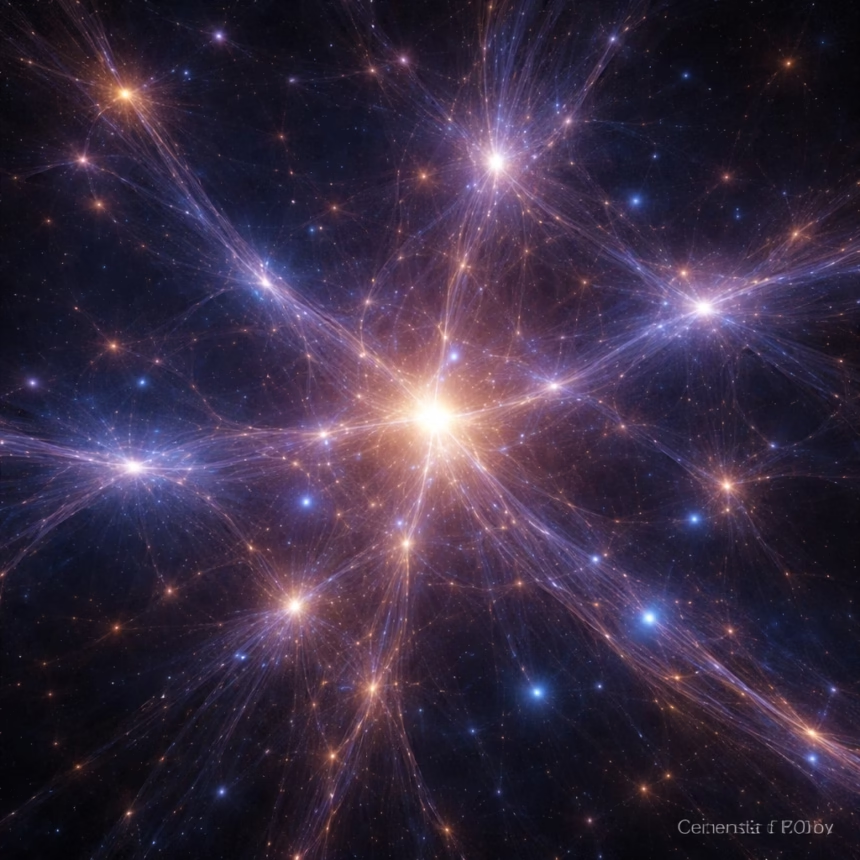
In a groundbreaking announcement this week, an international consortium of astrophysicists has unveiled the most detailed map yet of the Universe's hidden scaffolding – the vast cosmic web of dark matter and galaxies that dictates the distribution of all known matter. This monumental achievement, stemming from decades of observational data and advanced computational modeling, offers unprecedented insight into the fundamental architecture of the cosmos. The findings were formally presented at the annual meeting of the International Astronomical Union in Geneva, Switzerland, on October 26, 2023.
Background: Tracing the Universe’s Blueprint
The concept of a large-scale cosmic structure, often referred to as the "cosmic web," has been a cornerstone of modern cosmology for decades. Early in the 20th century, Albert Einstein's general theory of relativity provided the theoretical framework for understanding the Universe's large-scale dynamics. However, it wasn't until the 1930s that astronomer Fritz Zwicky, observing the Coma Cluster, first inferred the presence of unseen "dark matter" – a mysterious substance whose gravitational pull seemed to hold galaxies together more strongly than visible matter alone could account for.
The discovery of the Cosmic Microwave Background (CMB) in the 1960s provided compelling evidence for the Big Bang and offered a snapshot of the Universe when it was only about 380,000 years old. Subtle temperature fluctuations in the CMB, later precisely mapped by missions like WMAP (2001-2010) and Planck (2009-2013), were identified as the primordial seeds from which all cosmic structures would eventually grow.
From Theory to Observation
By the 1980s, theoretical models, notably those incorporating cold dark matter, began to predict that the Universe should evolve into a vast network of filaments, sheets, and dense knots (galaxy clusters) surrounding immense, nearly empty voids. This intricate structure would form through gravitational instability, with dark matter acting as the primary scaffold.
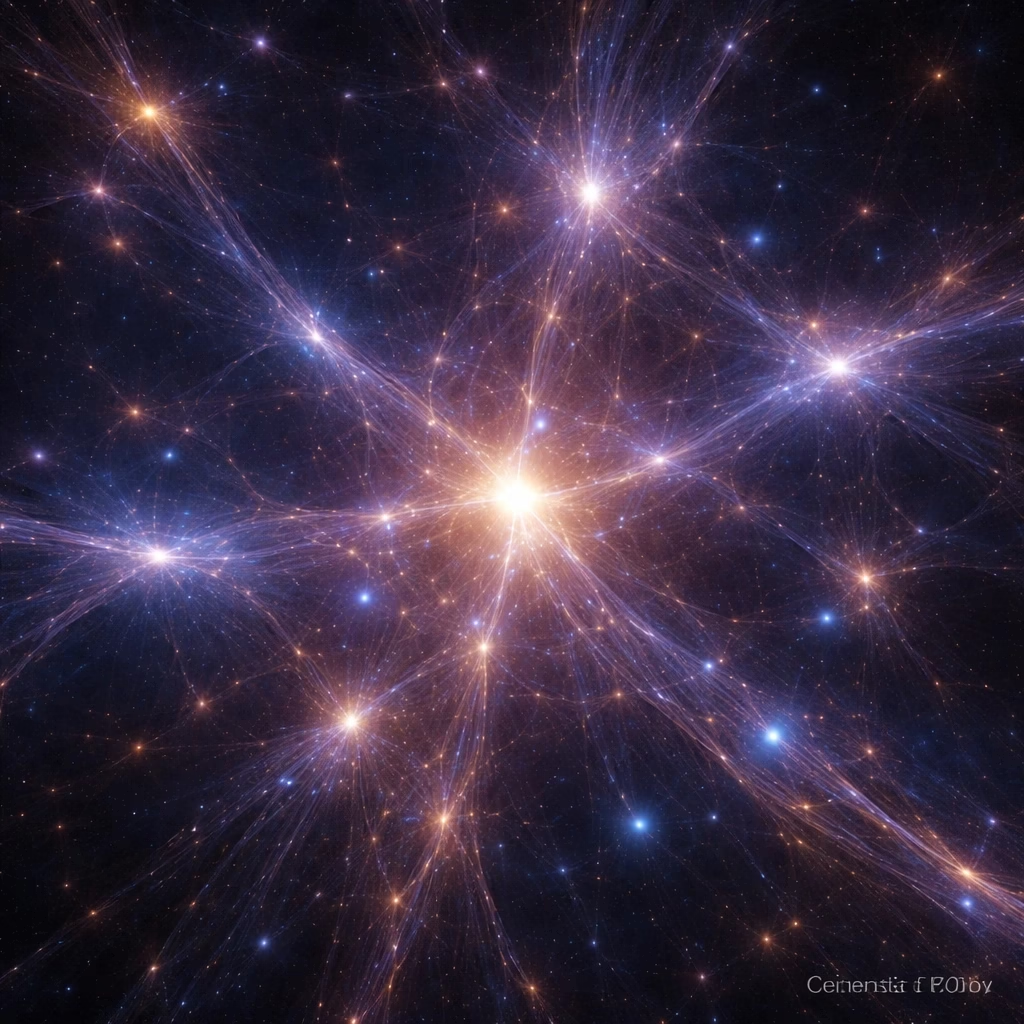

Observational astronomy began to catch up in the 1990s and early 2000s. Large-scale galaxy surveys, such as the 2dF Galaxy Redshift Survey (2dFGRS) and the ongoing Sloan Digital Sky Survey (SDSS), started mapping the positions of hundreds of thousands, then millions, of galaxies. These surveys provided the first direct observational evidence for the filamentary distribution of galaxies, confirming the theoretical predictions of a cosmic web. However, these early maps were limited in depth and resolution, offering only a partial view of this immense structure.
Simultaneously, sophisticated N-body simulations, like the Millennium Simulation (2005) and IllustrisTNG (2018), became indispensable tools. These simulations, running on supercomputers, modeled the gravitational evolution of billions of dark matter particles and gas, vividly demonstrating how the cosmic web emerges from initial density fluctuations, forming halos where galaxies reside and the vast network connecting them. The challenge remained to empirically confirm and precisely map this invisible dark matter skeleton that underpins the visible Universe.
Key Developments: Mapping the Invisible Threads
The new, high-resolution map of the cosmic web is the culmination of the "Cosmic Filaments Initiative," a multi-institutional project that synthesized data from an unprecedented array of next-generation observatories and employed cutting-edge analytical techniques. This initiative specifically aimed to move beyond simply observing galaxy distributions to inferring the underlying dark matter framework with greater precision.
More Read

Integrated Observational Data
The project integrated vast datasets from several premier astronomical missions:
Dark Energy Spectroscopic Instrument (DESI): Operating from Kitt Peak National Observatory in Arizona, DESI has been mapping the 3D positions of over 40 million galaxies and quasars, providing the backbone of the visible matter distribution across billions of light-years.
* ESA's Euclid Mission: Launched in July 2023, Euclid's wide-field imager and spectrometer are providing high-precision measurements of weak gravitational lensing. This technique detects the subtle distortions of light from distant galaxies as it passes through intervening dark matter concentrations, offering a direct probe of the invisible mass.
* Subaru Hyper Suprime-Cam (HSC) Survey: From the Subaru Telescope in Hawaii, the HSC survey has contributed exceptionally deep and wide-field imaging data, crucial for identifying faint, distant galaxies and for weak lensing analyses.
* Ground-based spectroscopic surveys: Additional data from telescopes like the Anglo-Australian Telescope and the Very Large Telescope in Chile provided crucial redshift information, allowing for precise distance measurements and a 3D reconstruction of the Universe.
Novel Analytical Algorithms and AI
A major breakthrough came from the development of novel analytical algorithms and the deployment of artificial intelligence (AI) and machine learning techniques. Traditional methods struggled to disentangle the complex interplay between visible galaxies and the invisible dark matter. The Cosmic Filaments Initiative utilized:
AI-driven reconstruction: Machine learning models were trained on cosmological simulations to learn the relationship between the distribution of luminous matter (galaxies) and the underlying dark matter web. These models could then infer the dark matter density fields from the observational galaxy data with unprecedented accuracy.
* Bayesian inference models: These sophisticated statistical tools allowed researchers to combine disparate datasets, each with its own uncertainties and biases, into a coherent and robust map. They enabled the identification of "ghost filaments" – regions of dark matter filaments that contain very few or no observable galaxies, previously undetectable.
* Redshift space distortions and baryonic acoustic oscillations (BAO): These cosmological probes, which measure the clustering of galaxies and characteristic scales in the Universe, were used as "standard rulers" to precisely calibrate distances and map the expansion history, providing a true 3D context for the web.
The resulting map extends to a redshift of approximately z=3-4, meaning it reveals the cosmic web as it existed when the Universe was only about 2 to 3 billion years old. This provides a dynamic, 3D view of structure formation across cosmic time, showing how the web evolved from its nascent stages. The map reveals density fluctuations, filamentary connections, and vast void regions with clarity that was previously only achievable in simulations.
Impact: Reshaping Our Cosmic Understanding
The unveiling of this highly detailed cosmic web map has profound implications across multiple scientific disciplines, from fundamental physics to practical applications in data science.
More Read

Revolutionizing Cosmology and Astrophysics
The map provides the most robust empirical test yet for the Lambda-CDM model, the standard cosmological model that describes a Universe dominated by dark energy (Lambda), cold dark matter (CDM), and ordinary baryonic matter. While largely confirming the model's predictions, the map also highlights subtle deviations and previously unobserved features, offering new avenues for refinement.
It offers unprecedented insights into the interplay between dark matter and baryonic matter. Researchers can now study how galaxies form and evolve within specific environments of the web – whether they are in dense nodes, along filaments, or isolated in voids. This helps resolve long-standing discrepancies in galaxy formation simulations, explaining why some regions are more active in star formation than others. The map also pinpoints extreme cosmic environments, such as massive galaxy clusters at filament intersections and the vast, empty cosmic voids, for future targeted study.
Advancing Fundamental Physics
The precise mapping of the dark matter distribution places tighter constraints on the properties of dark matter particles. By comparing the observed web with simulations based on different dark matter candidates (e.g., weakly interacting massive particles or axions), physicists can narrow down the range of possibilities for this elusive substance. This could be a crucial step towards detecting subtle signatures of new physics beyond the Standard Model. Furthermore, the map refines measurements of fundamental cosmological parameters, such as the Hubble constant (the Universe's expansion rate) and the total density of matter, contributing to ongoing efforts to resolve current tensions in these measurements.
Technological and Data Science Frontiers
The sheer volume of data processed and the complexity of the algorithms developed for this project have pushed the boundaries of computational science, data visualization, and artificial intelligence. The new AI-driven reconstruction techniques and Bayesian inference models are transferable, offering potential applications in other fields dealing with massive, noisy datasets, from medical imaging to climate modeling.
Public Engagement and Education
Beyond the scientific community, the detailed and visually stunning map of the cosmic web offers a tangible and awe-inspiring representation of the Universe's structure. It enhances public engagement with science, providing a powerful educational tool to illustrate complex cosmological concepts like dark matter, dark energy, and the evolution of cosmic structures.
What Next: Charting Future Cosmic Exploration
The unveiling of this detailed cosmic web map is not an endpoint but a significant milestone, setting the stage for the next generation of cosmological research. Scientists are already outlining ambitious plans to build upon this foundational work.
Deeper and Wider Surveys
Future phases of the DESI project, alongside ongoing and upcoming missions like the Nancy Grace Roman Space Telescope (launching mid-2020s) and the Vera C. Rubin Observatory's Legacy Survey of Space and Time (LSST), will extend the map to even greater depths and higher precision. These observatories will allow astronomers to peer further back in time, mapping the cosmic web when the Universe was even younger, and to cover larger volumes, capturing rarer structures. There's a particular focus on mapping the "intergalactic medium" – the diffuse gas that makes up the filaments – using techniques like quasar absorption line spectroscopy, which can reveal the distribution of ordinary matter within the dark matter scaffolding.
Multi-Messenger Astronomy Integration
The cosmic web map will become an invaluable reference for multi-messenger astronomy. By correlating the map with observations from gravitational wave detectors (like LIGO and Virgo) and neutrino observatories, scientists hope to gain new insights into the most energetic events in the Universe, such as black hole mergers and supernova explosions, and how they relate to the large-scale structure.
Probing Dark Energy’s Mysteries
The precise geometry and evolution of the cosmic web are intimately linked to the properties of dark energy, the mysterious force accelerating the Universe's expansion. The new map will be a crucial tool for refining our understanding of dark energy, allowing scientists to test different models for its nature and evolution over cosmic time. By studying how the web's growth has been affected by dark energy, researchers aim to constrain its equation of state with unprecedented accuracy.
Guiding Simulations and Search for Dark Matter
The highly detailed map will serve as a critical benchmark for cosmological simulations, allowing theorists to refine their models of structure formation and galaxy evolution. This iterative process will lead to even more accurate predictions about the Universe's past and future. Furthermore, a better understanding of the local dark matter distribution, inferred from the global map, could inform terrestrial dark matter detection experiments, guiding their search for the elusive particles.
Interactive Public Access
Looking ahead, the Cosmic Filaments Initiative plans to release interactive 3D visualizations of the cosmic web to the public and the broader scientific community. These tools will allow anyone to explore the Universe's vast hidden structure, fostering a deeper appreciation for the intricate cosmic tapestry that binds everything together.