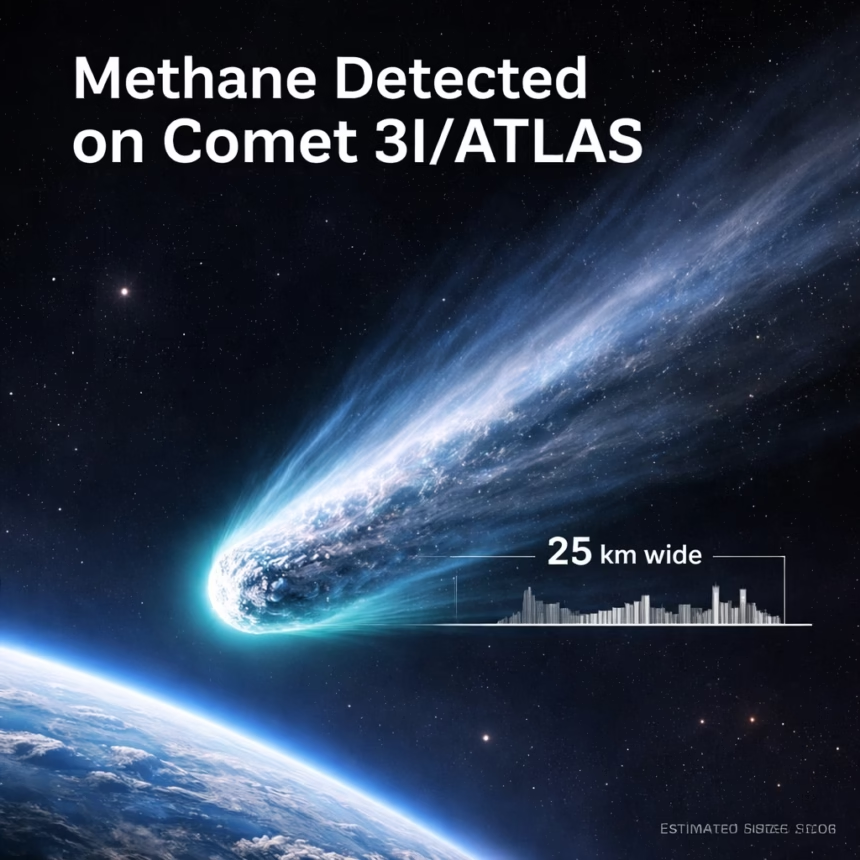
Recent groundbreaking observations have unveiled the surprising detection of significant methane reserves within the interstellar comet 3I/ATLAS, prompting a substantial recalculation of its estimated size and activity. This discovery, made possible by advanced spectroscopic analysis from leading observatories, provides unprecedented insights into the composition of objects originating from beyond our solar system. The findings challenge long-held assumptions about interstellar visitors and promise to reshape our understanding of planet formation in distant stellar nurseries.
Background: A Wanderer from Beyond
Comet 3I/ATLAS, formally designated C/2019 Q4 (ATLAS), was first identified on August 29, 2019, by the Asteroid Terrestrial-impact Last Alert System (ATLAS) telescope in Hawaii. Its trajectory quickly revealed its extraordinary nature: a hyperbolic orbit indicated it was not gravitationally bound to our Sun, marking it as only the third confirmed interstellar object to traverse our solar system, following 'Oumuamua and Borisov. This revelation immediately positioned 3I/ATLAS as a prime target for intensive study, offering a rare glimpse into the material makeup of other star systems.
The ATLAS Survey
The ATLAS project, a robotic astronomical survey system, plays a critical role in planetary defense by detecting near-Earth objects. Its unexpected discovery of 3I/ATLAS underscored its capability to identify celestial bodies with unusual trajectories, even those originating from vast interstellar distances. The initial observations of 3I/ATLAS showed it developing a distinct coma and tail as it approached the Sun, characteristic of a cometary body, distinguishing it from the more enigmatic, possibly asteroidal 'Oumuamua.
Interstellar Visitors: A Rare Opportunity
The arrival of interstellar objects provides unique opportunities for astronomers. Unlike objects formed within our solar system, these visitors carry pristine material from their birthplaces around other stars, offering direct samples of extrasolar chemistry. Prior to 3I/ATLAS, comet 2I/Borisov, discovered in 2019, was the first unequivocally cometary interstellar object, showing a composition broadly similar to comets in our own solar system, primarily water ice, carbon monoxide, and carbon dioxide. This similarity led to initial expectations that 3I/ATLAS would follow a similar chemical profile, making the recent methane detection particularly surprising. Early size estimates for 3I/ATLAS, based on its initial brightness and assumed albedo, placed its nucleus at a few kilometers across, comparable to many solar system comets.
Key Developments: Methane and a Shifting Scale
The pivotal shift in our understanding of 3I/ATLAS occurred in late 2023 and early 2024, when advanced spectroscopic data became available from instruments aboard the James Webb Space Telescope (JWST) and several large ground-based observatories, including the European Southern Observatory's Very Large Telescope (VLT) in Chile. These observations provided an unprecedented spectral resolution of the comet's coma, revealing distinct molecular signatures previously undetected.

Unveiling Methane through Spectroscopy
The spectroscopic analysis definitively identified strong emission lines corresponding to methane (CH4) within the comet's outgassing material. While trace amounts of methane have been found in some solar system comets, its significant abundance in 3I/ATLAS suggests a different formation environment or evolutionary history. Methane is a highly volatile ice, sublimating at much lower temperatures than water ice, carbon dioxide, or carbon monoxide. Its detection implies that 3I/ATLAS either formed in an exceptionally cold region of its home stellar system or has preserved its primordial volatiles remarkably well over cosmic timescales. This finding contrasts sharply with earlier assumptions that 3I/ATLAS's activity was primarily driven by water ice or CO/CO2, challenging the prevailing models for interstellar cometary compositions.
Recalibrating the Comet’s Dimensions
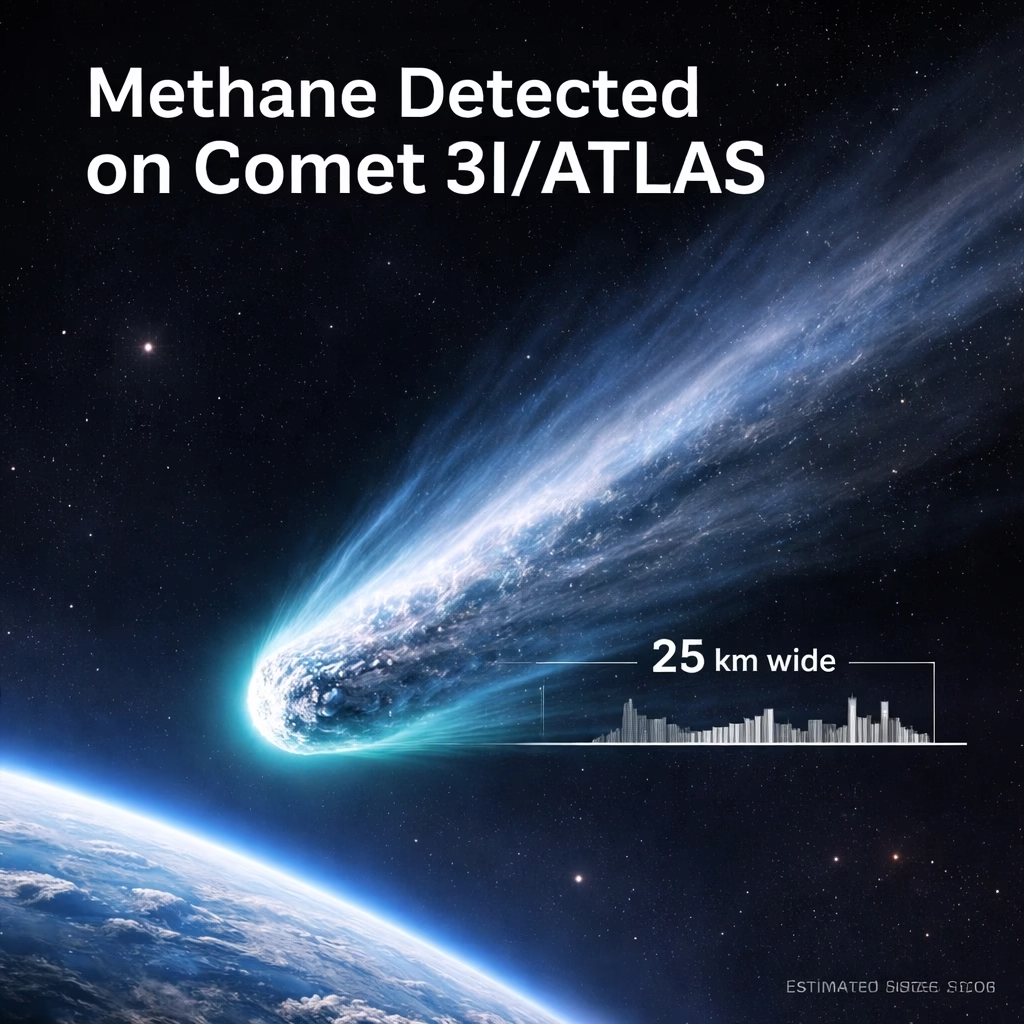
The presence of abundant methane has necessitated a significant revision of 3I/ATLAS's estimated size. Previous size calculations relied on the comet's observed brightness and an assumed composition dominated by less volatile materials. However, methane's high volatility means that even a relatively small nucleus can produce a vastly extended and bright coma when its methane ice sublimates. This enhanced outgassing can significantly inflate the comet's apparent brightness, leading to an overestimation of its solid nucleus size if the more common volatile drivers are assumed.
Scientists now hypothesize that the nucleus of 3I/ATLAS could be considerably smaller than initially thought, possibly by a factor of two or more in diameter, while still accounting for its observed activity due to the vigorous methane outgassing. Conversely, if the nucleus is indeed larger, the sheer volume of methane activity implies an incredibly active and volatile object. The precise new estimates are still undergoing peer review, but preliminary figures suggest the nucleus could range from a few hundred meters to perhaps two kilometers, a narrower and potentially smaller range than earlier, broader estimates. This recalibration is crucial for understanding the comet's mass, density, and internal structure.

Impact: Reshaping Cosmic Perspectives
The methane detection and subsequent size revisions for 3I/ATLAS carry profound implications across several scientific disciplines, primarily for planetary scientists, astrophysicists, and astrobiologists.
Reshaping Exoplanetary Formation Models
For planetary scientists, the composition of 3I/ATLAS offers a direct chemical fingerprint of a protoplanetary disk around another star. The high methane content suggests that the region where 3I/ATLAS formed was rich in carbon and experienced conditions cold enough to preserve this volatile ice. This data provides critical constraints for refining models of planet and comet formation in diverse stellar environments, particularly those with different metallicity or thermal gradients than our own solar system. It hints at a greater diversity in extrasolar comet compositions than previously assumed, potentially expanding our understanding of how volatile-rich bodies form across the galaxy.
Implications for Volatile Transport
Astrobiologists are keenly interested in the role of comets in delivering water and organic molecules to nascent planets, a process believed to be crucial for the emergence of life. The discovery of methane, a simple hydrocarbon, in an interstellar comet adds another dimension to this narrative. While methane itself is not a direct building block of life, its presence indicates a reservoir of carbon-rich volatiles that could contribute to the complex chemistry necessary for abiogenesis. It prompts questions about how frequently such methane-rich comets might impact young planets, potentially seeding them with diverse chemical inventories.
Future Missions and Public Understanding
Space agencies like NASA and ESA will undoubtedly factor these new findings into future mission planning. Understanding the composition of interstellar objects could inform target selection for potential future sample-return missions or flybys, should such objects prove accessible. For the broader public, this discovery underscores the dynamic and chemically diverse nature of the cosmos, highlighting that even seemingly familiar objects like comets can hold surprising secrets when they originate from beyond our cosmic neighborhood. It broadens our collective imagination about what other star systems might harbor.
What Next: Unveiling More Secrets
The journey to fully understand 3I/ATLAS is far from over. The recent discoveries have opened new avenues of research and set the stage for further investigations as the comet continues its outbound journey from the Sun.
More Read

Future Observational Campaigns
Astronomers plan extensive follow-up observations using an array of instruments. The JWST will continue to be a primary tool, leveraging its infrared capabilities to search for other complex organic molecules and additional volatile ices that might be present in smaller quantities. Ground-based telescopes, including next-generation observatories like the Vera C. Rubin Observatory, will monitor its long-term activity, fading rate, and potential fragmentation, which could offer clues about its internal structure and stability. Researchers will also attempt to refine the comet's trajectory with even greater precision, aiming to trace its origin back to a specific stellar association or open cluster if possible.
Advancing Theoretical Frameworks
On the theoretical front, scientists will be busy integrating the new methane data into sophisticated computer models. These models will simulate the comet's formation conditions, its thermal history, and the dynamics of its outgassing. Understanding how methane-driven activity influences the comet's brightness and morphology will be key to accurately interpreting observations of future interstellar objects. The data from 3I/ATLAS will help to build a more robust framework for classifying and characterizing these elusive cosmic messengers. The scientific community eagerly awaits the formal publication of these findings and the subsequent discussions and debates that will undoubtedly shape our evolving understanding of the universe beyond our solar system.