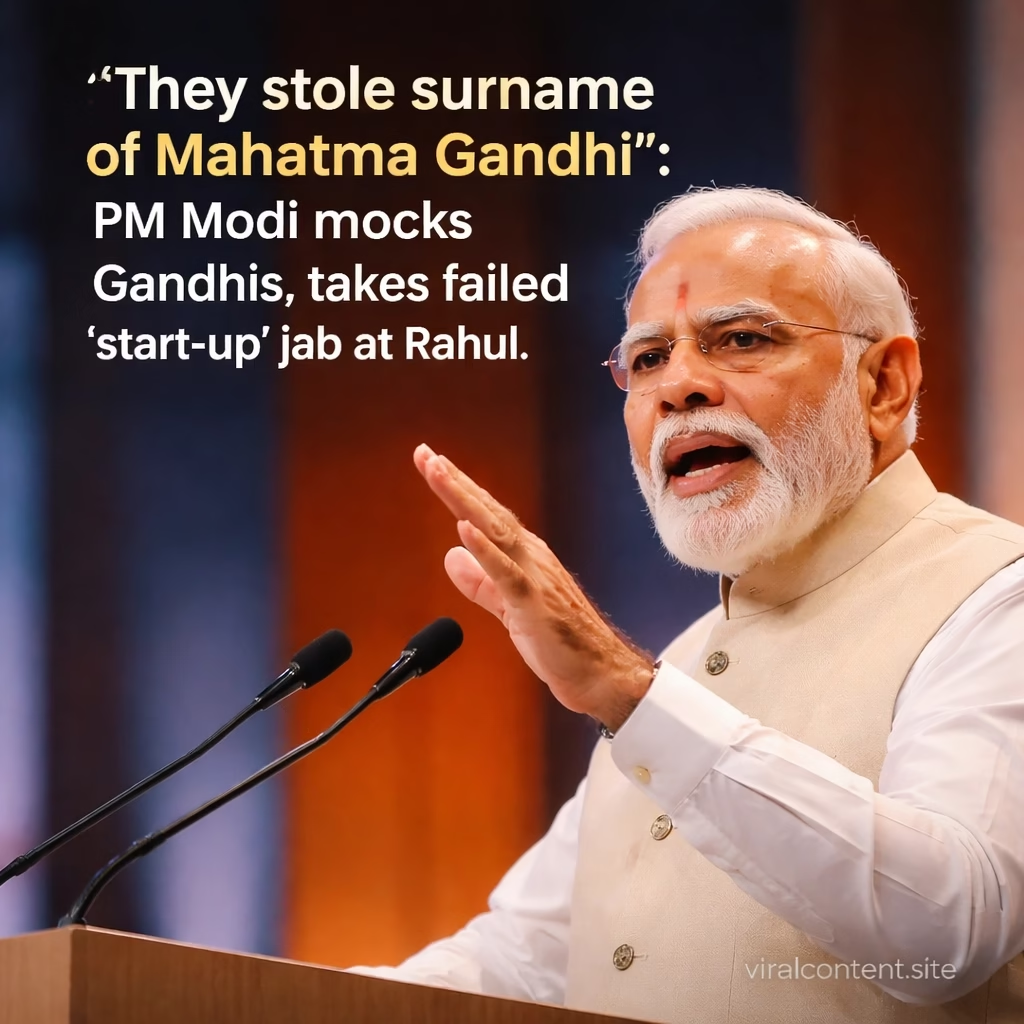
‘They stole surname of Mahatma Gandhi’: PM Modi mocks Gandhis, takes failed ‘start-up’ jab at Rahul

Viral_X
By
Viral_X
10 Min Read
#image_title

In a recent political broadside, Prime Minister Narendra Modi accused the Nehru-Gandhi family of "stealing" the surname of Mahatma Gandhi, while simultaneously mocking Congress leader Rahul Gandhi's political trajectory as a "failed start-up." The sharp remarks, delivered during a public address, have intensified the already fractious political discourse in India, drawing swift condemnation from the opposition and rallying support from the ruling Bharatiya Janata Party (BJP). This latest verbal volley underscores the deep-seated rivalry between the nation's two dominant political forces and their contrasting interpretations of India's historical and contemporary leadership.

Background: A Legacy Under Scrutiny

The contentious relationship between the BJP and the Indian National Congress, particularly the Nehru-Gandhi dynasty, forms a foundational element of modern Indian politics. For decades, the BJP has sought to challenge the Congress's historical narrative and its perceived monopoly over the legacy of India's freedom struggle. At the heart of this contest lies the figure of Mahatma Gandhi, revered nationwide as the Father of the Nation.

The 'Gandhi' surname itself has been a point of contention for years. While Mohandas Karamchand Gandhi, revered as Mahatma Gandhi, is globally recognized, the political family that has led the Congress party for much of independent India's history—Jawaharlal Nehru, Indira Gandhi, Rajiv Gandhi, Sonia Gandhi, and Rahul Gandhi—bears the same surname through Feroze Gandhi, Indira Gandhi's husband. Feroze Gandhi, though a Parsi by birth, adopted the surname 'Gandhi' earlier in his life, reportedly influenced by Mahatma Gandhi's non-cooperation movement. Critically, Feroze Gandhi was not related by blood to Mahatma Gandhi. This distinction has frequently been highlighted by critics to question the Nehru-Gandhi family's direct claim to Mahatma Gandhi's legacy, often implying a deliberate appropriation for political mileage.

Rahul Gandhi, the scion of this prominent political family, has been a central figure in the Congress party for nearly two decades. His political career, marked by various roles including Member of Parliament and Congress President, has been a frequent target of BJP criticism. Despite his lineage, Rahul Gandhi has faced challenges in consolidating leadership and delivering electoral victories, particularly against the formidable electoral machine of the BJP under PM Modi. His attempts to rejuvenate the Congress party and connect with the masses, such as through the recent 'Bharat Jodo Yatra' (Unite India March), are often framed by the BJP as ineffective or lacking substance, leading to jibes about his political acumen and leadership capabilities.

Key Developments: Modi’s Latest Barbs

Prime Minister Modi's recent comments represent a significant escalation in the rhetoric against the Gandhi family. Speaking at a public rally in a politically crucial state, the Prime Minister directly questioned the family's right to use the Gandhi surname. "They are not even related to Mahatma Gandhi," Modi reportedly stated, "but they shamelessly stole his surname. They do not have the right to use it." This accusation explicitly played on the historical fact that the Nehru-Gandhi family's surname connection to Mahatma Gandhi is not through direct bloodline.

The ‘Failed Start-up’ Analogy

Beyond the surname controversy, PM Modi also took aim at Rahul Gandhi's political career, employing a contemporary analogy. "Some people tried to launch a 'start-up' in politics," Modi remarked, "but it failed to take off. Their every attempt has been a failure, and they continue to fail." This jab was widely interpreted as a direct reference to Rahul Gandhi's leadership of the Congress party and his electoral track record. The term 'start-up' carries connotations of innovation, risk-taking, and, crucially, the high rate of failure in new ventures. By likening Rahul Gandhi's political journey to a "failed start-up," Modi aimed to diminish his credibility and reinforce the narrative of his political ineffectiveness.

The timing of these remarks is also pertinent, coming amidst preparations for upcoming state assembly elections and the looming general elections. Such pointed attacks serve to energize the BJP's electoral base, reinforce their narrative against the Congress, and potentially sow doubt among swing voters regarding the opposition's leadership.
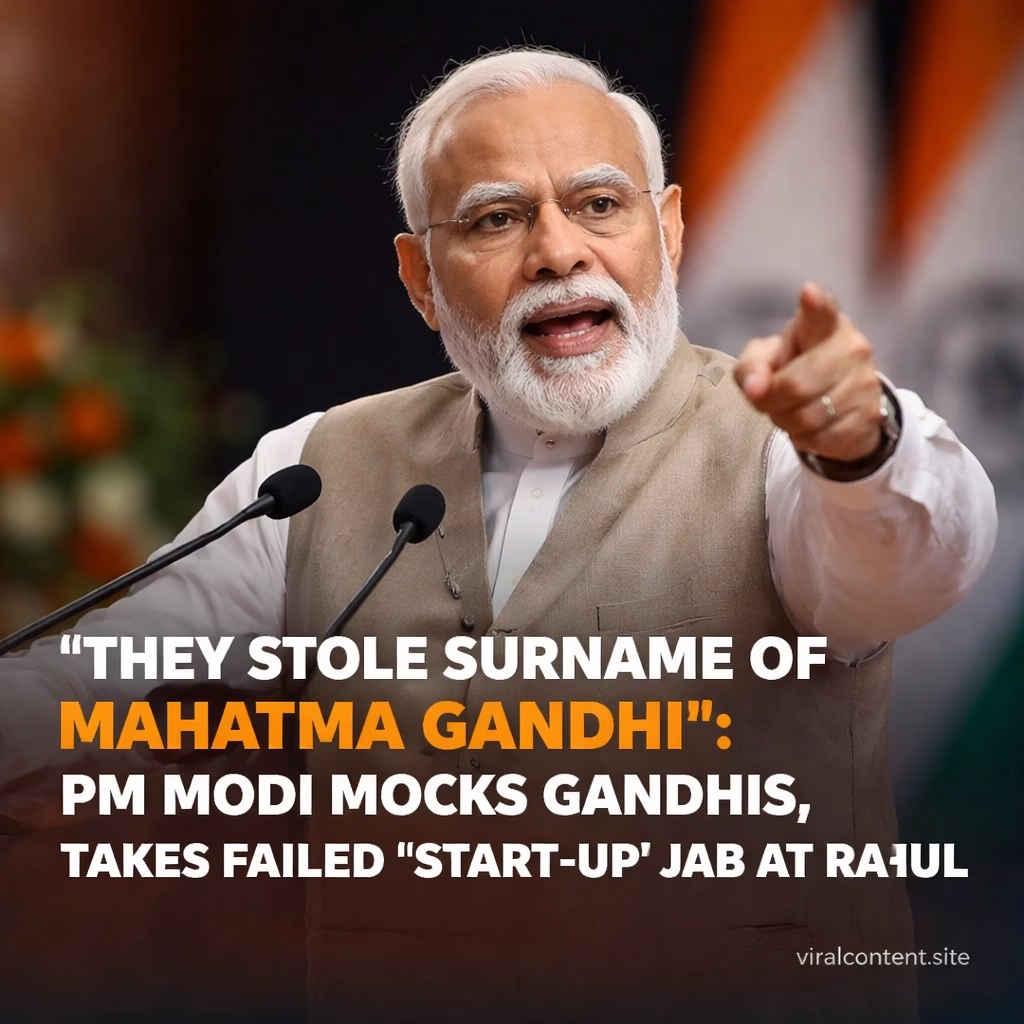

'They stole surname of Mahatma Gandhi': PM Modi mocks Gandhis, takes failed 'start-up' jab at Rahul

Impact: Echoes Across the Political Spectrum

The Prime Minister's statements immediately reverberated across India's political landscape, eliciting strong reactions from various quarters.

Congress’s Vehement Defense

The Indian National Congress swiftly condemned PM Modi's remarks as "baseless," "malicious," and "beneath the dignity of the Prime Minister's office." Congress leaders highlighted the family's sacrifices for the nation, including the assassinations of Indira Gandhi and Rajiv Gandhi, arguing that their commitment to India's ideals transcends any surname. They emphasized that the 'Gandhi' surname has become synonymous with a legacy of struggle, sacrifice, and service to the nation, irrespective of biological lineage. Many also pointed out that Mahatma Gandhi himself considered the Nehru family as his political heirs and close associates. Rahul Gandhi, while not directly addressing the "start-up" remark, has consistently asserted his commitment to fighting for democratic values and the rights of the common people, often framing his political struggle as a battle against divisive forces.

BJP’s Reinforcement of Narrative

For the BJP, Modi's statements align perfectly with their long-standing strategy of challenging the Congress's dynastic politics and questioning the Nehru-Gandhi family's historical preeminence. Party spokespersons and leaders quickly rallied behind the Prime Minister, amplifying his accusations and reiterating the claim that the Congress has exploited national symbols and legacies for personal and political gain. The remarks are seen as a calculated move to further erode the Congress's traditional support base and consolidate the BJP's nationalist agenda.

Public and Media Reaction

The comments have sparked extensive debate in mainstream media and on social media platforms. Analysts have discussed the ethical implications of such personal attacks in political discourse, while others have delved into the historical accuracy and political motivations behind the 'stolen surname' claim. Public opinion remains divided, with supporters of the BJP applauding the Prime Minister's directness and critics decrying the perceived trivialization of Mahatma Gandhi's legacy and the use of personal attacks in lieu of policy debates. The controversy is likely to keep the focus on personalities rather than substantive issues, at least in the short term.

What Next: Escalating Rhetoric Towards Elections

The political fallout from PM Modi's comments is expected to continue shaping the national discourse in the coming weeks and months.

Continued Verbal Sparring

The Congress party is unlikely to let these accusations go unchallenged. Expect further counter-attacks, with Congress leaders likely to remind the public of the BJP's own historical connections (or lack thereof) to the freedom movement, and to accuse the government of diverting attention from pressing economic and social issues. Rahul Gandhi himself may respond more directly to the "failed start-up" jibe, perhaps by emphasizing his commitment to long-term political struggle over short-term electoral gains.

Weaponization in Electoral Campaigns

As India gears up for crucial state elections and the 2024 general elections, these remarks will undoubtedly be weaponized by both sides. The BJP will likely continue to question the Congress's lineage and leadership, while the Congress will portray the BJP's attacks as disrespectful to national icons and a sign of desperation. The debate over historical legacies, dynastic politics, and leadership effectiveness will remain central to the electoral narrative.

Focus on Policy vs. Personality

A key question remains whether the political discourse will eventually shift back to substantive policy debates concerning the economy, employment, social justice, and development. While personal attacks and historical revisionism often dominate headlines, voters ultimately seek solutions to their everyday problems. The challenge for both the ruling party and the opposition will be to balance their political messaging with tangible proposals that address the concerns of the electorate, even amidst the ongoing war of words.

The latest salvo from PM Modi ensures that the 'Gandhi' surname and Rahul Gandhi's political journey will remain hot-button issues, keeping the political pot boiling as the nation inches closer to its next major electoral showdown.


Share This Article
Leave a Comment

Leave a Reply

‘They stole surname of Mahatma Gandhi’: PM Modi mocks Gandhis, takes failed ‘start-up’ jab at Rahul

Viral_X
By
Viral_X
11 Min Read
#image_title

New Delhi, India – Prime Minister Narendra Modi recently unleashed a sharp critique against the Nehru-Gandhi family, publicly questioning their use of the 'Gandhi' surname and delivering a pointed jab at Rahul Gandhi's political career, likening it to a "failed start-up." These remarks, made during a parliamentary address on February 7, 2024, have intensified the ongoing political skirmish between the ruling Bharatiya Janata Party (BJP) and the opposition Indian National Congress.

Background: The Enduring Dynastic Debate

The 'Gandhi' surname has long been a focal point of political contention in India, particularly regarding the Nehru-Gandhi family. The current lineage, tracing back to Jawaharlal Nehru, India's first Prime Minister, adopted the Gandhi surname through Indira Nehru's marriage to Feroze Gandhi. It is crucial to note that Feroze Gandhi, a prominent politician and journalist, was not related by blood to Mahatma Gandhi, the Father of the Nation. This distinction forms the core of the BJP's repeated challenge to the family's claim to the revered 'Gandhi' name.

Historical Roots of the Surname

Indira Nehru married Feroze Gandhi in 1942. Feroze Gandhi, an orphan, had been adopted by a Parsi family in Allahabad and later became a close associate of the Nehru family. His surname, Gandhi, has often been a source of confusion and political leverage, implying a direct lineage to Mahatma Gandhi, which is factually incorrect. The Nehru-Gandhi dynasty, including Rajiv Gandhi, Sonia Gandhi, Rahul Gandhi, and Priyanka Gandhi Vadra, have all carried this surname, cementing its association with India's most prominent political family.

A History of Political Rivalry

The BJP has consistently employed anti-dynastic rhetoric as a cornerstone of its political strategy, particularly against the Congress party. This strategy aims to portray the Congress as a party beholden to a single family, contrasting it with the BJP's narrative of meritocracy and collective leadership. Attacks on the Gandhi surname serve to delegitimize the family's claim to political authority and challenge their historical legacy, often attempting to strip them of the moral authority associated with Mahatma Gandhi.

Previous instances of this debate are numerous. BJP leaders, including former Prime Minister Atal Bihari Vajpayee and current Home Minister Amit Shah, have, at various times, questioned the family's right to the Gandhi surname. These attacks often resurface during election campaigns or significant parliamentary debates, designed to provoke a strong reaction and dominate media discourse.

Key Developments: Modi’s Latest Offensive

Prime Minister Modi's recent comments in Parliament represent a calculated escalation of this long-standing political attack. His choice of words – "They stole surname of Mahatma Gandhi" – is particularly inflammatory, implying a deliberate act of appropriation rather than an accidental association.

The Parliamentary Address

The remarks were made during a Lok Sabha session, amidst a heated debate on the President's address. Modi, known for his rhetorical prowess, used the platform to directly confront the opposition, particularly targeting the Congress and its first family. He questioned why members of the Nehru family, specifically those descending from Jawaharlal Nehru, chose not to use the 'Nehru' surname but instead adopted 'Gandhi'. This line of questioning aims to undermine the family's political identity and historical narrative.

The “Failed Start-up” Jab

Beyond the surname controversy, PM Modi also took a direct swipe at Rahul Gandhi, referring to his political career as a "failed start-up." This analogy is potent in contemporary India, a nation increasingly focused on entrepreneurship and economic growth. By framing Rahul Gandhi's political journey in such terms, Modi sought to portray him as ineffectual, lacking vision, and incapable of leading, appealing to a demographic that values success and innovation.

The "failed start-up" comment draws upon a narrative that the BJP has meticulously built around Rahul Gandhi – one of inconsistency, political missteps, and an inability to connect with the masses despite his lineage. This particular jab resonates with a younger, aspirational electorate, who might view political careers through the lens of performance and tangible results, much like a business venture.

Immediate Reactions and Political Fallout

The comments immediately drew sharp condemnation from Congress leaders, who accused the Prime Minister of stooping to personal attacks and disrespecting the legacy of both Mahatma Gandhi and the Nehru-Gandhi family. Congress leaders countered by highlighting the sacrifices made by the Nehru-Gandhi family for the nation, including the assassinations of Indira Gandhi and Rajiv Gandhi. They argued that the BJP's tactic was a diversion from pressing national issues.

Other opposition parties also weighed in, with some criticizing the personal nature of the attack, while others remained silent, reflecting the complex political landscape. The media widely covered the remarks, leading to extensive debates across news channels and social media platforms, with hashtags related to the "Gandhi surname" and "failed start-up" trending for days.

Impact: Reshaping Narratives and Public Perception

PM Modi's remarks have a multi-faceted impact, influencing the political narrative, public perception, and the strategic positioning of both the BJP and the Congress.

On the Gandhi Family’s Image

The attack aims to chip away at the moral authority and historical legitimacy that the 'Gandhi' surname bestows upon the Nehru-Gandhi family. By questioning its origins and implying appropriation, the BJP seeks to diminish the family's perceived connection to Mahatma Gandhi's ideals and legacy. This can sow doubt among fence-sitters and reinforce existing skepticism among critics regarding the family's claim to national leadership.

On the Congress Party’s Strategy

For the Congress, such attacks put them on the defensive, forcing them to expend energy refuting personal allegations rather than focusing on their policy agenda. It also forces them to constantly reiterate their historical contributions and sacrifices. The challenge for Congress is to effectively counter this narrative without appearing overly sensitive or out of touch with modern political discourse. They often respond by accusing the BJP of divisive politics and attempting to rewrite history.

BJP’s Strategic Advantage

From the BJP's perspective, these comments serve several strategic objectives. Firstly, they energize the party's base, which often views the Nehru-Gandhi family as emblematic of dynastic politics and a historical rival. Secondly, they distract from any potential criticism against the government, shifting the media's focus to a politically charged debate. Thirdly, the "failed start-up" analogy helps to further diminish Rahul Gandhi's stature as a credible challenger, aligning with the BJP's long-term strategy to undermine his leadership.

Impact on Public Discourse

The debate also influences broader public discourse on dynastic politics, historical narratives, and political ethics. It forces a re-examination of how political legacies are formed and maintained in India. While some citizens may find the attacks distasteful, others might resonate with the anti-dynasty sentiment, particularly those who believe in merit-based leadership and are frustrated with perceived political stagnation.

What Next: The Road Ahead for Political Combat

The recent exchange is unlikely to be an isolated incident. Such rhetorical battles are integral to India's vibrant, often confrontational, political landscape, especially as the nation gears up for crucial electoral cycles.

Continued Political Sparring

Expect the 'Gandhi' surname and Rahul Gandhi's leadership to remain recurring themes in the BJP's arsenal. With state elections and the 2024 General Elections on the horizon, the frequency and intensity of such attacks are likely to increase. The BJP will continue to use these narratives to consolidate its voter base and discredit the opposition.

The Congress, in turn, will likely refine its counter-strategy. This could involve more robust defenses of their family's legacy, emphasizing their commitment to public service, and redirecting attention back to the government's performance on economic issues, unemployment, and social welfare. They might also attempt to frame the BJP's attacks as desperate attempts to divert attention from its own governance challenges.

Implications for Upcoming Elections

The efficacy of such rhetoric will be tested in the upcoming electoral battles. While personal attacks can energize a party's core voters, they also risk alienating undecided voters who might prefer a focus on substantive policy debates. The "failed start-up" jab, in particular, targets a younger, more aspirational demographic whose votes are crucial. The success of this strategy will depend on whether it resonates beyond the BJP's traditional support base.

The Future of Dynastic Politics in India

More broadly, this episode underscores the enduring debate about dynastic politics in India. While many democratic nations have seen political families emerge, the scale and prominence of dynastic succession in India, particularly within the Congress, remain a unique characteristic. The BJP's consistent assault on this aspect seeks to fundamentally alter the political culture, pushing for a narrative of meritocracy over lineage.

The long-term impact of these political exchanges could shape how future generations view political leadership and succession. Whether India moves towards a more meritocratic political system or continues to grapple with the influence of powerful political families will, in part, be determined by the outcome of these ongoing rhetorical and electoral battles. The 'Gandhi' surname debate, therefore, is not merely a personal attack but a significant thread in the larger tapestry of Indian democracy.

'They stole surname of Mahatma Gandhi': PM Modi mocks Gandhis, takes failed 'start-up' jab at Rahul

Share This Article
Leave a Comment

Leave a Reply