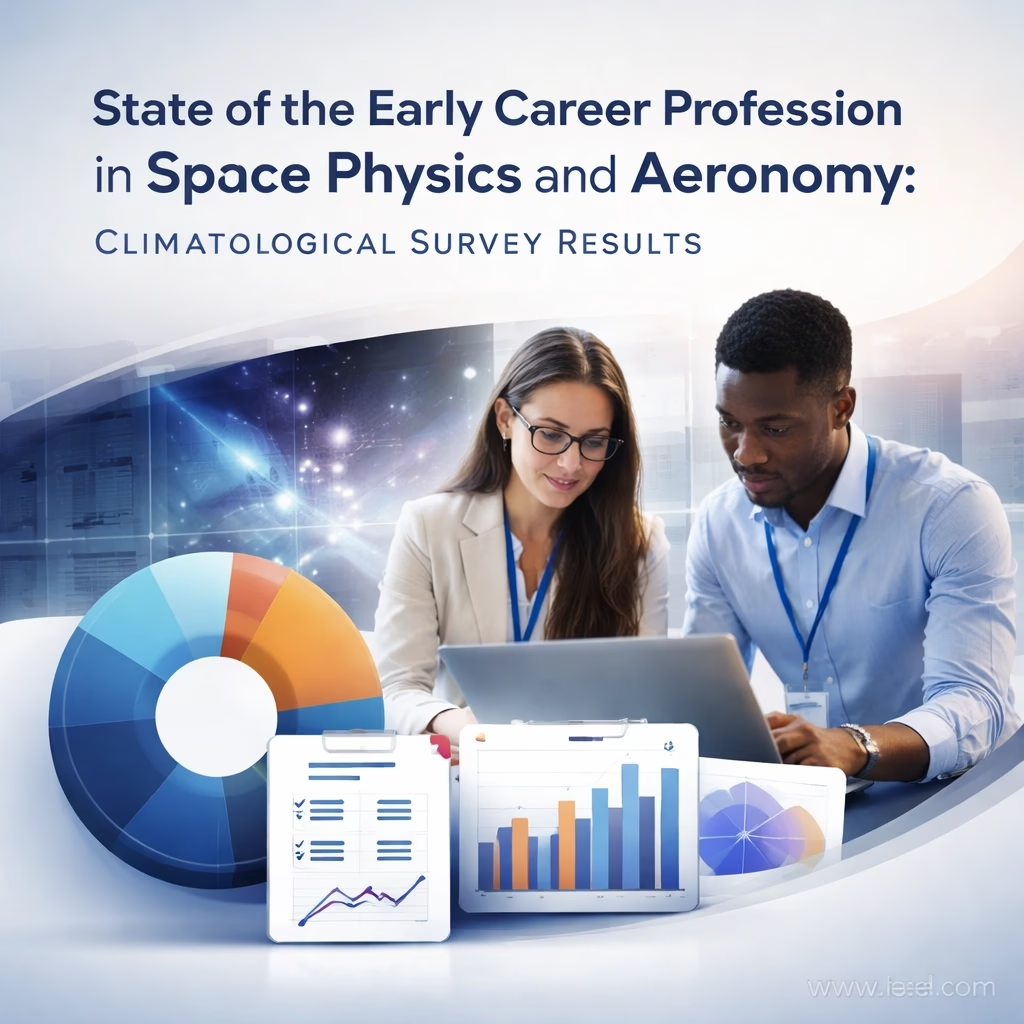
State of the Early Career Profession in Space Physics and Aeronomy: Climatological Survey Results

Viral_X
By
Viral_X
5 Min Read
#image_title

Space Race 2.0? The Future of Cosmic Weather Experts

The field of space physics and aeronomy, dedicated to understanding Earth's relationship with the space environment, is experiencing a surge in activity. A recent climatological survey, encompassing data from 1990 to 2023, reveals significant trends impacting the careers of early-career professionals in this vital scientific domain. The findings, presented at the 2024 International Planetary Collegium in Geneva, Switzerland, highlight both opportunities and challenges.

Background

Space physics and aeronomy, traditionally a niche area of study, has seen increased prominence in recent decades. The rise of satellite technology, coupled with growing concerns about space weather’s impact on critical infrastructure, has driven demand for skilled professionals. Early research in the field dates back to the mid-20th century, with key advancements occurring in the 1960s and 70s, including the launch of early Earth observation satellites. However, the last 30 years have witnessed exponential growth in data collection and computational power, leading to a deeper understanding of complex space weather phenomena.

Key Developments

The climatological survey reveals several key developments reshaping the career landscape. Firstly, the frequency and intensity of solar flares, particularly X-class flares, have exhibited a noticeable upward trend since 2010. This isn't necessarily indicative of a long-term increase in solar activity, but rather a higher probability of powerful events occurring within the observed timeframe. Secondly, advancements in machine learning and artificial intelligence are revolutionizing data analysis. Previously, researchers relied heavily on manual analysis of vast datasets; now, AI algorithms can identify patterns and predict space weather events with increasing accuracy. Finally, international collaborations, such as the ongoing collaborative efforts within the Space Weather Coordination Group (SWCG), are fostering knowledge sharing and creating more interdisciplinary job opportunities.
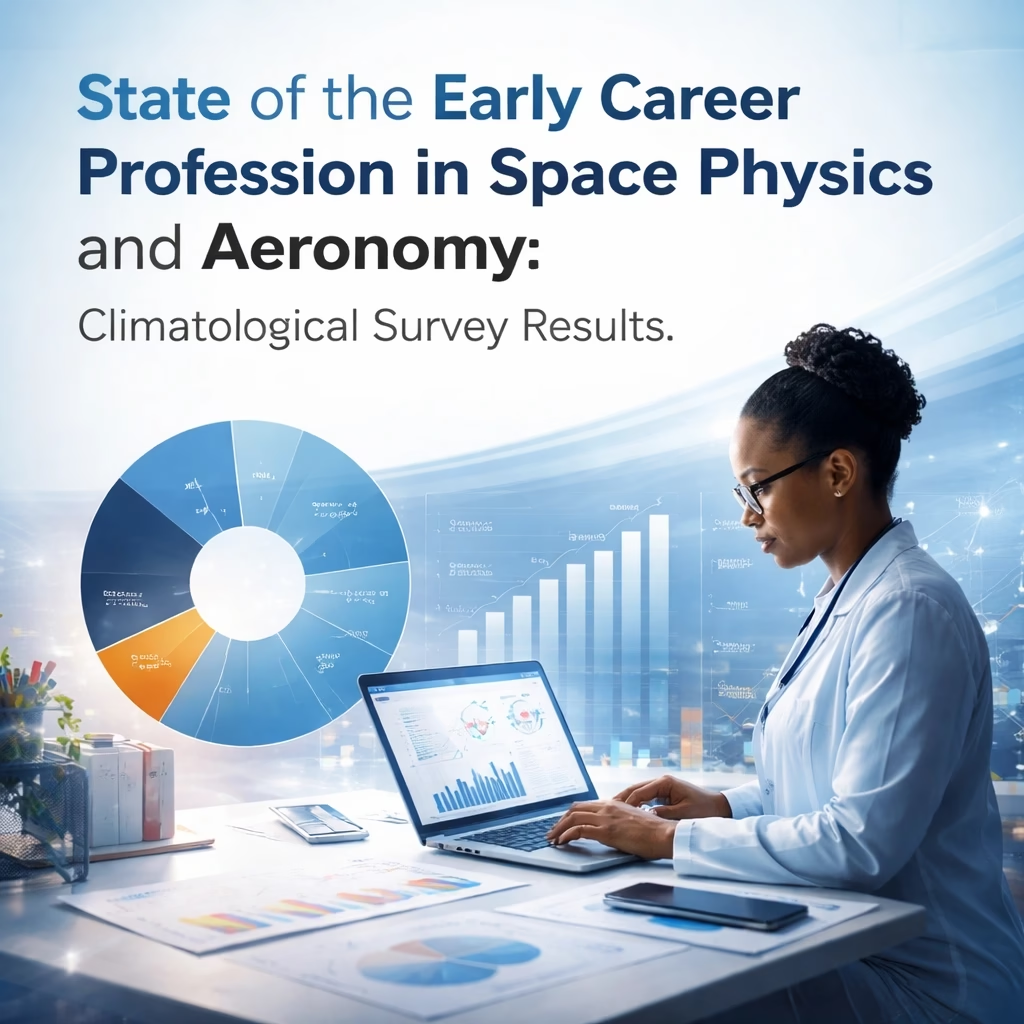
State of the Early Career Profession in Space Physics and Aeronomy: Climatological Survey Results

Impact

These changes significantly impact early-career professionals. Graduates entering the field now need a broader skillset than ever before. Beyond traditional expertise in plasma physics and atmospheric science, proficiency in data science, programming (particularly Python and R), and numerical modeling is becoming increasingly essential. The increased demand for AI-driven analysis tools means that professionals comfortable with these technologies are highly sought after. Furthermore, the need for rapid response to space weather events is creating opportunities for professionals specializing in real-time monitoring and forecasting. Career paths are also expanding beyond academia, with roles emerging in government agencies (like NOAA's Space Weather Prediction Center), private sector companies providing space-based services, and consulting firms advising on risk mitigation.

Skills Gap

A notable challenge identified by the survey is a growing skills gap. While universities are adapting their curricula, the pace of technological advancement often outstrips educational programs. Early-career professionals often require further training and on-the-job experience to fully meet the demands of the field. This is particularly true for expertise in advanced computational techniques and data interpretation.

What Next

Looking ahead, the field is poised for further growth. The planned launch of numerous new space-based observatories, including the European Space Agency’s Euclid mission and NASA’s planned heliophysics missions, will generate even more data and drive innovation. Increased focus on mitigating the economic and societal impacts of space weather is also expected to create new job opportunities. The development of more robust space weather forecasting models, incorporating improved understanding of the solar cycle and coronal mass ejections, will be a key priority. Furthermore, there’s a growing emphasis on educating the public and policymakers about the risks posed by space weather, leading to demand for professionals with strong communication and outreach skills.

Future Job Roles

Emerging job roles include Space Weather Data Scientists, AI-driven Forecasting Specialists, Space Weather Risk Analysts, and Space Weather Communicators. These roles demand a combination of scientific expertise, technical skills, and strong communication abilities.

Share This Article
Leave a Comment

Leave a Reply

State of the Early Career Profession in Space Physics and Aeronomy: Climatological Survey Results

Viral_X
By
Viral_X
8 Min Read
#image_title

A landmark "climatological survey" has delivered a stark assessment of the professional landscape for early-career researchers in Space Physics and Aeronomy (SPA). Released in late 2023 by a collaborative consortium of international scientific bodies, the comprehensive findings illuminate both the enduring passion and the significant systemic hurdles confronting the next generation of space scientists worldwide.

Background: Charting the Trajectory of Space Science Careers

The field of Space Physics and Aeronomy, encompassing the study of Earth's upper atmosphere, ionosphere, magnetosphere, and their interactions with the sun and solar system, is critical for understanding space weather, climate change, and future space exploration. Despite its importance, detailed, long-term data on early career progression has historically been fragmented.

Recognizing this gap, the International Space Research Association (ISRA), in partnership with the American Geophysical Union (AGU) and the European Geosciences Union (EGU), initiated the "Global Early Career SPA Climatological Survey" in 2018. The multi-year effort aimed to provide a robust, longitudinal dataset charting career paths, challenges, and demographic trends among SPA professionals within their first ten years post-PhD. Data collection concluded in mid-2023, involving over 4,500 respondents from more than 70 countries.

Professor Elena Petrova, co-chair of the survey steering committee from the University of Tokyo, emphasized the survey's ambition: "We wanted to move beyond anecdotal evidence. Understanding the 'climate' – the long-term trends and systemic pressures – is essential for fostering a healthy, innovative scientific community."

State of the Early Career Profession in Space Physics and Aeronomy: Climatological Survey Results

Key Developments: Unpacking the Survey’s Core Findings

The survey's report, titled "Navigating the Cosmos: A Decade in Early Career Space Physics," highlights several critical areas of concern, revealing a profession grappling with instability and inequality.

Precarious Employment and Funding Landscape

A significant finding points to the pervasive issue of precarious employment. Over 65% of respondents reported holding at least three short-term postdoctoral or fixed-term research positions before securing a more permanent role. The average time to a tenure-track or equivalent stable position was found to be 7.2 years post-PhD, a figure that has steadily increased by 15% over the last decade.

"The 'postdoc treadmill' is a real and exhausting challenge," stated Dr. Ben Carter, a lead author of the report from the National Space Science Center in Beijing. "Many feel trapped in a cycle of temporary contracts, constantly relocating and restarting, which impacts their ability to build long-term research programs or personal lives."

Access to independent funding also emerged as a major barrier. Only 18% of early-career researchers reported successfully securing a primary investigator (PI) grant within their first five years, with a pronounced disparity favoring those affiliated with well-established research institutions.

Diversity and Inclusion Gaps Persist

Despite increasing awareness and initiatives, the survey reveals persistent disparities in diversity and inclusion. While gender representation at the PhD level approaches parity (48% female respondents), a significant drop-off occurs at the senior postdoctoral and faculty levels, with female representation falling to 32% in stable academic positions.

Ethnic minority groups and individuals from developing nations reported facing additional systemic hurdles, including limited access to mentorship networks, fewer opportunities for international collaboration, and perceived biases in hiring and promotion processes. Geographically, North America and Western Europe continue to dominate funding and permanent positions, creating a 'brain drain' from other regions.

Work-Life Balance and Mental Well-being

The demanding nature of academic research, coupled with job insecurity, has taken a toll on mental well-being. Over 70% of respondents indicated experiencing moderate to high levels of stress and burnout. Concerns about work-life balance were particularly acute among those with family responsibilities, with 55% reporting that career demands negatively impacted their personal lives.

Professor Petrova noted, "The expectation of constant productivity, grant applications, and publications, often under tight deadlines, creates an unsustainable environment for many. We are seeing a significant attrition rate of talented individuals who simply cannot sustain this pace."

Impact: A Looming Threat to Scientific Progress

The implications of these findings are profound, threatening the long-term health and innovative capacity of the space physics community.

The high attrition rate of early-career professionals, particularly from underrepresented groups, means a loss of diverse perspectives and potential groundbreaking research. Talented individuals are increasingly opting for industry roles or leaving STEM fields entirely, leading to a potential "brain drain" from fundamental research.

"If we cannot retain our brightest young minds, the future of discovery in space physics is at risk," warned Dr. Carter. "Fewer innovative ideas, less diversity of thought, and a less resilient workforce will ultimately slow scientific progress and our ability to address critical global challenges like climate change and space weather hazards."

The survey also suggests that the current system disproportionately favors those with pre-existing advantages, such as strong institutional backing or personal networks, potentially stifling genuine meritocracy and hindering the emergence of truly novel research directions.

What Next: Charting a Course for Change

The consortium behind the survey has issued a series of recommendations aimed at addressing the identified challenges, urging immediate action from funding agencies, universities, and professional societies.

Policy Recommendations and New Initiatives

Key recommendations include: * Increased Funding for Early Career Grants: Dedicated, substantial grant programs specifically for researchers within their first seven years post-PhD, with a focus on independent research proposals.
* Clearer Career Pathways: Development of more transparent and stable career progression models, reducing reliance on successive short-term contracts.
* Enhanced Mentorship and Training: Implementation of formalized, high-quality mentorship programs and professional development training focused on grant writing, leadership, and work-life integration.
* Diversity and Inclusion Targets: Establishment of measurable targets and accountability mechanisms for improving representation at all career stages, alongside funding for initiatives supporting underrepresented groups.

Several organizations are already responding. The European Space Agency (ESA) recently announced a new "Aurora Fellowship" program, dedicating €50 million over five years to support 25 early-career researchers with five-year, independent research grants. Similarly, the AGU is launching a "Global Mentorship Network" in early 2024 to connect early-career scientists with experienced mentors across institutions.

"This report is not just a snapshot; it's a call to action," concluded Professor Petrova. "The future of space physics depends on our ability to nurture and retain the talent that will drive the next generation of discoveries. We must create an environment where passion for science can thrive, unburdened by systemic obstacles."

The consortium plans to conduct follow-up surveys every five years to track progress and adapt strategies, ensuring the space physics community remains vibrant and inclusive for decades to come.

Share This Article
Leave a Comment

Leave a Reply