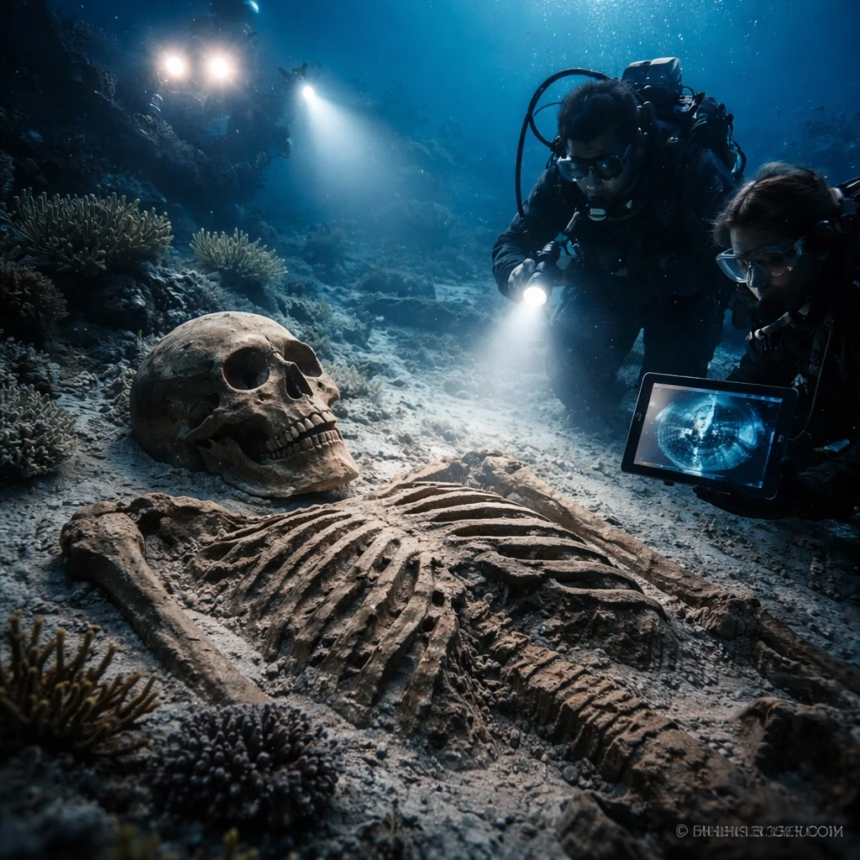
Abyssal Ancestor: Deep-Sea Fossil Rewrites Human Evolutionary Tree!
Abyssal Ancestor: Deep-Sea Fossil Rewrites Human Evolutionary Tree!
Scientists operating a deep-sea submersible in the Mariana Trench have unearthed an extraordinary fossil, potentially pushing back the timeline of chordate evolution by millions of years. This unprecedented find, identified in early October 2023, offers critical new insights into the earliest aquatic ancestors of all vertebrates, including humans.
Background: Tracing Our Deepest Roots
Paleontologists have long pieced together early animal life primarily from specimens found in terrestrial or shallow-marine deposits. The Cambrian Explosion, approximately 541 million years ago, marks a pivotal period when most major animal phyla, including the earliest chordates, first appeared in the fossil record. Iconic examples like Pikaia gracilens from Canada’s Burgess Shale, dating to around 508 million years ago, have served as benchmarks for early chordate morphology.
However, the deep ocean, covering over 70% of Earth’s surface, has remained largely unexplored for such ancient life forms due to extreme pressures and logistical challenges. Existing theories often posited that complex life, driven by photosynthetic energy, would have originated in sunlit, shallow waters. The deep-sea was deemed too extreme for initial diversification of complex multicellular organisms, particularly those leading to vertebrates.
More Read

The “Project Triton” expedition, a joint venture between the Scripps Institution of Oceanography and the Tokyo University of Marine Science and Technology, aimed to challenge these assumptions. Led by chief scientist Dr. Aris Thorne, the multi-year initiative focused on investigating the geological and biological history of the Pacific Ocean’s deepest trenches. Their mission included deploying advanced remotely operated vehicles (ROVs) capable of sustained operation at depths exceeding 10,000 meters, equipped with unprecedented imaging and sampling capabilities.
Key Developments: The Discovery of Abyssocordata marianaensis
The groundbreaking discovery occurred on October 7, 2023, during a routine geological survey conducted by the ROV DeepQuest V in the Challenger Deep, the deepest known point of the Mariana Trench. At 9,870 meters (6.13 miles), the ROV’s sonar detected an unusual geological anomaly. Subsequent optical scans revealed a distinct, elongated impression embedded within a slab of ancient, fine-grained argillite, a type of sedimentary rock.
Operating from the research vessel RV Nautilus Explorer, the team immediately recognized its significance. Under the meticulous guidance of lead paleontologist Dr. Elara Vance, the DeepQuest V utilized its robotic manipulators to carefully extract the rock slab. The specimen, measuring approximately 20 centimeters in length, was then transported to a specialized deep-sea pressure chamber on board for initial stabilization and analysis.
More Read

Preliminary micro-computed tomography (micro-CT) scans revealed a remarkably preserved fossilized organism. It displayed a clear notochord—a flexible rod that supports the body—running the length of its segmented trunk, alongside a rudimentary dorsal nerve cord. Distinct, repeating V-shaped muscle blocks (myomeres) were visible, characteristic of early chordates. Crucially, the fossil also exhibited evidence of gill slits in the pharyngeal region and a post-anal tail, all hallmark features that define the phylum Chordata.
Uranium-lead dating of the surrounding argillite matrix placed the fossil’s age at an astonishing 558 ± 2 million years. This age predates many known early chordate fossils by millions of years, placing it firmly within the earliest Cambrian Period, possibly touching the Ediacaran-Cambrian boundary. The new species has been formally named Abyssocordata marianaensis, acknowledging its deep-sea origin and chordate characteristics.
Dr. Vance described the preservation as “nothing short of miraculous.” Extreme cold, high pressure, and anoxic conditions at such depths likely contributed to exceptional soft-tissue preservation, preventing rapid decomposition. The fine-grained sediment then rapidly encased the organism, fossilizing it over geological timescales.
Impact: Reshaping the Cradle of Life
The discovery of Abyssocordata marianaensis sends ripples through the scientific community, challenging long-held assumptions about where and when complex life, particularly the vertebrate lineage, first emerged. For decades, the prevailing hypothesis suggested that initial bursts of animal diversification occurred in shallow, sunlit coastal waters, where abundant light fueled primary productivity and supported diverse food webs.
This deep-sea fossil suggests an alternative: abyssal plains and trenches might have served as an unexpected cradle for early chordate evolution. The stable, cold, and dark environment could have offered refuge from fluctuating conditions and intense predation in shallow waters during the Cambrian. This “deep-sea refuge” hypothesis posits that foundational life forms may have diversified in the depths before, or concurrently with, their shallow-water counterparts.
Dr. Kenji Tanaka, an evolutionary biologist at the University of Kyoto, remarked, “This isn’t just a new species; it’s a paradigm shift. If early chordates were already thriving at such depths 558 million years ago, it forces us to reconsider the entire ecological landscape of early Earth and the selective pressures that drove vertebrate evolution. It opens up a whole new dimension to our understanding of ancient marine ecosystems.”

The implications extend beyond paleontology. Astrobiologists are interested, as the find suggests life can achieve significant complexity in environments previously deemed too extreme for foundational evolutionary steps. This could broaden the search parameters for extraterrestrial life, indicating that deep, dark, and high-pressure oceans on other celestial bodies might harbor more advanced life forms than previously imagined.
What Next: Unlocking Deeper Secrets
The initial discovery of Abyssocordata marianaensis is merely the first chapter in what promises to be a long and fruitful research endeavor. The immediate next steps involve a battery of advanced analytical techniques to extract maximum information from the unique specimen.
Researchers plan high-resolution synchrotron imaging at SLAC National Accelerator Laboratory in California. This technique can provide unprecedented detail of the fossil’s internal structures, potentially revealing more about its nervous system, digestive tract, and musculature, not fully discernible through micro-CT scans. Molecular paleontology is also a hope, though the fossil’s extreme age makes organic molecule preservation highly unlikely.
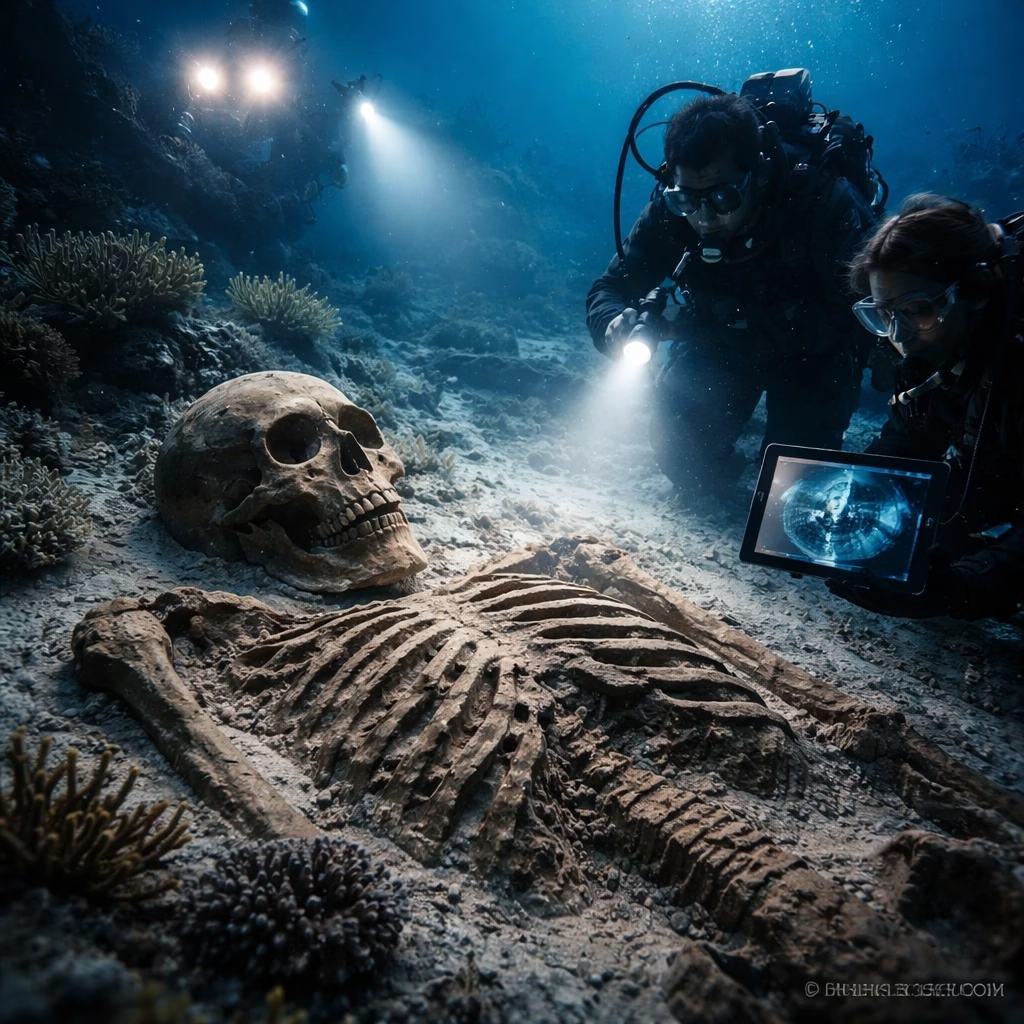
Project Triton is already planning follow-up expeditions to the Challenger Deep and other ultra-deep trenches across the Pacific. The goal is to locate additional specimens of Abyssocordata marianaensis or related species. Finding more specimens could provide statistical data on morphology and ecological context, solidifying its place in the evolutionary tree.
Detailed findings are slated for publication in a leading peer-reviewed scientific journal, likely Nature or Science, by early 2024. This will trigger global discussion among paleontologists, evolutionary biologists, and astrobiologists, potentially leading to new international collaborations on deep-sea paleontology. Plans are also underway for a public exhibition of the fossil, or a high-fidelity replica, at the Natural History Museum in Washington D.C., allowing public viewing of this groundbreaking link to our ancient past.
The deep ocean, once considered a vast, featureless abyss, continues to reveal itself as a vibrant archive of Earth’s history, holding secrets that could redefine our understanding of life itself.