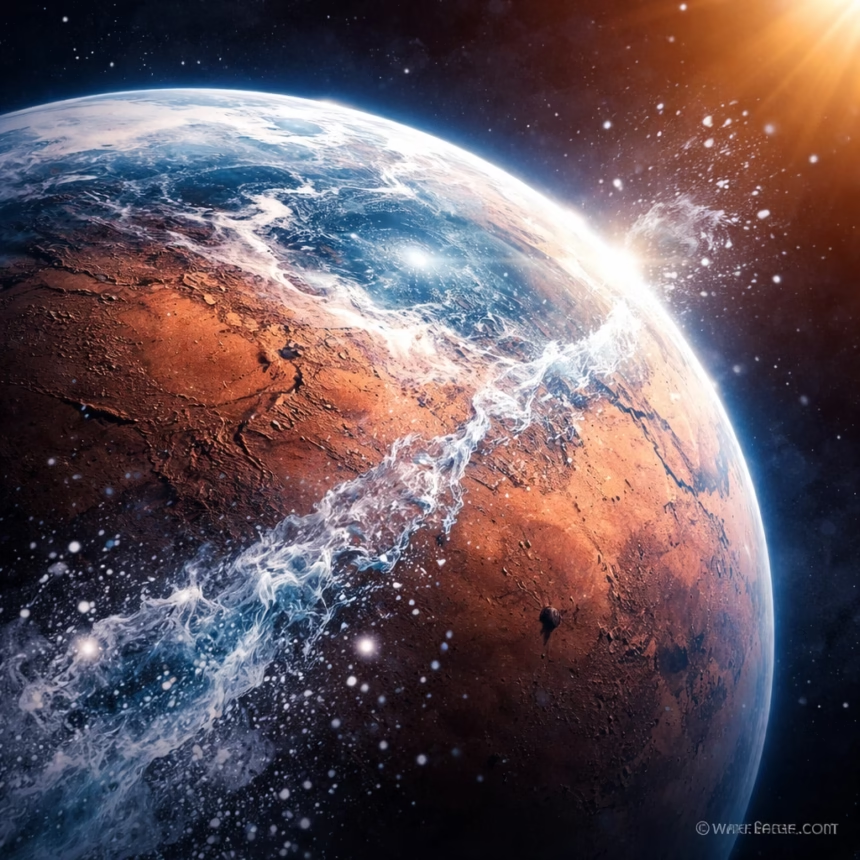
Recent scientific findings reveal that Mars is losing water to space at a much faster rate and through mechanisms previously unaccounted for, particularly during specific seasons and dust storm events. This discovery, primarily leveraging data from the European Space Agency's (ESA) ExoMars Trace Gas Orbiter (TGO), challenges long-held assumptions about the Red Planet's desiccation process. The new insights, published in prominent scientific journals, indicate water vapor is reaching higher altitudes in the Martian atmosphere than anticipated, accelerating its escape into interplanetary space.
Background: A Planet’s Vanishing Oceans
Mars once harbored vast oceans, rivers, and lakes, a period estimated to have lasted for hundreds of millions of years during its early history, roughly 4 billion years ago. Evidence for this ancient wet epoch comes from geological features like dried-up riverbeds, mineral deposits, and sedimentary rocks observed by various Mars orbiters and rovers, including NASA's Curiosity and Perseverance. Over eons, as Mars lost its protective magnetic field, its atmosphere thinned, and much of its surface water either froze into polar ice caps and subsurface reservoirs or escaped into space.
For decades, scientists understood that solar radiation, particularly ultraviolet light, breaks down water molecules (H2O) in the upper atmosphere into hydrogen and oxygen atoms. The lighter hydrogen atoms, with less gravitational pull, then slowly drift away into space. This process has been a cornerstone of models explaining Mars's transition from a water-rich world to the arid planet it is today. Missions like NASA's Mars Atmosphere and Volatile Evolution (MAVEN) spacecraft have been crucial in quantifying this atmospheric escape, focusing on the upper atmosphere and the role of solar wind stripping.
Previous observations, including those from ESA's Mars Express orbiter and its SPICAM instrument, confirmed the presence of water vapor in the lower atmosphere, primarily confined below 60 kilometers. The general consensus was that the cold "cold trap" at the mesopause (around 80-90 kilometers altitude) effectively prevented significant amounts of water from rising higher, thus limiting its exposure to the solar UV radiation that drives atmospheric escape.
Key Developments: Water’s Uncharted Ascent
The paradigm began to shift with data from the ExoMars Trace Gas Orbiter (TGO), which arrived at Mars in 2016. TGO's Atmospheric Chemistry Suite (ACS) instrument, designed to precisely measure atmospheric composition, provided unprecedented insights into the vertical distribution of water vapor.
More Read

High-Altitude Water Vapor
Contrary to expectations, TGO's ACS data revealed that water vapor can reach altitudes exceeding 80 kilometers, sometimes even up to 120 kilometers, during specific Martian seasons. This finding directly contradicts the "cold trap" theory, which suggested a much lower ceiling for water vapor. At these extreme altitudes, water molecules are far more susceptible to photodissociation by solar ultraviolet radiation, leading to a much more efficient escape of hydrogen atoms into space.
The Role of Seasons and Dust Storms
Scientists identified a strong correlation between this elevated water vapor and two key factors: the Martian southern hemisphere summer and global dust storms. During southern summer, Mars's orbit brings it closer to the Sun, leading to warmer surface temperatures and more vigorous atmospheric circulation. This increased thermal energy appears to be strong enough to overcome the cold trap effect, lofting water vapor to unprecedented heights.
Furthermore, observations during the massive 2018 global dust storm provided critical evidence. During this event, which engulfed the entire planet for several months, TGO detected a dramatic increase in water vapor at high altitudes. Dust particles, known to absorb solar radiation and warm the atmosphere, seem to act as an "elevator" for water. As dust storms heat the lower atmosphere, they create stronger updrafts that carry water vapor much higher than usual, bypassing the cold trap and making it vulnerable to solar radiation.
More Read

New Escape Pathways
These findings suggest new, more efficient pathways for water loss from Mars. Instead of a slow, steady leakage, the planet experiences episodic "bursts" of water escape, particularly during its warm, dusty seasons. This revised understanding implies that the rate of water loss could be significantly higher than previously estimated, especially when factoring in the frequency and intensity of Martian dust storms throughout its history.
Impact: Reshaping Martian History and Future
The implications of these discoveries are far-reaching, affecting our understanding of Mars's past, present, and potential future.
Revisiting Martian Desiccation Models
The accelerated water loss mechanisms necessitate a re-evaluation of models detailing how Mars lost its ancient oceans. If water escaped at a faster rate due to these newly identified processes, it means the planet may have dried up more quickly than previously thought. This impacts theories about the duration of Mars's habitable period and the windows of opportunity for life to emerge and thrive.
Challenges for Future Human Missions
For future human missions to Mars, water is an invaluable resource, essential for drinking, oxygen production, and rocket fuel. While vast amounts of water ice exist at the poles and beneath the surface, a more rapid loss rate from the atmosphere underscores the preciousness of this resource. Accurate knowledge of atmospheric water dynamics is crucial for planning resource utilization strategies and understanding the overall water cycle on Mars.
Comparative Planetology
These findings also offer valuable insights into comparative planetology, helping scientists understand how other planets, especially exoplanets, evolve and lose their atmospheres. The mechanisms observed on Mars could be at play in other planetary systems, informing our search for habitable worlds beyond our own. Understanding these processes helps predict which exoplanets might retain water over geological timescales.

What Next: Deeper Insights and Future Exploration
The scientific community is now focused on refining atmospheric models to incorporate these new findings and further quantify the total water loss from Mars.
Continued Orbiter Observations
Ongoing observations from TGO, MAVEN, and other orbiters will be critical. Future data collection will aim to track the precise altitudes and quantities of water vapor during different seasons, dust storm intensities, and solar activity levels. This will help build a comprehensive picture of the Martian water cycle and its interaction with atmospheric dynamics.
Future Missions and Technologies
Future missions could involve dedicated instruments designed to specifically measure hydrogen escape rates more directly and with greater precision. Concepts for advanced atmospheric probes or even small, localized weather stations could provide ground-truth data on atmospheric circulation and water transport. Furthermore, missions focused on subsurface water ice mapping will complement atmospheric studies, providing a holistic view of Mars's remaining water inventory.
Refining Habitable Zone Definitions
The knowledge gained from Mars's water loss will contribute to refining the definition of a "habitable zone" around stars. Understanding the nuanced ways planets lose their water can help scientists better assess the long-term habitability of distant worlds, moving beyond simple distance-from-star criteria to include atmospheric escape mechanisms. The ongoing scientific endeavor promises to unlock more secrets of the Red Planet's watery past and its arid present.