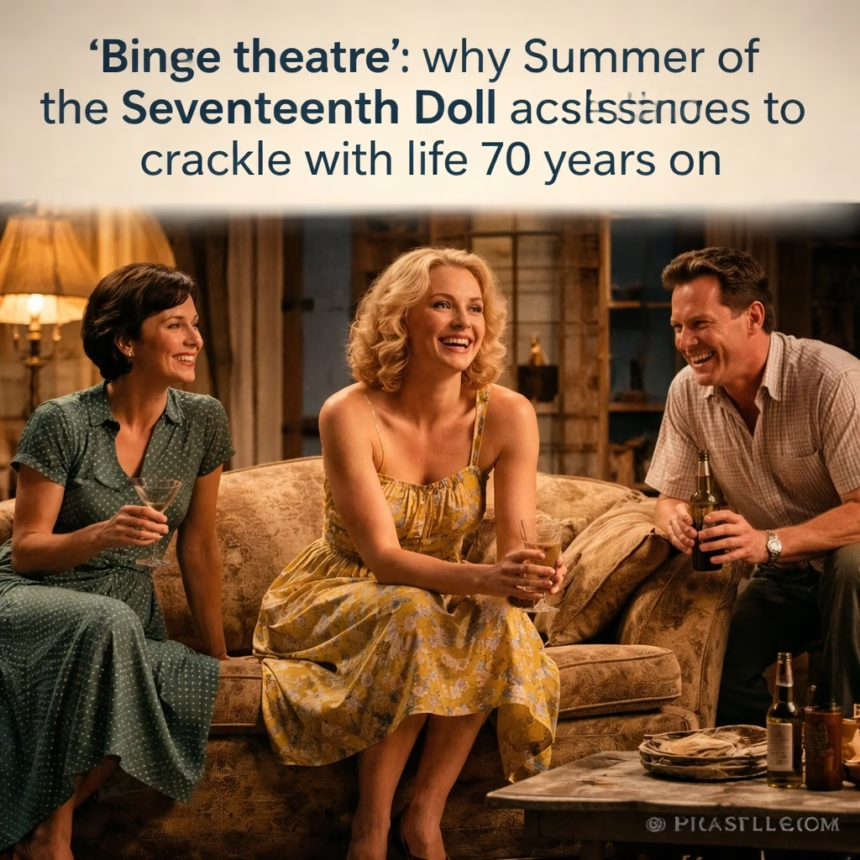
Seventy years after its groundbreaking premiere, Ray Lawler's "Summer of the Seventeenth Doll" continues to captivate audiences and artists across Australia. This enduring Australian classic, first staged in 1955, remains a poignant exploration of identity, disillusionment, and the fading of an era, solidifying its status as a cornerstone of the nation's theatrical landscape. Its perennial relevance invites a form of "binge theatre," where each new production offers fresh insight into its timeless themes.
Background: The Play That Defined a Nation
“Summer of the Seventeenth Doll,” often affectionately known as “The Doll,” premiered on 28 November 1955 at the Union Theatre in Melbourne. Penned by then-unknown actor Ray Lawler, the play was an immediate sensation, marking a pivotal moment in Australian theatre history. Before “The Doll,” Australian stages were largely dominated by imported British and American works, or local plays that often felt derivative. Lawler’s work broke this mould, presenting a distinctly Australian voice, characters, and vernacular that resonated deeply with local audiences.
The narrative unfolds during the annual summer lay-off of two Queensland cane cutters, Roo and Barney. For 16 years, they have spent their off-season in a Melbourne inner-city terrace with their girlfriends, Olive and Nancy. Each year, Roo brings Olive a new kewpie doll, a symbol of their unconventional, carefree existence. However, as the play opens, Nancy has married, and Pearl, a barmaid, is introduced as Barney's new companion. The "seventeenth doll" becomes a poignant symbol of a tradition that can no longer sustain itself, forcing the characters to confront the harsh realities of ageing, changing social norms, and the erosion of their youthful dreams.
Lawler masterfully wove themes of mateship, the Australian male identity, female independence, and the stark contrast between romanticised ideals and grinding reality. Set in post-World War II Australia, a period of rapid industrial growth and shifting societal expectations, the play captured the spirit of a nation grappling with its identity. Its raw honesty and authentic portrayal of working-class life, complete with its vernacular and emotional complexity, cemented its status as a theatrical landmark.
More Read

Key Developments: Reimagining a Classic for New Generations
Over the past seven decades, “Summer of the Seventeenth Doll” has seen countless revivals, each production offering a fresh lens on its well-trodden narrative. Its enduring popularity lies in its capacity for reinterpretation, allowing contemporary directors and actors to explore its universal themes through a modern sensibility. Recent years have witnessed a resurgence of interest, particularly as the play approaches its 70th anniversary.
A notable 2019 production by the Melbourne Theatre Company, directed by Sarah Goodes, garnered critical acclaim for its nuanced approach. Goodes’ staging subtly highlighted the play's underlying feminist currents, emphasizing Olive and Pearl’s agency and the limitations placed upon them by societal expectations and their partners' fading dreams. This interpretation brought a fresh perspective to Olive's fierce independence and Pearl's pragmatic realism, moving beyond purely patriarchal readings.
Similarly, a 2022 staging by the State Theatre Company of South Australia focused on the economic anxieties underpinning the characters' lives. The cane cutters' struggle to maintain their seasonal work, and the women's reliance on their annual visits, were presented against a backdrop of increasing industrialisation and a changing economy. This allowed audiences to connect the historical context to contemporary concerns about job security and the pursuit of a stable life.
More Read

The concept of "binge theatre" applies uniquely to "The Doll." While not a multi-part series, its profound impact and the depth of its characterisations invite audiences to return to it repeatedly, much like re-watching a beloved show. Each viewing, particularly across different productions, reveals new layers of meaning, subtle shifts in performance, and evolving interpretations that deepen appreciation for Lawler's masterful script. This continuous engagement transforms the single play into an ongoing cultural conversation, a series of evolving insights into the Australian psyche.
Impact: A Mirror to the Australian Soul
“The Doll” has profoundly shaped Australian culture, serving as a powerful mirror reflecting the nation’s evolving identity. Its impact extends far beyond the stage, influencing literature, film, and the broader understanding of what it means to be Australian. For many, it remains the quintessential Australian play, a benchmark against which others are measured.
Shaping National Identity
The play’s unflinching portrayal of Australian mateship, resilience, and the disillusionment of the “great Australian dream” resonated deeply with audiences in 1955 and continues to do so today. It captured a specific moment in time but presented universal truths about human nature, particularly the struggle to reconcile youthful idealism with the realities of adulthood. Its characters, from the proud, declining Roo to the fiercely independent Olive, have become archetypes in the national consciousness.
Educational Cornerstone
“The Doll” holds a prominent place in Australian educational curricula, from high school English and drama studies to university-level theatre courses. Generations of students have studied its themes, structure, and historical significance, ensuring its continued relevance and introducing its power to new audiences. This academic engagement helps demystify the play’s historical context while highlighting its enduring literary and dramatic merit.
Influence on Artists
For actors and directors, “The Doll” presents both a challenge and an honour. Taking on these iconic roles requires a deep understanding of Australian history and character, while directing it demands a fresh vision that respects its legacy yet speaks to contemporary audiences. Many prominent Australian theatre practitioners have, at some point, engaged with “The Doll,” contributing to its ongoing artistic evolution and securing its place as a rite of passage in Australian theatre. Its complex emotional landscape and rich dialogue provide fertile ground for powerful performances and innovative staging.
What Next: The Seventieth Doll and Beyond
As “Summer of the Seventeenth Doll” approaches its 70th anniversary in 2025, anticipation is building for celebratory productions and analyses that will undoubtedly re-examine its legacy. Major theatre companies across Australia are expected to stage significant revivals, likely inviting new interpretations that reflect the nation’s current social and political landscape.

Anniversary Celebrations
The 70th anniversary will not just be a moment for reflection but also for renewed engagement. Expect academic conferences, public forums, and special media features exploring the play’s historical impact and contemporary relevance. These events will undoubtedly draw connections between the characters’ struggles and modern issues such as economic uncertainty, changing gender roles, and the search for identity in a rapidly evolving world.
Enduring Legacy and Adaptations
The play’s enduring power suggests that its story will continue to be told and reinterpreted for generations to come. While film adaptations have existed, the possibility of new screen versions – perhaps a limited television series exploring the characters’ backstories or futures – remains an intriguing prospect. Such adaptations could broaden its reach, introducing “The Doll” to a global audience accustomed to complex, character-driven narratives.
Ray Lawler's masterpiece is more than just a play; it is a living document of Australian culture, a narrative that continues to resonate because its core themes are universal. The "seventeenth doll" may have marked the end of an era for Roo and Olive, but for Australian theatre, it signifies an enduring beginning, a classic that promises to crackle with life for many decades to come. Its ability to draw audiences back, time and again, confirms its status as the ultimate Australian "binge theatre" experience.