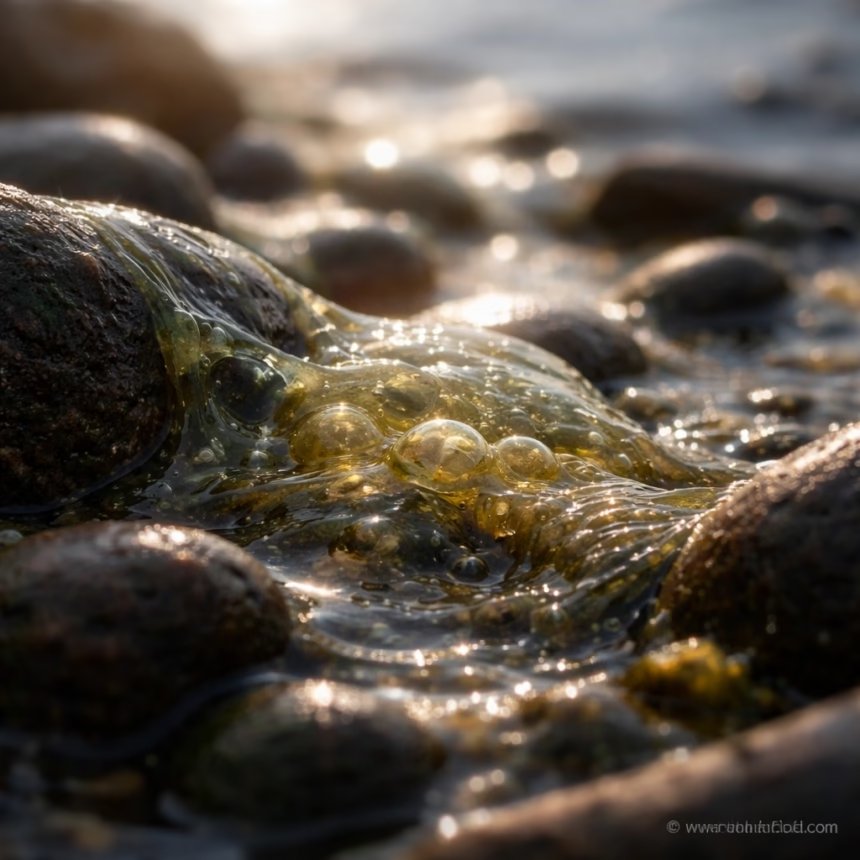
A groundbreaking theory is challenging the long-held "primordial soup" model for the origin of life on Earth. Scientists now propose that the first biological molecules, and perhaps even early protocells, may have formed not in vast oceans but as concentrated, sticky films clinging to mineral surfaces. This hypothesis offers a compelling new narrative for abiogenesis, focusing on specific geological conditions prevalent billions of years ago.
Background: From Soup to Surfaces
For decades, the prevailing scientific consensus on the origin of life, known as the Oparin-Haldane hypothesis, suggested that life emerged from a "primordial soup." This concept envisioned a vast, warm ocean rich in organic molecules, formed spontaneously from inorganic compounds under early Earth's atmospheric conditions. The iconic Miller-Urey experiment in 1953 provided early experimental support, demonstrating that amino acids could indeed form from a mixture of water, methane, ammonia, and hydrogen exposed to electrical sparks, simulating lightning.
However, the primordial soup model has faced persistent challenges. A significant hurdle is the "dilution problem": how could essential organic molecules, even if formed, concentrate sufficiently in a vast ocean to react and polymerize into complex structures like proteins and nucleic acids? Chemical reactions require high concentrations of reactants, a condition difficult to achieve in an open body of water. Furthermore, forming long polymers typically requires energy input and specific environmental conditions that promote dehydration, which is difficult in an aqueous environment.
Alternative theories began to emerge in the late 20th century. The discovery of hydrothermal vents in the deep sea in the 1970s, particularly the "black smokers," offered a new potential cradle for life. These vents provide chemical gradients, energy, and mineral surfaces. Simultaneously, researchers like Graham Cairns-Smith in the 1980s proposed that clay minerals could act as templates for early genetic material, a concept that foreshadowed the current focus on mineral surfaces. These ideas laid the groundwork for a more nuanced understanding of where and how abiogenesis might have occurred, shifting the focus from homogeneous solutions to heterogeneous environments.
Key Developments: The Rise of Mineral-Based Abiogenesis
Recent scientific advancements have significantly bolstered the "sticky goo" hypothesis, moving it from speculative theory to a robust area of experimental research. Researchers are now actively demonstrating how mineral surfaces could have facilitated the critical steps in abiogenesis.

Mineral Catalysis and Concentration
A central advantage of mineral surfaces is their ability to act as both catalysts and concentrators. Experiments conducted at institutions like the Max Planck Institute for Astronomy and University College London have shown that various minerals, including silicates, iron sulfides, and carbonates, can bind organic molecules, effectively concentrating them by orders of magnitude compared to a dilute solution. This concentration effect overcomes the "dilution problem" inherent in the primordial soup model. Furthermore, the charged surfaces of minerals can orient molecules in specific ways, promoting reactions that might otherwise be improbable in solution. For instance, studies have demonstrated the formation of short peptides (chains of amino acids) and even RNA precursors like nucleotides on mineral templates, with the minerals providing the necessary catalytic boost.
The Role of Wet-Dry Cycles
Another critical development is the emphasis on wet-dry cycles. While life is fundamentally aqueous, the formation of complex polymers often involves dehydration reactions. On early Earth, environments like tidal pools, volcanic springs, or even ancient lakebeds would have experienced cycles of wetting and drying. During dry phases, water evaporates, leaving behind concentrated organic molecules clinging to mineral surfaces. This concentration, combined with the energy input from drying, can drive the polymerization of monomers into longer chains. Upon re-wetting, these polymers can then fold or interact, potentially forming more complex structures. Experiments simulating these cycles have successfully produced longer RNA strands and more intricate lipid vesicles on mineral substrates.
More Read

Formation of Protocells
The hypothesis also provides a plausible mechanism for the formation of protocells – the earliest, simplest forms of cellular life. Lipid molecules, which form cell membranes, have been shown to self-assemble into vesicles (bubble-like structures) when subjected to wet-dry cycles on mineral surfaces. These vesicles can encapsulate other organic molecules, creating a distinct internal environment, a crucial step towards cellularization. The interaction with minerals can also stabilize these fragile early membranes, offering protection from harsh environmental conditions. The discovery of ancient microfossils in cherts dating back 3.5 billion years, showing evidence of biofilm-like structures, lends further geological support to the idea of life emerging in association with surfaces.
Impact: Reshaping Scientific Frontiers
The sticky goo hypothesis has far-reaching implications, influencing multiple scientific disciplines and even our philosophical understanding of life.
Astrobiology and the Search for Extraterrestrial Life
Perhaps the most significant impact is on astrobiology. If life on Earth began on mineral surfaces in specific microenvironments rather than in vast oceans, it fundamentally alters the search for life beyond Earth. Astrobiologists are now increasingly focused on identifying planetary bodies with evidence of ancient or current mineral-rich environments, especially those that might have experienced wet-dry cycles. Mars, with its ancient lakebeds and diverse mineralogy, becomes an even more compelling target. Moons like Europa and Enceladus, with their subsurface oceans interacting with rocky cores, also present intriguing possibilities for surface-catalyzed reactions at hydrothermal vents. Future missions will likely prioritize detailed mineralogical mapping and the search for complex organic molecules in association with specific rock types.
Origin of Life Research
Within the origin of life research community, this theory has spurred new experimental designs and theoretical frameworks. Scientists are now exploring a wider range of mineral types, varying environmental conditions, and the complex interplay between geology and early biochemistry. It encourages interdisciplinary collaboration between geologists, chemists, biologists, and physicists, bringing diverse expertise to solve one of science's most profound mysteries. The focus shifts from merely identifying building blocks to understanding the physical and chemical processes that assembled them into living systems.
Public Understanding and Philosophical Implications
For the public, the sticky goo hypothesis offers a more tangible and perhaps less abstract narrative for life's origins than the "primordial soup." It paints a picture of life slowly coalescing on the very fabric of the early Earth. Philosophically, it reinforces the idea that life is not an isolated phenomenon but deeply intertwined with its geological context, emerging from the complex interactions between organic chemistry and planetary processes. It further blurs the line between non-living matter and biological systems, offering a more continuous spectrum of evolution from geochemistry to biochemistry.
What Next: Milestones on the Path to Understanding
The sticky goo hypothesis is a vibrant area of ongoing research, with several key milestones expected in the coming years that will further refine and validate its tenets.
More Read

Advanced Experimental Validation
A primary focus will be on achieving more complex steps in abiogenesis under simulated early Earth conditions. Researchers aim to demonstrate the surface-catalyzed formation of self-replicating RNA molecules, a critical step towards a functional genetic system. Efforts will also concentrate on evolving protocells with rudimentary metabolic capabilities on mineral surfaces, bridging the gap between simple chemical reactions and true biological function. This will involve more sophisticated laboratory setups that can precisely control temperature, pH, mineral composition, and wet-dry cycling.
Geochemical and Astrobiological Exploration
Geologists will continue to analyze ancient Earth rocks for signatures consistent with surface-catalyzed abiogenesis. This includes searching for specific mineral assemblages and organic residues within ancient sedimentary environments that could have harbored these processes. Astrobiological missions will increasingly target mineral-rich regions on other planetary bodies. NASA's Perseverance rover on Mars, for example, is already collecting samples from ancient lakebeds and river deltas, which could contain evidence of past organic concentration on mineral surfaces. Future missions to icy moons like Europa and Enceladus will prioritize sampling material from their subsurface oceans and associated hydrothermal vents, seeking similar geochemical fingerprints.
Computational Modeling and Interdisciplinary Synthesis
The development of advanced computational models will play a crucial role. These models can simulate molecular interactions at mineral interfaces with unprecedented detail, predicting which molecules are most likely to bind, react, and polymerize under various conditions. This will guide experimental design and help interpret complex results. Furthermore, increased interdisciplinary collaboration will be essential. By integrating insights from geology, chemistry, physics, and biology, scientists hope to construct a comprehensive, testable model for the emergence of life that accounts for both the chemical reactions and the geological context in which they occurred. The ultimate goal is to move closer to a unified theory of abiogenesis that explains how inanimate matter transitioned into the first living systems on Earth and potentially elsewhere in the cosmos.