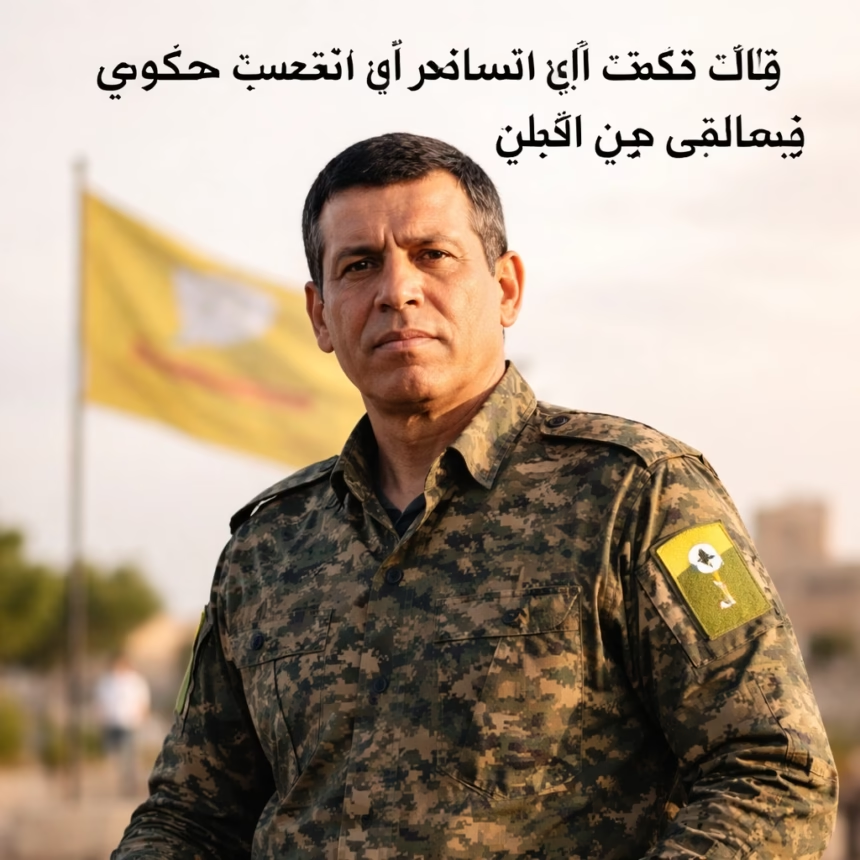
Shockwave in Syria: SDF Commander Mazloum Abdi Rejects Government Role, Pledges Allegiance to His Community
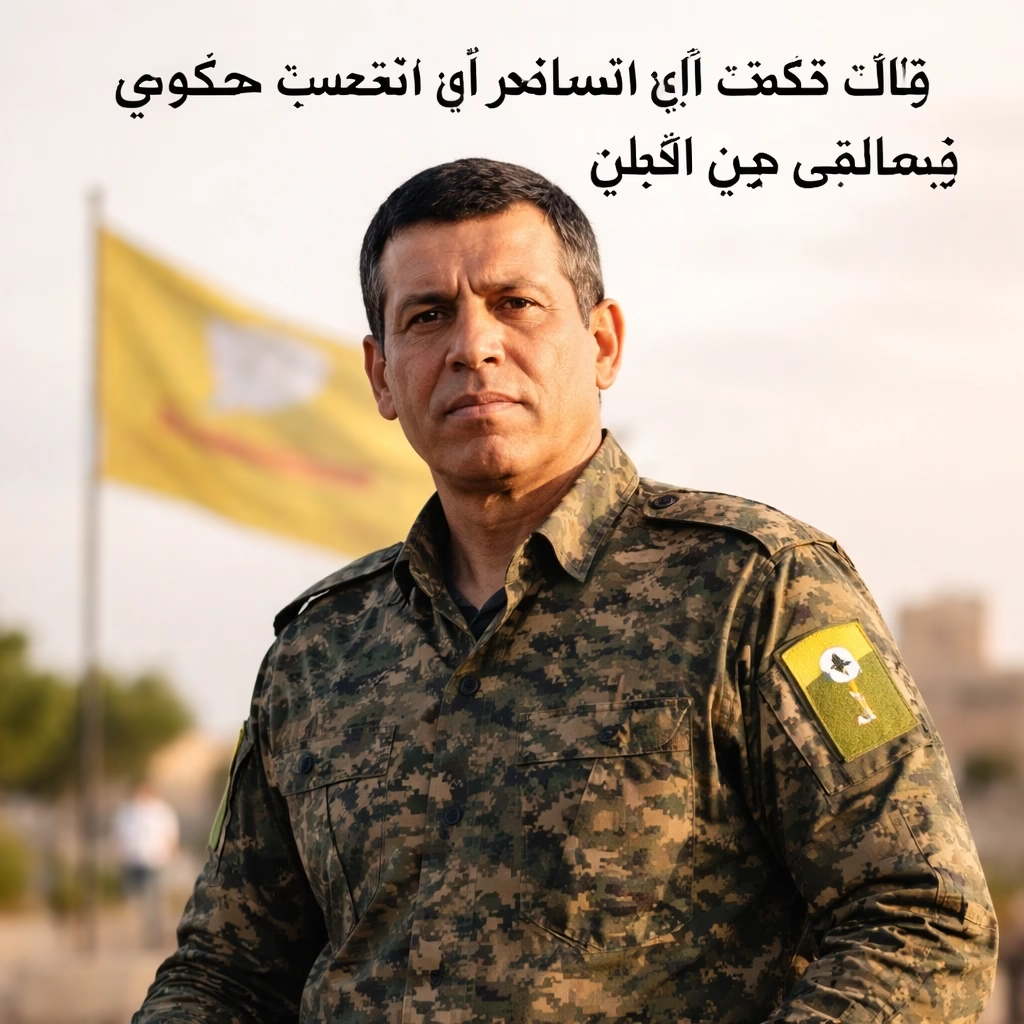
General Mazloum Abdi, the influential Commander-in-Chief of the Syrian Democratic Forces (SDF), has publicly declared his refusal to accept any governmental position within a future Syrian administration, asserting his commitment to remain among his people in northeastern Syria. This significant statement, widely reported, has sent ripples through the complex Syrian political landscape, redefining expectations for the region's future.
Abdi's firm stance underscores the deep-seated aspirations for self-governance within the Autonomous Administration of North and East Syria (AANES), challenging traditional notions of centralized authority and potentially complicating ongoing negotiations for a unified Syrian state.
Background: A Decade of Conflict and Autonomy
The Syrian Democratic Forces (SDF) emerged as a formidable military and political entity during the Syrian civil war, playing a pivotal role in the global fight against ISIS. Formed in October 2015, the SDF is a multi-ethnic, multi-religious alliance, predominantly Kurdish, with significant Arab, Syriac, and other minority components. Under the leadership of General Mazloum Abdi, also known by his nom de guerre Kobani, the SDF became the primary ground force partnered with the U.S.-led Global Coalition to Defeat ISIS.
The SDF liberated vast swathes of territory from ISIS control, including key cities like Raqqa, the former de facto capital of the extremist group's self-proclaimed caliphate, and Baghouz, its final territorial stronghold in March 2019. This military success allowed for the establishment of the Autonomous Administration of North and East Syria (AANES), often referred to as Rojava, which governs approximately one-third of Syria's landmass and significant oil resources.
The relationship between the SDF/AANES and the Syrian central government in Damascus has been characterized by a delicate balance of indirect communication, occasional clashes, and protracted, often stalled, negotiation attempts. Damascus views the SDF as an separatist force, while the SDF seeks a decentralized, democratic Syria that recognizes the rights and autonomy of its diverse populations, particularly the Kurdish community, which has historically faced marginalization.

Turkey, a NATO member and neighbor to Syria, considers the dominant Kurdish People's Protection Units (YPG) within the SDF as an extension of the Kurdistan Workers' Party (PKK), designated a terrorist organization by Turkey, the U.S., and the EU. This perception has led to multiple Turkish military incursions into northern Syria, including operations "Euphrates Shield" (2016), "Olive Branch" (2018), and "Peace Spring" (2019), targeting SDF-held areas and displacing hundreds of thousands.
Key Developments: A Clear Rejection of Central Authority
General Abdi's recent declaration, asserting his unwillingness to accept any position within a Syrian government, marks a significant moment in the ongoing Syrian crisis. This statement comes at a critical juncture, as regional dynamics shift and international actors re-evaluate their engagement with Syria.
The Nuance of the Statement
Abdi’s statement is not merely a personal preference but a strategic political message. By explicitly rejecting a “governmental position,” he appears to be drawing a clear line between his leadership of the SDF and AANES, and any potential role within the existing or a future centralized Syrian state apparatus. This reinforces the SDF’s long-standing demand for a decentralized political solution that grants substantial autonomy to the regions under its control.
More Read

His pledge to “remain among his people” further solidifies his image as a grassroots leader deeply embedded within the community he serves. This commitment contrasts sharply with the traditional Syrian political model, where power is highly centralized in Damascus. It suggests that his authority and legitimacy derive from the people of northeastern Syria, rather than from a national appointment.
Timing Amidst Shifting Sands
The timing of Abdi’s declaration is crucial. Syria has recently seen renewed diplomatic activity, including its reintegration into the Arab League, signaling a potential shift in regional approaches to the conflict. Discussions about a political resolution, constitutional reform, and the future of Syrian governance are ongoing, often with Russian and Iranian mediation. Abdi’s statement could be interpreted as a pre-emptive move to shape the parameters of these discussions, ensuring that the aspirations of northeastern Syria are not overlooked in broader political bargaining.
Furthermore, the statement comes as the U.S. maintains a military presence in northeastern Syria, primarily focused on counter-ISIS operations and supporting the SDF. Any perceived weakening of the SDF’s resolve or a move towards full integration with Damascus could complicate Washington’s strategy in the region.
Impact: Reshaping the Syrian Political Map
General Abdi's declaration has immediate and far-reaching implications for various stakeholders, influencing the trajectory of the Syrian conflict and the future of its diverse regions.
For the SDF and AANES
This statement unequivocally strengthens the position of the Autonomous Administration of North and East Syria. It reinforces the leadership’s commitment to the region’s self-governance project and signals a firm stance against full reintegration under Damascus’s centralized authority without significant concessions. It could bolster the morale of the local population who have invested in the AANES’s democratic and multi-ethnic governance model, offering reassurance against fears of a return to pre-2011 conditions.
More Read

For the Syrian Government in Damascus
Abdi’s rejection presents a significant hurdle for Damascus’s stated goal of regaining full control over all Syrian territory. It suggests that military solutions or forced reintegration might face even greater resistance. The Syrian government will likely need to reconsider its approach to negotiations with the AANES, potentially requiring more flexible proposals regarding decentralization, resource sharing, and local administration.
For the United States and the Global Coalition
For the U.S., Abdi’s stance aligns with its strategy of maintaining a stable, capable partner in northeastern Syria for ongoing counter-terrorism operations against ISIS remnants. A strong, autonomous SDF leadership, committed to its region, ensures the continuity of these efforts. The statement might also be seen as a reaffirmation of the SDF’s independence, which is vital for U.S. policy in the region amidst complex geopolitical rivalries.
For Turkey and Regional Powers
Turkey’s security concerns regarding the SDF remain unchanged, as its focus is on the YPG’s alleged links to the PKK. However, Abdi’s emphasis on local commitment rather than national political ambition might subtly shift the narrative. For Russia and Iran, key allies of the Syrian government, the statement adds another layer of complexity to their efforts to broker a comprehensive political settlement for Syria, potentially requiring them to exert more pressure on Damascus to engage meaningfully with AANES demands.
For the Local Population
The declaration offers a sense of stability and continuity for the millions living under AANES control. It signals that their leader is committed to their well-being and the future of their self-administration, rather than pursuing personal power within a potentially hostile central government. This can foster greater trust and legitimacy for the local governance structures.
What Next: Navigating a Fractured Future
General Mazloum Abdi's declaration sets a clear tone for the immediate future of northeastern Syria and its relationship with the broader Syrian state. The path ahead will be defined by a series of critical negotiations, evolving regional dynamics, and the steadfast pursuit of local governance.
Continued Negotiations and Dialogue
Despite the firm rejection of a central government post, dialogue between the AANES and Damascus is expected to continue, likely mediated by international actors, primarily Russia. These negotiations will now have a clearer parameter set by Abdi: any resolution must respect the autonomous nature of northeastern Syria and not demand its leadership’s assimilation into the existing state structure. Discussions will likely focus on administrative powers, resource sharing, border control, and security arrangements.
The Enduring U.S. Presence
The U.S. military presence in northeastern Syria, though relatively small, remains a critical factor. Its continued support for the SDF is vital for counter-ISIS operations and provides a degree of protection against external threats. Abdi’s statement reinforces the rationale for this presence, as it underscores the SDF’s commitment to stability and its independent role in fighting terrorism, rather than being a component of a centralized Syrian government. Any significant shift in U.S. policy would dramatically alter the region’s security landscape.
Regional Geopolitics and Turkish Actions
Turkey’s stance on the SDF remains a significant variable. While Abdi’s statement focuses on internal Syrian dynamics, it does not alleviate Turkish security concerns. Future Turkish military actions, either direct or through proxy forces, cannot be ruled out, especially if Ankara perceives a weakening of U.S. resolve or an opportunity to expand its “safe zones” in northern Syria. Regional powers like Russia and Iran will also continue to exert influence, seeking to balance their interests with those of Damascus and other stakeholders.
Consolidation of Self-Administration
In the absence of a comprehensive political settlement with Damascus, the Autonomous Administration of North and East Syria is likely to continue consolidating its governance structures, developing its institutions, and strengthening its social contract with the local population. This includes efforts in education, justice, economic development, and security, aiming to build a resilient and self-sufficient administration that can withstand external pressures and internal challenges.
Humanitarian and Reconstruction Challenges
The region continues to face immense humanitarian challenges, including the displacement of populations, the need for reconstruction, and the management of camps like Al-Hol, which houses tens of thousands of ISIS-linked individuals. Abdi’s focus on remaining with his people implies a continued commitment to addressing these pressing issues, which require international support and cooperation.
General Mazloum Abdi's declaration marks a definitive moment, signaling a deepening commitment to the principles of self-governance and decentralization in Syria. It clarifies the aspirations of millions in northeastern Syria and sets a complex course for future negotiations, ensuring that their voice remains central to any lasting resolution for the war-torn nation.