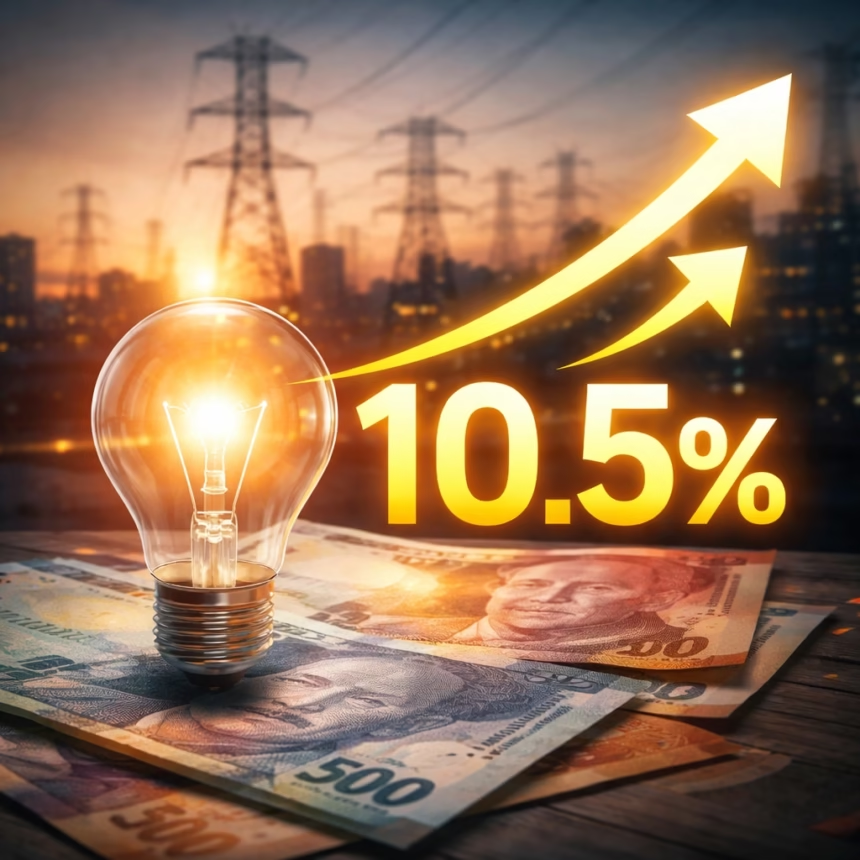
South Africa's Power Shockwave: Households and Businesses Brace for Double-Digit Electricity Hike
South Africa is reeling from the news of a significant 10.5% electricity price hike, set to impact consumers and businesses nationwide. This latest increase, approved by the National Energy Regulator of South Africa (NERSA), will take effect for Eskom's direct customers and municipalities from the upcoming financial year, adding further strain to an already struggling economy.
Background: A Decades-Long Energy Crisis
The announcement of the 10.5% electricity price increase is the latest chapter in South Africa's protracted energy crisis. At the heart of this crisis lies Eskom, the state-owned power utility responsible for generating approximately 95% of the nation's electricity. For decades, Eskom has been plagued by a confluence of issues, including severe financial mismanagement, rampant corruption, aging infrastructure, and inadequate maintenance.
Eskom's debt burden currently stands at hundreds of billions of Rands, a figure that continues to escalate despite government bailouts. This financial instability directly contributes to its inability to adequately invest in new generation capacity or maintain existing power plants, leading to chronic operational failures.

The most visible manifestation of Eskom's woes is load shedding – scheduled power cuts implemented to prevent a total collapse of the national grid. These power outages have become an unwelcome daily reality for millions of South Africans, disrupting daily life, crippling businesses, and stifling economic growth. Load shedding stages, ranging from Stage 1 (minimal cuts) to Stage 8 (up to 12 hours without power daily), have become a common lexicon in the country.
NERSA, established under the National Energy Regulator Act of 2004, is mandated to regulate the electricity supply industry, ensuring a balance between Eskom's financial sustainability and consumer affordability. However, the regulator often finds itself in a difficult position, having to approve price increases to keep Eskom afloat while facing strong public and business opposition.
Historically, electricity prices in South Africa have seen substantial increases over the past decade, far outstripping inflation and wage growth. This trend has steadily eroded the purchasing power of households and inflated operational costs for businesses across all sectors.
More Read

Key Developments: The Latest Tariff Approval
The 10.5% electricity price hike was officially sanctioned by NERSA following an extensive regulatory process. This approval forms part of the Multi-Year Price Determination (MYPD) methodology, which allows Eskom to apply for tariff increases for a three-to-five-year period, aiming to provide greater certainty for both the utility and consumers.
Specifically, the 10.5% increase applies to Eskom's direct customers, including large industrial users, mines, and some commercial entities. For municipalities, which purchase bulk electricity from Eskom and then on-sell it to residents and businesses within their jurisdictions, the increase is typically passed on with an an additional mark-up, often resulting in even higher percentage increases for the end-consumer at the municipal level.
Rationale Behind the Increase
Eskom and NERSA cite several critical factors underpinning the necessity of the latest tariff adjustment:
Cost Recovery: The utility argues that the increase is essential to recover its prudently incurred costs, including primary energy costs (coal, diesel for open-cycle gas turbines), employee costs, and depreciation of assets.
Infrastructure Investment: Funds are required for crucial maintenance, refurbishment, and upgrades of aging power plants and transmission infrastructure, which are vital for improving reliability and reducing load shedding.
Independent Power Producers (IPPs): A significant portion of the cost recovery relates to the increasing contribution of Independent Power Producers (IPPs) to the national grid. While IPPs offer diversified generation capacity, the power purchased from them often comes at a higher cost than Eskom's own generation.
Debt Servicing: Despite government bailouts, Eskom's enormous debt requires substantial funds for servicing, which is partially recouped through tariffs.
Public hearings were conducted as part of NERSA's decision-making process, allowing various stakeholders, including consumer groups, business associations, and labor unions, to present their arguments against or in favor of the proposed increases. Despite widespread opposition, NERSA ultimately approved the hike, emphasizing the imperative to ensure Eskom's financial viability to maintain electricity supply.
Impact: A Ripple Effect Across Society
The 10.5% electricity price hike is poised to send a profound ripple effect throughout South Africa's economy and society, exacerbating existing challenges and introducing new pressures.

Households and Consumers
For ordinary South African households, the increase translates directly into a higher cost of living. Electricity is a fundamental necessity, and its rising price will squeeze household budgets already strained by inflation in food, fuel, and transport. Disposable income will shrink, potentially pushing more households into energy poverty.
Families using pre-paid electricity meters will notice their units diminishing faster for the same rand amount, while post-paid customers will see higher monthly bills. This disproportionately affects low-income households, who spend a larger percentage of their income on essential services.
Businesses and Economic Growth
The business sector, already grappling with persistent load shedding, will face significantly elevated operational costs. Manufacturers will see increased expenses for running machinery; agricultural enterprises for irrigation and cold storage; and retailers for lighting and refrigeration.
These increased costs will inevitably be passed on to consumers in the form of higher prices for goods and services, fueling inflationary pressures across the economy. South Africa’s global competitiveness could also diminish. Small, Medium, and Micro Enterprises (SMMEs), which form the backbone of job creation, are particularly vulnerable. Many SMMEs operate on thin margins, and a substantial increase in utility costs could force closures, leading to job losses and hindering economic recovery.
Investment into the country may also be deterred. High, unpredictable energy costs, coupled with load shedding, present a significant disincentive for potential investors.
What Next: Navigating the Energy Landscape
As South Africa braces for the full impact of the 10.5% electricity price hike, various stakeholders are contemplating strategies and actions to navigate the challenging energy landscape.
Consumer and Business Responses
On the consumer front, there is an expected surge in demand for energy-efficient appliances and small-scale rooftop solar photovoltaic (PV) installations. Advocacy groups may intensify calls for government intervention or legal challenges against NERSA’s decisions.
Businesses, especially in energy-intensive sectors, are actively exploring self-generation options. Large corporations are investing in utility-scale solar farms or procuring power directly from IPPs. Smaller businesses are looking at rooftop solar and battery storage solutions to reduce reliance on Eskom.
Government and Policy Directives
The South African government remains committed to its long-term energy plan, which includes restructuring Eskom and diversifying the energy mix. Efforts are underway to unbundle Eskom into separate generation, transmission, and distribution entities, aiming to improve efficiency. The establishment of the National Transmission Company South Africa (NTCSA) is a key step.
The acceleration of the Renewable Energy Independent Power Producer Procurement Programme (REIPPPP) is also crucial, aiming to bring significant new renewable energy capacity onto the grid, reducing dependence on coal-fired power stations and potentially stabilizing future electricity prices. Policy adjustments, such as increasing the licensing threshold for embedded generation projects, empower businesses and individuals to generate their own power.
Future Price Reviews and Energy Transition
NERSA’s Multi-Year Price Determination process will continue to be a critical mechanism for setting future tariffs. Given Eskom’s ongoing financial challenges and infrastructure investment needs, further electricity price increases in subsequent years remain a significant concern.
Ultimately, South Africa’s journey towards a stable and affordable energy future hinges on the successful implementation of its energy transition strategy. This involves bringing new generation capacity online, improving grid efficiency, fostering greater competition, and empowering consumers and businesses. The 10.5% hike serves as a stark reminder of the urgency required to address these systemic issues and build a resilient energy sector for the nation.