5 Game-Changing Technologies Set to Redefine 2026
As we move closer to 2026, technology is poised to transform industries, daily life, and global economies. From advancements in artificial intelligence to breakthroughs in quantum computing, these trends are not just on the horizon—they are already reshaping our world. Here's a look at the five key technologies that will shape the year 2026 and beyond.
Background: The Rapid Evolution of Technology
The past decade has witnessed an exponential acceleration in technological innovation. The convergence of AI, biotechnology, and energy solutions is creating a perfect storm of change. Governments and private sectors are investing heavily in these areas, recognizing their potential to drive economic growth and solve global challenges.
In 2023, the global AI market was valued at $202.5 billion, but by 2026, it is projected to reach $407 billion. Similarly, quantum computing, which was once a theoretical concept, has now become a reality, with major players like IBM and Google making significant strides. These technologies are not just evolving—they are converging, creating new opportunities and challenges.
Key Developments in 2026
Artificial Intelligence: Smarter and More Autonomous
By 2026, AI will have evolved beyond simple automation, becoming a critical partner in decision-making across industries. Advances in natural language processing (NLP) and machine learning (ML) will enable AI systems to understand and respond to human emotions, making them more intuitive and adaptable. Companies like DeepMind and OpenAI are already working on AI models that can reason, learn, and even generate creative content.

In healthcare, AI will play a pivotal role in diagnostics and personalized medicine. AI-driven tools will analyze vast amounts of patient data to predict diseases before symptoms appear, enabling early intervention. Additionally, AI-powered robots will assist in surgeries, reducing human error and improving outcomes.
Quantum Computing: Breaking Barriers
Quantum computing, once a niche field, will become a mainstream technology by 2026. Companies like IBM, Google, and startups such as Rigetti are racing to develop quantum computers that can solve problems beyond the reach of classical computers. These machines will revolutionize fields like cryptography, materials science, and drug discovery.
In 2024, IBM announced its 1000-qubit quantum processor, a milestone that brought quantum computing closer to practical applications. By 2026, we can expect to see quantum computers solving real-world problems, such as optimizing supply chains, improving financial modeling, and even aiding in the development of new materials for renewable energy.
More Read

Biotechnology: The Next Frontier
Biotechnology is on the verge of a breakthrough, with gene-editing tools like CRISPR becoming more precise and accessible. By 2026, these technologies will be used to treat genetic disorders, extend lifespans, and even modify human traits. The ethical implications of such advancements will spark global debates, but the potential benefits are undeniable.
In agriculture, biotech innovations will lead to more resilient crops, reducing the need for pesticides and fertilizers. This will not only improve food security but also help combat climate change by reducing the environmental impact of farming. CRISPR and other gene-editing tools will also be used to develop bioengineered materials, such as lab-grown leather and sustainable fuels.
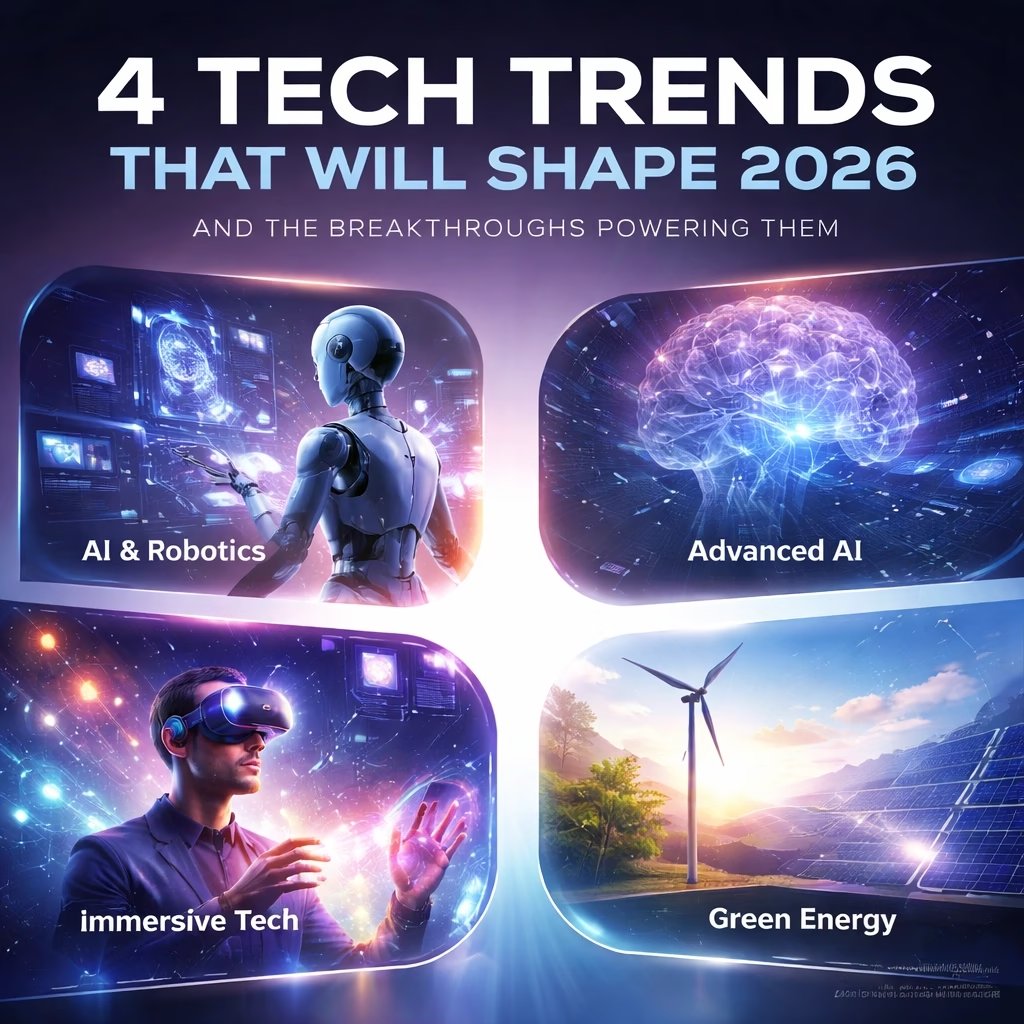
Energy Solutions: A Greener Future
As the world shifts towards sustainability, energy solutions will take center stage. By 2026, advancements in solar, wind, and nuclear energy will make renewable sources more efficient and cost-effective. Breakthroughs in battery technology will enable longer-lasting, faster-charging energy storage solutions, making electric vehicles (EVs) and grid storage more viable.
Fusion energy, long considered the "holy grail" of clean energy, is also making progress. Companies like Commonwealth Fusion Systems and TAE Technologies are working on compact fusion reactors that could provide nearly limitless, zero-carbon energy. While fusion power plants are still years away, the foundational research in 2026 will bring us closer to this goal.
Space Exploration: The Final Frontier
Space exploration will continue to captivate the world in 2026, with both government agencies and private companies making significant strides. NASA's Artemis program, aimed at returning humans to the Moon, will reach a critical milestone in 2026 with the establishment of a sustainable lunar base. This will pave the way for future missions to Mars and beyond.

Private companies like SpaceX and Blue Origin will also play a crucial role in space tourism and satellite deployment. By 2026, commercial space travel will become more accessible, with companies offering suborbital flights to paying customers. Additionally, advancements in propulsion technologies will reduce travel time to Mars, making interplanetary colonization a realistic possibility.
Impact: Who Stands to Gain (or Lose)?
The technologies shaping 2026 will have far-reaching consequences for businesses, governments, and individuals. Industries like healthcare, agriculture, and energy will undergo significant transformations, creating new job opportunities while displacing others. Governments will need to adapt policies to regulate these advancements, ensuring they benefit society without compromising ethical standards.
For consumers, these technologies will bring unprecedented convenience and efficiency. AI-powered assistants will become more intuitive, while biotech advancements will improve health outcomes. However, there will also be challenges, such as data privacy concerns and the digital divide, where access to these technologies may not be equal.
What Next: Milestones to Watch in 2026
As we approach 2026, several milestones will define the trajectory of these technologies. In AI, we can expect to see the first commercial applications of general AI, capable of performing tasks across multiple domains. Quantum computing will likely achieve "quantum advantage," solving problems that classical computers cannot.
In biotechnology, the first CRISPR-based therapies for genetic disorders will be approved for widespread use. Energy solutions will see the deployment of next-generation solar panels and advanced battery technologies, making renewable energy more viable. Space exploration will reach new heights with the establishment of a lunar base and the first crewed missions to Mars.
The year 2026 is set to be a defining moment in the history of technology. While challenges remain, the potential benefits are immense. As these technologies continue to evolve, they will reshape our world in ways we can only begin to imagine.