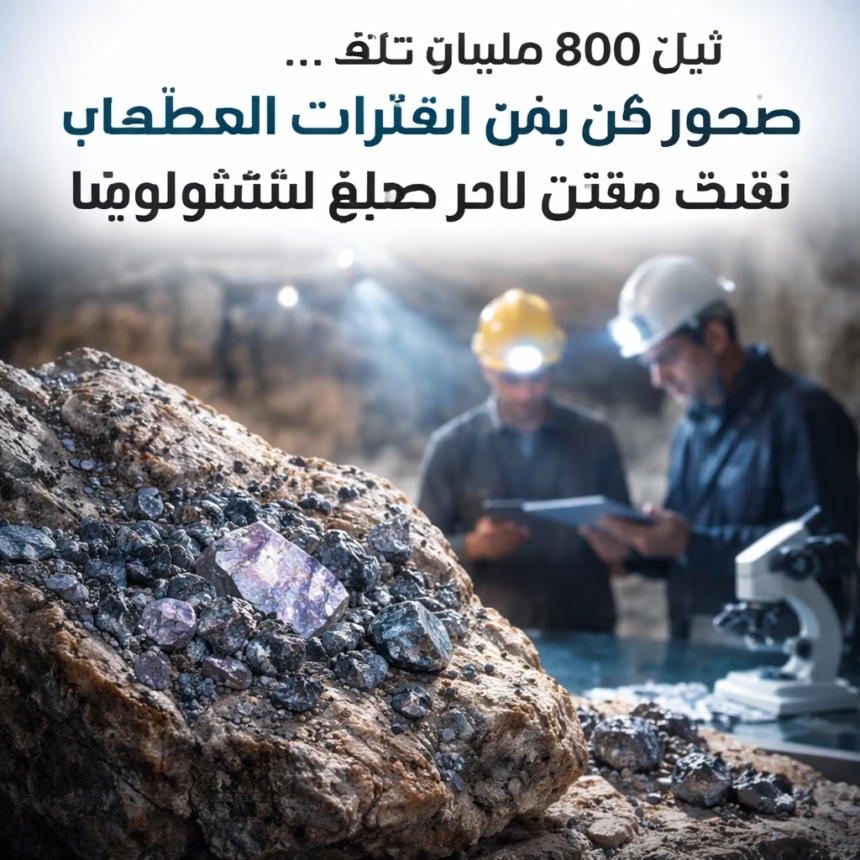
Ancient Rocks Hold Key to Next-Gen Tech
Scientists have discovered a unique and potentially revolutionary mineral within ancient rocks dating back 800 million years. The find, made in the Pilbara region of Western Australia, could have significant implications for the future of technology, particularly in areas like energy storage and advanced materials.
A Glimpse into Earth’s Deep Past
The rocks, part of the Pilbara Craton in Western Australia, represent some of the oldest known continental crust on Earth. Formed during the Neoarchean period, approximately 2.7 to 2.0 billion years ago, these rocks offer a rare window into the planet's early geological history. The Pilbara Craton is renowned for its exceptionally well-preserved Archean rocks, providing invaluable insights into the planet's formation and the evolution of life.
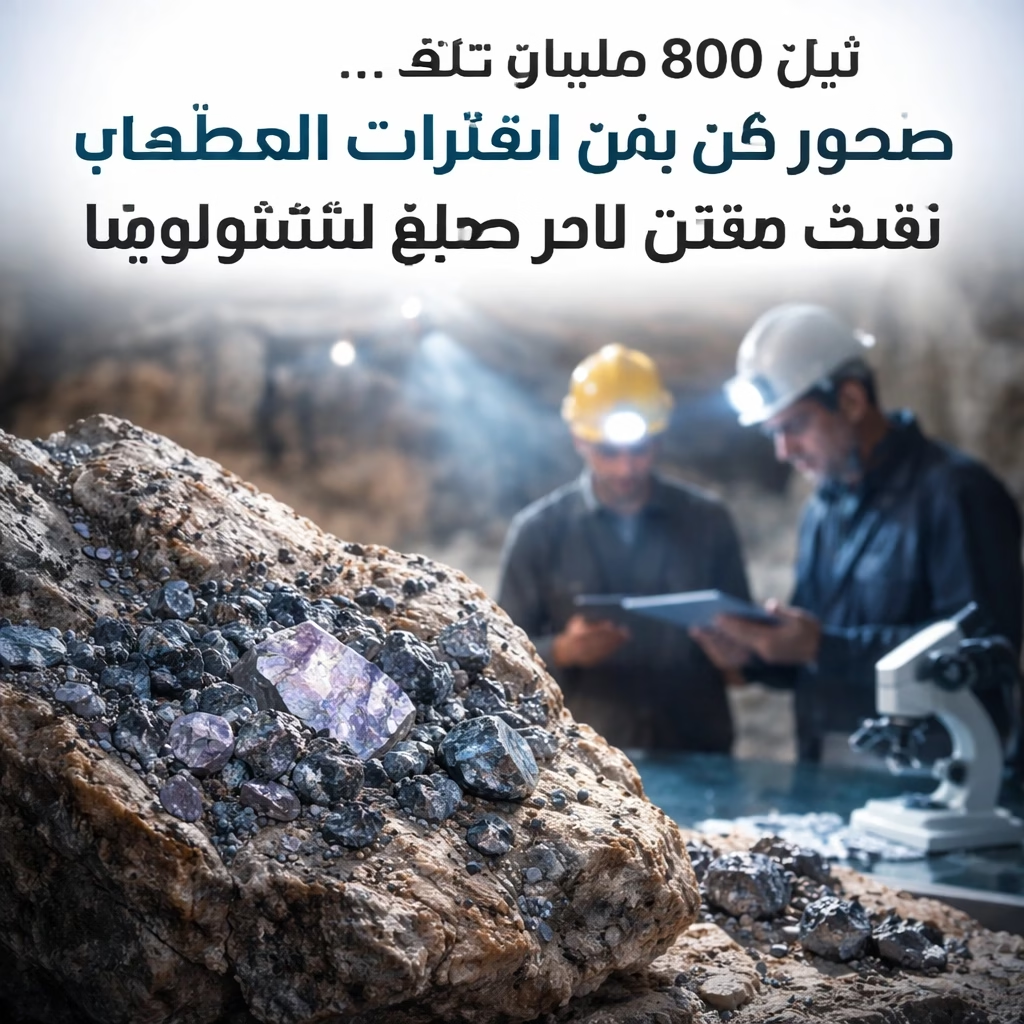
The Neoarchean era witnessed significant geological activity, including the formation of the first continents and the rise of early life forms. Understanding the chemical composition of rocks from this period helps researchers reconstruct the environmental conditions and processes that shaped early Earth. The rocks now being studied are being examined for clues about the planet’s atmosphere, oceans, and the origin of key elements.
More Read

The Discovery: A Mineral with Unique Properties
The recent discovery centers around a previously unknown mineral exhibiting exceptional electrical conductivity and structural properties. Researchers from the University of New South Wales (UNSW) and the Australian National University (ANU) made the finding while conducting detailed analysis of the ancient rocks. The mineral is currently being referred to as "Pilbaraite" by the research team, although a formal naming process is still underway.
Initial analysis suggests Pilbaraite possesses a unique crystalline structure that allows for efficient electron transport. This characteristic, combined with its chemical stability, makes it a promising candidate for use in developing next-generation batteries, superconductors, and other advanced electronic components. The mineral's formation conditions, involving specific chemical reactions under immense pressure and temperature, are also of keen scientific interest.
Unusual Formation Conditions
The presence of Pilbaraite is linked to a specific geochemical environment that existed 800 million years ago. The ancient rocks formed in a hydrothermal setting, where hot, chemically-rich fluids interacted with the surrounding rock. This interaction led to the precipitation of Pilbaraite from the fluid, trapping it within the rock matrix.
More Read

The extreme conditions required for Pilbaraite formation – including high pressure, elevated temperatures, and a specific combination of elements – are not commonly found in modern Earth environments. This rarity contributes to the mineral's unique properties and potential technological applications.
Potential Impacts: Revolutionizing Technology
The discovery of Pilbaraite could have a wide-ranging impact on various technological sectors. Its superior electrical conductivity could lead to the development of more efficient and powerful batteries for electric vehicles and portable electronics. Furthermore, its potential as a superconductor could revolutionize energy transmission, eliminating energy loss during electricity distribution.
Beyond energy, Pilbaraite's structural properties could be harnessed in the creation of advanced composite materials for aerospace, construction, and other industries. Scientists are also exploring its potential applications in quantum computing and other emerging fields. The discovery represents a significant step toward developing sustainable and high-performance technologies.
Looking Ahead: Future Research and Development
The research team is currently focused on further characterizing the properties of Pilbaraite and exploring its potential applications. This includes detailed structural analysis, electrical measurements, and chemical composition studies. Scientists are also investigating the geological processes that led to its formation in the Pilbara region.
Future research will involve attempting to synthesize Pilbaraite in the laboratory to produce larger quantities of the mineral. This will be crucial for conducting large-scale testing and evaluating its feasibility for commercial applications. Collaborations with materials scientists and engineers are also planned to accelerate the development of Pilbaraite-based technologies. The team anticipates publishing more detailed findings in peer-reviewed scientific journals within the next year.
Challenges in Synthesis
Synthesizing Pilbaraite in a laboratory setting presents significant challenges. Replicating the extreme pressure and temperature conditions that prevailed during its formation 800 million years ago requires specialized equipment and techniques. Researchers are exploring various methods, including high-pressure hydrothermal synthesis, to overcome these challenges.

Even if successful synthesis is achieved, scaling up production to meet potential industrial demand will require significant investment and technological innovation. However, the potential benefits of Pilbaraite-based technologies make the effort worthwhile.