Legal Storm Brews: AGC Unpacks Downgrade of High-Profile Rape Charge
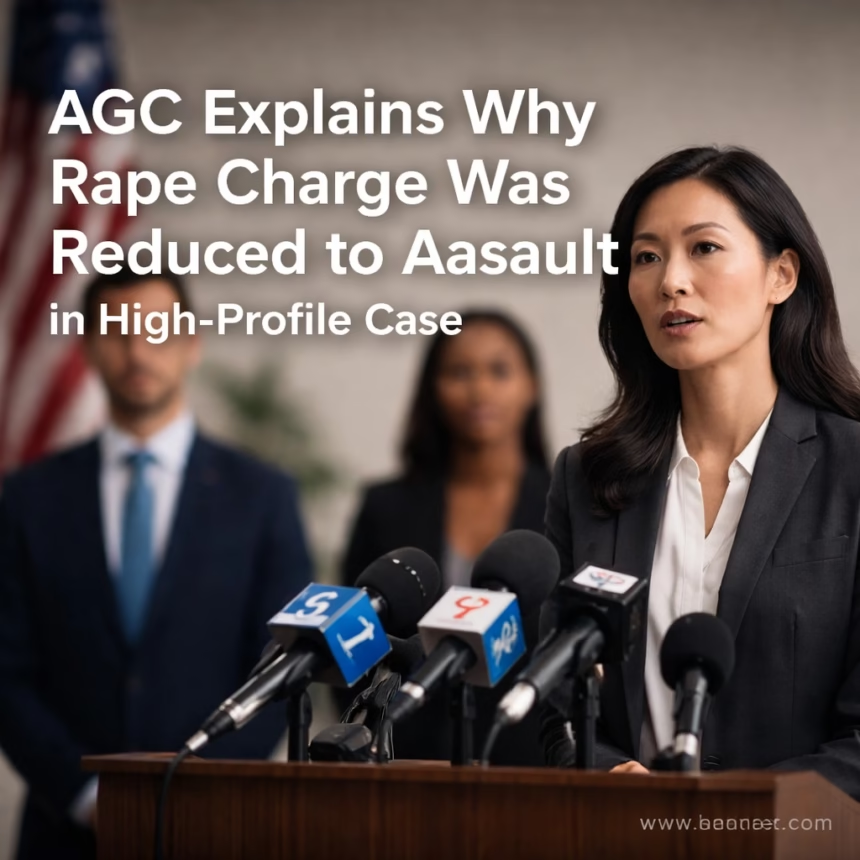
The Attorney-General's Chambers (AGC) in Singapore recently issued a detailed explanation regarding its decision to reduce a high-profile rape charge to voluntarily causing hurt in a case that has gripped public attention. This clarification, released on October 26, 2023, addresses widespread public queries and concerns surrounding the legal process and prosecutorial discretion, particularly in sensitive cases.
The move comes amidst intense scrutiny and public outcry over the perceived leniency in the justice system, prompting the AGC to shed light on the intricate legal considerations guiding such critical decisions.
Background: The Case That Sparked Debate
The case involves Mr. Adrian Tan, 42, a prominent business executive, who was initially charged with sexual assault by penetration, a severe offence under Singapore's Penal Code. The incident, which allegedly occurred in the early hours of March 12, 2023, at a private residence in the upscale River Valley district, involved Ms. Sarah Lim, 28, whose identity has been protected for privacy reasons.
Initial Allegations and Public Reaction
Following Mr. Tan's arrest in April 2023, news of the charges sent shockwaves across the nation. Public sentiment quickly leaned towards condemnation, fueled by the high-profile nature of the accused and a growing awareness of sexual assault issues. Victim advocacy groups and social media users called for swift and severe justice, emphasizing the need to protect vulnerable individuals and hold perpetrators accountable.
More Read

The Downgrade Decision
However, during a pre-trial conference on September 18, 2023, the prosecution informed the court of its decision to amend the charge from sexual assault by penetration to voluntarily causing hurt. This downgrade, which carries significantly lesser penalties, immediately ignited a firestorm of criticism and disbelief among the public, leading to widespread speculation about the reasons behind the AGC's decision.
Key Developments: AGC’s Rationale Unveiled
In response to the escalating public discourse, the AGC released a comprehensive press statement last week, detailing the rigorous evidentiary review process that led to the charge reduction. The statement underscored the fundamental principle of criminal justice: proving guilt beyond a reasonable doubt.
Evidentiary Challenges
The AGC explained that while Ms. Lim's account consistently alleged non-consensual sexual activity, crucial forensic and corroborating evidence proved insufficient to meet the stringent legal threshold for sexual assault by penetration. Specifically, medical reports confirmed injuries consistent with a struggle and physical contact, but these injuries could not definitively establish non-consensual penetration with the requisite force or lack of consent beyond all doubt.
Furthermore, the investigation revealed inconsistencies in peripheral details of the victim's testimony when cross-referenced with other available evidence, such as digital communications and witness statements from individuals present at the location earlier in the evening. While these inconsistencies did not invalidate the core allegation of assault, they presented significant challenges for proving the specific elements of sexual assault by penetration to the high standard required for conviction.

Prosecutorial Discretion and Public Interest
The AGC emphasized that prosecutorial discretion is exercised judiciously, balancing the public interest, the strength of available evidence, and the welfare of the victim. Proceeding with a charge that has a low probability of conviction due to evidentiary gaps would not only prolong the victim's trauma through a lengthy trial but also risk an acquittal, which could be perceived as a failure of justice.
Therefore, the decision to proceed with a charge of voluntarily causing hurt was made to ensure a higher likelihood of conviction for the provable offence, thereby securing a measure of justice for the victim and holding the accused accountable for his actions, albeit on a lesser charge.
Impact: Repercussions Across Society
The AGC's explanation, while legally sound, has had far-reaching impacts on various stakeholders, fueling ongoing debates about justice, consent, and public trust.
For the Victim and Survivors
For Ms. Lim, the downgrade could be deeply disheartening, potentially leading to feelings of betrayal and injustice, despite the AGC's efforts to explain its rationale. Victim advocacy groups have expressed concern that such decisions might deter future victims from coming forward, fearing that their experiences might be similarly downplayed or disbelieved by the legal system. This case reignites conversations about the emotional toll on survivors navigating the complexities of criminal proceedings.
Public Perception and Trust
The public's reaction has been largely divided. While some acknowledge the AGC's adherence to legal principles and the burden of proof, many others express frustration and a perceived disconnect between legal technicalities and moral justice. This sentiment risks eroding public trust in the justice system, particularly concerning gender-based violence, and highlights the ongoing need for greater transparency and public education on legal processes.
Legal Community and Reform Advocates
Within the legal community, the case has prompted discussions on the challenges of prosecuting sexual offences, especially when direct physical evidence of non-consensual penetration is ambiguous. Legal experts are debating whether current evidentiary standards adequately address the realities of sexual assault, where consent can be complex and often lacks independent corroboration. This may spur calls for legislative review of consent laws or evidentiary rules in sexual offence cases.
What Next: The Path Forward
The legal proceedings for Mr. Adrian Tan will now continue under the amended charge of voluntarily causing hurt. His next court appearance is scheduled for November 15, 2023, where he is expected to enter a plea.
More Read

Upcoming Legal Milestones
Should Mr. Tan plead guilty, the court will proceed to sentencing, taking into account factors such as the extent of injuries, any aggravating circumstances, and his previous record. If he pleads not guilty, a trial will ensue, focusing specifically on the elements of voluntarily causing hurt, which typically involves proving intent to cause physical injury.
Ongoing Public Discourse and Potential Reforms
Beyond the courtroom, the debate surrounding this case is likely to persist. Victim support organizations continue to advocate for enhanced victim protection measures and clearer definitions of consent in law. There may be renewed pressure on policymakers to review existing legislation and judicial guidelines to ensure that the justice system is both fair and sensitive to the unique challenges presented by sexual offence cases.
The AGC, for its part, may engage in further public outreach initiatives to demystify its role and the intricacies of prosecutorial decisions, striving to bridge the gap between legal principles and public expectations in high-stakes cases.