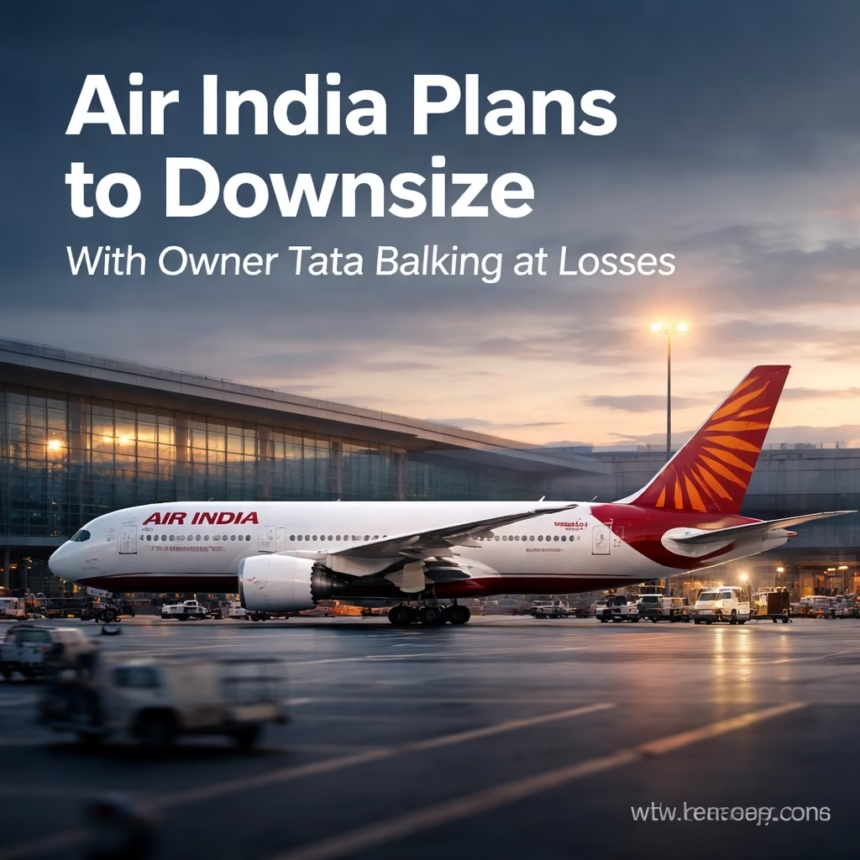
Air India, the flag carrier of India, is reportedly embarking on a significant downsizing initiative as its owner, the Tata Group, grows increasingly concerned over persistent financial losses. The strategic shift, unfolding across its global operations, signals a renewed urgency from the conglomerate to steer the airline towards profitability following its acquisition in early 2022.
Background: A Legacy of Red Ink and a Hopeful Homecoming
For decades, Air India was synonymous with government ownership, chronic operational inefficiencies, and a staggering debt burden. The airline, once a symbol of national pride, had accumulated losses reaching tens of billions of dollars, making it a drain on public finances. Various attempts at revival under state control proved futile, with the carrier struggling to compete against more agile private players in both domestic and international markets. Its fleet aged, service standards wavered, and market share dwindled.
The Tata Acquisition: A New Dawn?
In January 2022, the Tata Group, the original founder of Air India in 1932, successfully reacquired the airline in a highly anticipated "homecoming." The deal, valued at approximately $2.4 billion, included the government's entire stake in Air India, along with its low-cost subsidiary Air India Express and a 50% stake in the ground handling joint venture AISATS. The acquisition was met with widespread optimism, as the Tatas were known for their strong business acumen and a track record of turning around struggling enterprises. The conglomerate articulated an ambitious five-year transformation plan, dubbed 'Vihaan.AI' (Sanskrit for "dawn of an new era"), aiming to modernize the fleet, expand its network, enhance customer service, and integrate its other aviation ventures.
Ambitious Mergers and Persistent Challenges
As part of the Vihaan.AI strategy, Tata announced the consolidation of its aviation portfolio. This included merging AirAsia India into Air India Express and, more significantly, integrating full-service carrier Vistara (a joint venture with Singapore Airlines) into Air India. These mergers were intended to create a single, unified, larger full-service airline and a consolidated low-cost carrier, streamlining operations and leveraging synergies. However, despite these ambitious plans and significant initial investments in fleet upgrades and service improvements, Air India has continued to incur substantial losses. Industry analysts estimate the airline's monthly burn rate to be considerable, challenging Tata's patience and financial commitment.
Key Developments: Tata’s Push for Leaner Operations
The persistent losses have prompted the Tata Group to take a more assertive stance, reportedly directing Air India's management to accelerate cost-cutting measures and rationalize its operations. This directive signifies a shift from growth-at-all-costs to a more disciplined approach focused on achieving financial sustainability.

Route Rationalization and Network Optimization
One of the primary areas of focus is Air India's extensive global network. The airline is reportedly evaluating the profitability of various routes, with an eye towards discontinuing or reducing frequencies on underperforming sectors. This strategic review aims to eliminate routes that do not generate sufficient revenue or fill enough seats, thereby reducing fuel, crew, and operational costs. The goal is to optimize the network for higher yield and better load factors, ensuring that every flight contributes positively to the bottom line. This could mean a greater emphasis on lucrative long-haul routes connecting major global hubs, potentially at the expense of less trafficked destinations.
Fleet Review and Procurement Adjustments
Air India has made significant commitments to modernizing its fleet, including historic orders for hundreds of new aircraft from Airbus and Boeing. While these orders are crucial for long-term competitiveness, the current financial pressures are leading to a review of the delivery schedules. There are discussions about potentially delaying some aircraft deliveries or re-evaluating certain order configurations to align with the revised operational strategy and conserve capital. Additionally, older, less fuel-efficient aircraft in the existing fleet are being considered for accelerated retirement, further contributing to cost savings and environmental efficiency.
Manpower Adjustments and Voluntary Retirement Schemes
With a large workforce inherited from its government ownership days, manpower costs represent a significant expenditure for Air India. The airline has approximately 18,000 employees, and while it has been actively recruiting new talent, the focus is now shifting towards optimizing existing staff numbers. Air India has previously offered Voluntary Retirement Schemes (VRS) to a segment of its employees. More such schemes or targeted adjustments are anticipated as part of the downsizing efforts. The aim is to achieve a leaner, more efficient organizational structure without resorting to large-scale involuntary layoffs, which could damage morale and public perception.

Leadership and Strategic Navigation
Under the leadership of CEO Campbell Wilson, Air India is tasked with navigating these complex changes. Wilson, who previously headed Scoot, Singapore Airlines' low-cost carrier, brings experience in efficiency and cost management. His challenge is to implement Tata's mandate for profitability while simultaneously integrating the diverse cultures and operational procedures of Air India, Vistara, and AirAsia India, a task fraught with complexities and potential friction points.
Impact: Who Feels the Pinch?
The downsizing plans will inevitably have ripple effects across various stakeholders, from employees to passengers and the broader aviation ecosystem.
Employees Face Uncertainty
For Air India's vast employee base, the downsizing initiatives bring a degree of uncertainty. While voluntary retirement schemes aim to mitigate the impact, there is inherent anxiety about job security and career progression. The integration of employees from Vistara and AirAsia India into the unified Air India structure also presents challenges in terms of roles, seniority, and cultural alignment. Employee morale will be a critical factor for management to address during this transition.
Passengers and Network Changes
Passengers may experience changes in Air India's flight schedules and network. While some routes might be discontinued, the overall goal is to enhance the quality of service and reliability on the remaining, more profitable routes. A more efficient Air India could eventually lead to a better passenger experience, with improved on-time performance, modern aircraft, and more consistent service standards. However, initial adjustments could lead to temporary disruptions or reduced options on certain sectors.
The Aviation Sector and Tata’s Reputation
The move signals a more pragmatic and fiscally conservative approach to airline operations in India. It underscores that even with the backing of a powerful conglomerate like Tata, the airline business remains inherently challenging and requires strict financial discipline. For the Tata Group, this period is crucial for demonstrating its ability to transform Air India into a viable, profitable entity, thereby safeguarding its reputation as a turnaround specialist. Failure to do so could cast a shadow on its ambitious plans within the aviation sector.
What Next: Path to Profitability
The coming months will be critical for Air India as it implements these strategic adjustments under Tata's watchful eye.
More Read

Implementation of Downsizing Measures
Air India is expected to roll out specific details regarding route rationalization, fleet adjustments, and potential new voluntary retirement schemes in the near future. These measures will likely be phased in to minimize disruption, but the intent to streamline operations will be clear. The airline will need to communicate these changes effectively to both its workforce and its customer base.
Financial Targets and Performance Review
The Tata Group has undoubtedly set clear financial targets for Air India, with a strong emphasis on achieving a path to profitability within a defined timeline. Regular performance reviews will monitor progress against these benchmarks, and further strategic adjustments may be made based on initial outcomes. The focus will be on improving key metrics such as passenger load factor, yield management, and operational efficiency.
Finalizing the Merger Integration
The complete integration of Vistara into Air India remains a significant milestone. While regulatory approvals are largely in place, the operational and cultural integration is a complex process. Successfully merging fleets, IT systems, employee policies, and brand identities will be crucial for realizing the anticipated synergies and cost savings. This integration is expected to continue throughout 2024.
Long-Term Vision for a Competitive Air India
Ultimately, Tata's objective is to transform Air India into a world-class airline, capable of competing effectively with established global carriers. The current downsizing, while challenging, is viewed as a necessary step to build a stronger, more sustainable foundation. The long-term vision includes a modern fleet, an optimized global network, superior customer service, and a robust financial position, allowing Air India to reclaim its prominence in the international aviation landscape. The success of these measures will determine whether Air India can truly soar to new heights under its new ownership.