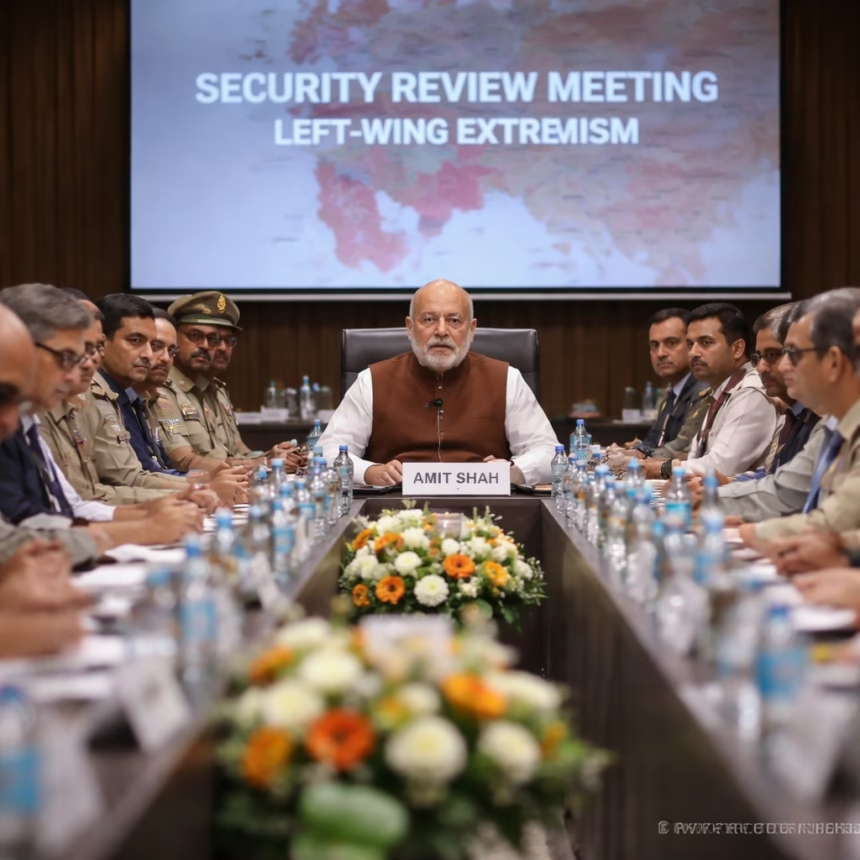
In a significant strategic push recently, Union Home Minister Amit Shah chaired a high-level security review meeting in Raipur, Chhattisgarh. The pivotal gathering focused intensely on strengthening the government's multi-pronged strategy to combat Left-Wing Extremism (LWE), particularly within the persistently affected Bastar region. This summit brought together key stakeholders to assess current operations and forge a decisive path forward in the nation's ongoing battle against Maoist insurgency.
Background: The Enduring Challenge of Left-Wing Extremism
Left-Wing Extremism, commonly referred to as the Naxalite or Maoist movement, has been a significant internal security challenge for India for over five decades. Originating in the village of Naxalbari in West Bengal in 1967, the movement initially aimed at empowering landless peasants and tribals against perceived state oppression and exploitation. Over time, it evolved into an armed insurgency, advocating for the overthrow of the democratic state through protracted people's war.
Geographically, the movement's influence once spanned a vast contiguous territory known as the "Red Corridor," extending across parts of Chhattisgarh, Odisha, Jharkhand, Bihar, Maharashtra, Andhra Pradesh, and Telangana. These regions, often characterized by dense forests, challenging terrain, and significant tribal populations, provided fertile ground for Maoist ideology and operations. The presence of mineral wealth in many of these areas also led to conflicts over resource control and development.
Chhattisgarh, particularly its southern Bastar division comprising districts like Sukma, Bijapur, Dantewada, Narayanpur, and Kanker, remains the epicenter of LWE activity. The region's deep jungles and lack of infrastructure have historically allowed Maoists to establish strongholds, operate training camps, and launch attacks against security forces and government assets. Notable incidents, such as the 2010 Tadmetla ambush and the 2013 Jeeram Ghati attack, underscore the severe challenges faced by the state in this critical zone.
Over the years, successive governments have responded with a dual strategy encompassing robust security operations and accelerated socio-economic development. Initiatives like Operation Green Hunt in the late 2000s marked a significant escalation in security efforts. Concurrently, schemes focusing on road construction, education, health, and skill development were launched to address the root causes of discontent and integrate affected populations into the mainstream.
More Read

Despite these efforts, and a significant decline in overall LWE-related violence across the country, pockets of intense activity persist. The Union Home Ministry reports a substantial reduction in the geographical spread and intensity of Maoist violence, with the number of affected districts shrinking considerably. However, the core areas, especially in Chhattisgarh, continue to pose a formidable challenge, necessitating continuous strategic recalibration.
Key Developments: Shah’s Strategic Mandate in Raipur
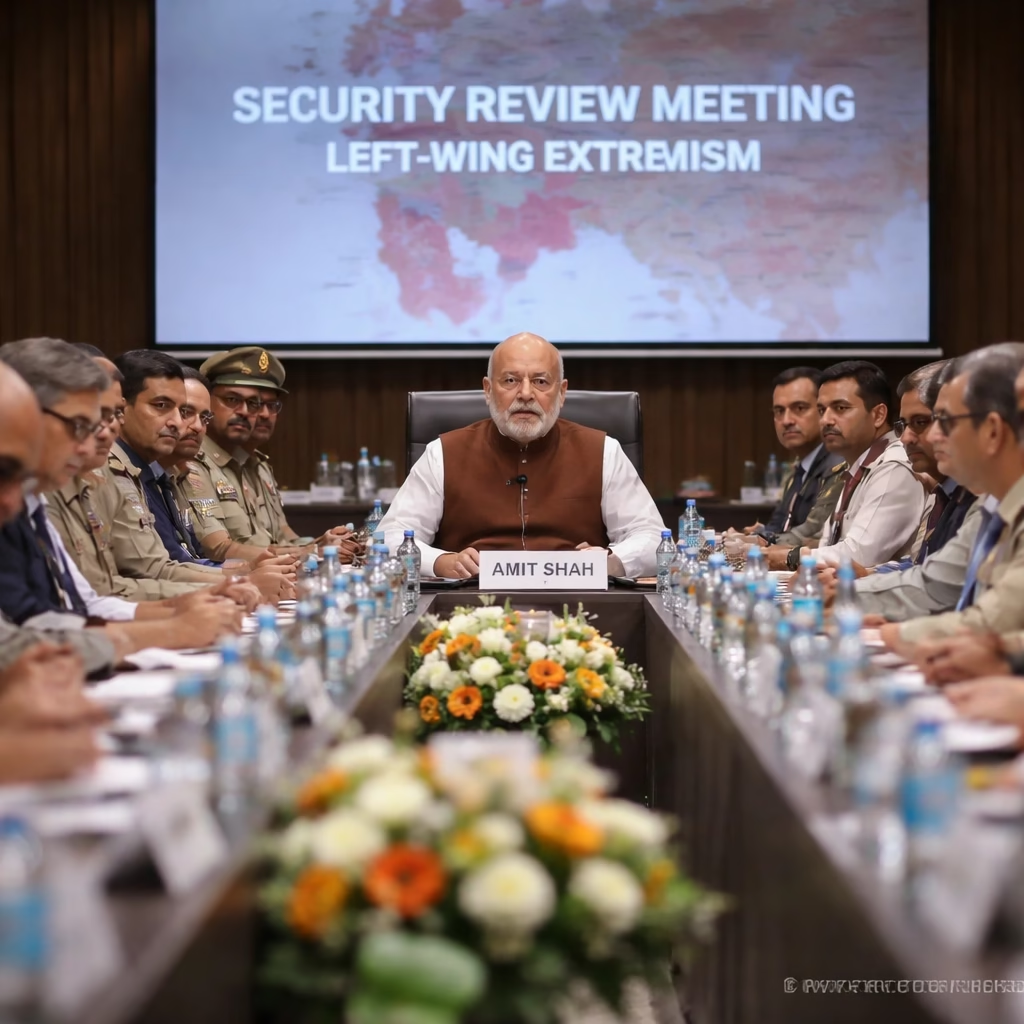
The recent security meeting chaired by Union Home Minister Amit Shah in Raipur underscored the central government's unwavering commitment to eradicating LWE. The summit served as a critical platform for a comprehensive review of the ongoing anti-Maoist campaign and to formulate updated strategies for its final phases.
The high-profile gathering saw the participation of Chhattisgarh Chief Minister Vishnu Deo Sai, senior officials from the Union Home Ministry, the Director Generals of Police (DGPs) of LWE-affected states, and the heads of various Central Armed Police Forces (CAPFs) including the CRPF, BSF, and ITBP. This convergence of political leadership and top security brass highlighted the coordinated, multi-agency approach being adopted.
More Read

A key focus of the discussions was the effectiveness of current security operations, particularly intelligence-led offensives and area domination exercises. Shah emphasized the need for enhanced intelligence gathering mechanisms, ensuring actionable intelligence reaches ground forces swiftly. The meeting also stressed the importance of seamless inter-state coordination, recognizing that Maoist groups often exploit state boundaries to evade security operations.
Another significant directive emerging from the summit was the acceleration of development initiatives in LWE-affected regions. The Home Minister reiterated that security operations must be complemented by robust socio-economic upliftment to win the hearts and minds of the local populace. This includes fast-tracking the construction of critical infrastructure such as roads, bridges, schools, and health centres, alongside improving telecom connectivity and access to government services.
Enhanced Ground Operations and Infrastructure
The meeting outlined plans for strengthening security infrastructure on the ground. This involves establishing new Forward Operating Bases (FOBs) and security camps in previously inaccessible areas, thereby expanding the footprint of security forces and denying Maoists safe havens. The strategy aims at dismantling the remaining strongholds of LWE, particularly in the tri-junction areas of Chhattisgarh, Odisha, and Maharashtra, which have historically served as crucial operational hubs for Maoist leadership. Emphasis was also placed on equipping security personnel with advanced technology, including drones for surveillance and improved communication systems.
Accelerating Socio-Economic Upliftment
Beyond security, a significant portion of the strategy revolves around integrated development. The Home Minister directed officials to ensure that welfare schemes reach the last mile, providing opportunities for education, employment, and sustainable livelihoods to tribal communities. Rehabilitation policies for surrendered Maoist cadres were also reviewed, with a focus on ensuring their successful reintegration into society and preventing re-recruitment. This holistic approach seeks to address the root causes of extremism by fostering an environment of development and opportunity.
Impact: A Multifaceted Crisis and Its Repercussions
The enduring presence of Left-Wing Extremism has had profound and far-reaching impacts on various facets of society, particularly in the affected regions. At its core, the conflict deeply affects the local populace, primarily tribal communities who often find themselves caught between the state and the Maoists. They face displacement, fear, disruption of daily life, and limited access to essential services. Recruitment of youth, often through coercion or false promises, further perpetuates the cycle of violence, tearing apart social fabric and hindering generational progress.
More Read

Security forces bear a heavy burden, frequently operating in challenging terrains and under constant threat. Casualties among police and paramilitary personnel are a grim reality, highlighting the extreme dangers inherent in anti-LWE operations. The psychological toll on these forces and their families is also significant, requiring robust support systems and continuous training.
For the government, LWE poses a considerable drain on resources, necessitating substantial allocation for security operations, intelligence gathering, and development projects in these areas. It also impacts the perception of governance, as the state's ability to assert its authority and deliver basic services is challenged. Economically, the presence of LWE acts as a major deterrent to industrial investment and infrastructure development in mineral-rich regions, stifling potential growth and employment opportunities.
Furthermore, the conflict raises complex human rights concerns. Allegations of excesses against both Maoists and security forces frequently surface, leading to scrutiny from national and international bodies. The delicate balance between maintaining security and protecting civil liberties remains a constant challenge, necessitating transparency and accountability from all parties. The overall impact is a vicious cycle of underdevelopment, insecurity, and mistrust that hinders the region's ability to flourish.
What Next: Charting the Path to a Maoist-Free India
The Raipur summit marks a renewed push in the government's long-term strategy to decisively end Left-Wing Extremism. The immediate future will likely see a sustained intensification of security operations, particularly in the remaining Maoist strongholds. Intelligence-led strikes, increased area domination by security forces, and targeted operations against senior Maoist leadership are expected to become more frequent and precise. The focus will be on maintaining relentless pressure to dismantle the organizational structure and operational capabilities of LWE groups.
Alongside security measures, there will be an accelerated push for development projects. The Home Ministry's emphasis on fast-tracking infrastructure, improving connectivity, and ensuring welfare schemes reach the grassroots signals a commitment to address the socio-economic grievances that Maoists exploit. This includes ensuring access to education, healthcare, clean drinking water, and livelihood opportunities for tribal communities, thereby integrating them more fully into the national mainstream.
Regular monitoring and review mechanisms will be crucial to assess the effectiveness of these strategies. Union Home Minister Amit Shah has indicated his personal oversight of the progress, suggesting that similar high-level meetings will likely be convened periodically to adapt strategies based on evolving ground realities. Inter-agency synergy and enhanced cooperation between central and state forces will be paramount in executing this comprehensive plan.
The path ahead, however, is not without its challenges. The difficult terrain, the ability of Maoists to exploit local grievances, and the need for sustained political will and financial resources will continue to test the resolve of the state. Nevertheless, the government's stated goal is the complete eradication of LWE within a defined timeframe, aiming to transform the "Red Corridor" into a corridor of peace and prosperity. This ambitious vision requires unwavering commitment, meticulous planning, and coordinated execution to achieve a truly Maoist-free India.