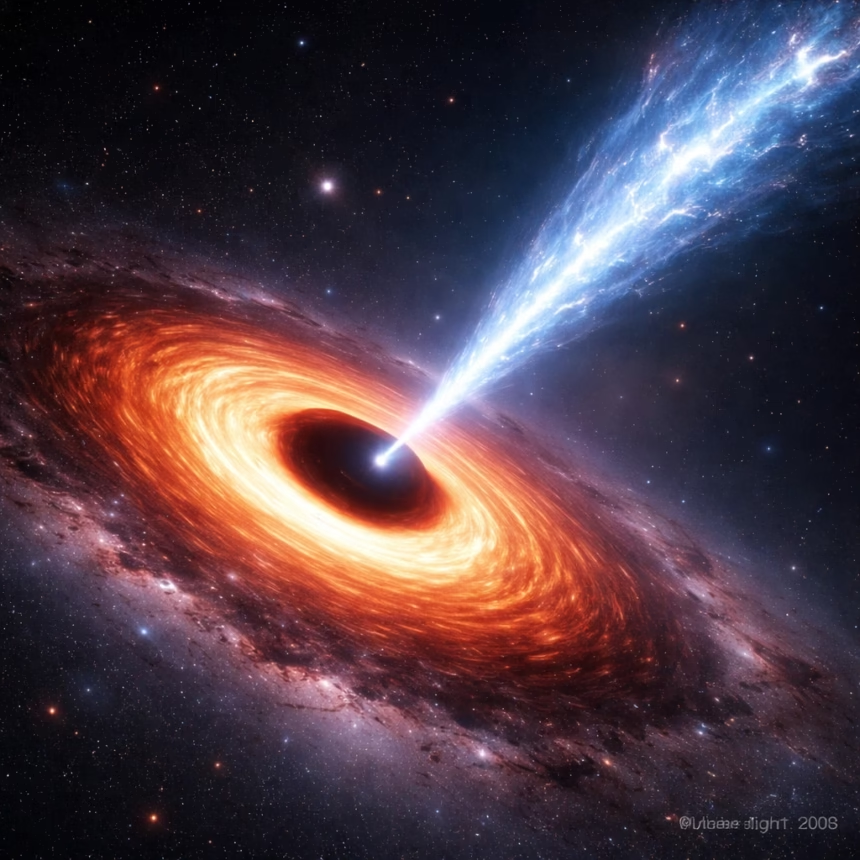
Cosmic Blast from the Abyss: Black Hole Unleashes Massive Jet
Astronomers have witnessed an unprecedented event: the first black hole ever directly imaged launching a colossal jet of plasma stretching over 3,000 light-years. The phenomenon, observed using the Event Horizon Telescope (EHT) collaboration, provides new insights into the behavior of these enigmatic objects and their influence on the surrounding universe. The findings were announced on January 25, 2024.
Background: Understanding Black Holes and Jets
Black holes are regions of spacetime where gravity is so intense that nothing, not even light, can escape. They form from the remnants of massive stars that have collapsed under their own gravity. For decades, scientists have theorized that black holes can launch powerful jets of particles traveling at near the speed of light. These jets are believed to be powered by the black hole's rotation and magnetic fields, accelerating charged particles to incredible velocities.
The Event Horizon Telescope, a global network of radio telescopes, was designed to directly image the "shadow" of a black hole – the dark central region created by its intense gravity bending light. Previous observations, like the 2019 image of the black hole at the center of Messier 87 (M87*), provided strong evidence for the existence of these jets, but lacked the detail to fully understand their origin and behavior.
Key Developments: A Jet Emerges from the Shadow
The EHT collaboration, comprised of scientists from around the world, focused its observations on the supermassive black hole at the center of galaxy M87, located approximately 55 million light-years from Earth in the constellation Virgo. Using advanced image processing techniques, researchers detected a faint, elongated structure extending far beyond the black hole's shadow.

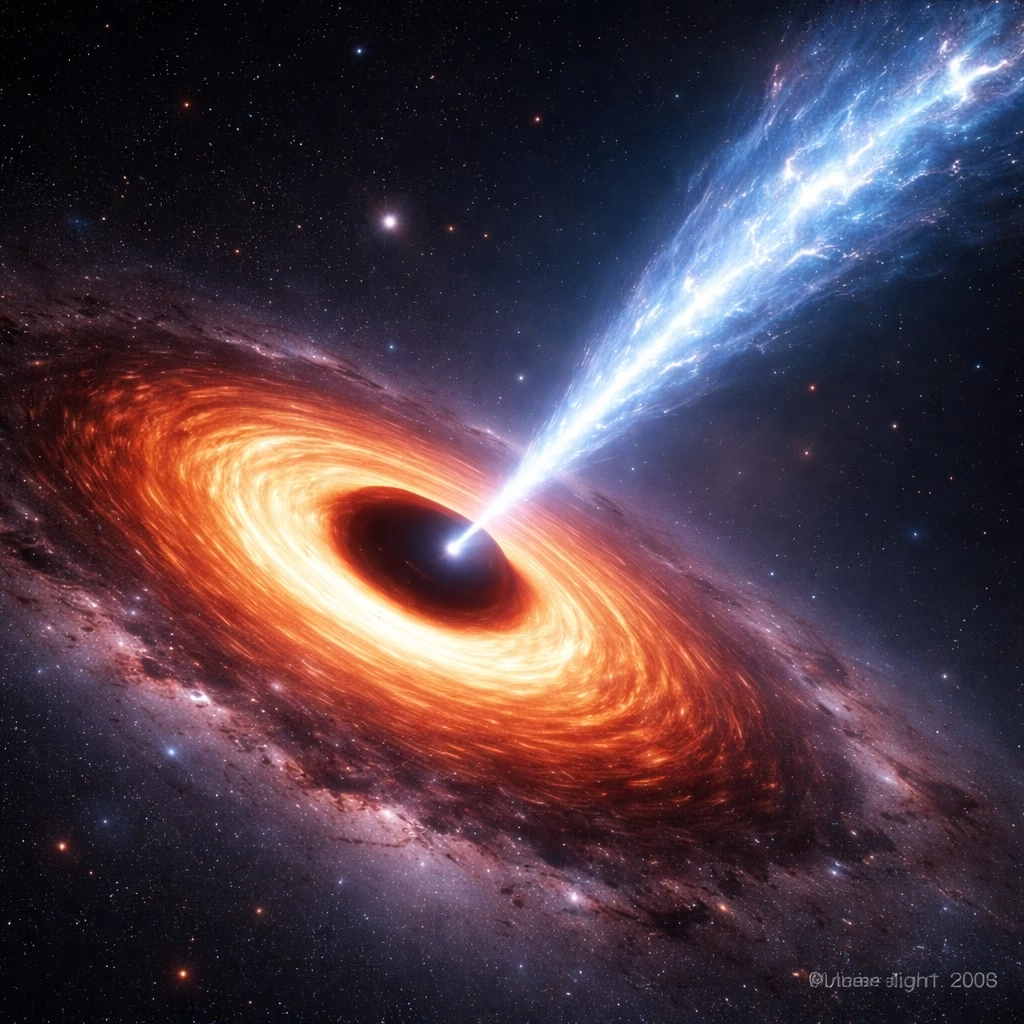
This structure is a powerful jet of plasma, composed of hot gas and magnetic fields, that originates from the black hole's vicinity. The jet stretches for an estimated 3,000 light-years, making it one of the largest cosmic jets ever observed. The data reveals a complex and dynamic structure within the jet, with swirling patterns and knots of intense activity.
Crucially, the image demonstrates a direct link between the black hole's event horizon and the jet's formation. The jet appears to originate from regions close to the black hole, supporting theories about the role of magnetic fields in launching these powerful outflows.
Impact: Refining Our Understanding of the Cosmos
This discovery has significant implications for our understanding of black holes and their role in galaxy evolution. Supermassive black holes are found at the centers of most galaxies, and their activity, including the launching of jets, can influence the growth and development of their host galaxies.
More Read

The observations will help refine models of how jets are formed and how they interact with the surrounding interstellar medium. This knowledge is crucial for understanding the distribution of matter in the universe and the processes that drive galaxy formation. The findings also bolster the Event Horizon Telescope’s capabilities and demonstrate the power of international collaboration in astronomical research.
What Next: Future Observations and Research
Further Jet Analysis
Scientists plan to continue observing the M87 black hole with the EHT and other telescopes to study the jet in more detail. Future observations will focus on measuring the jet’s magnetic field strength, its particle composition, and its interaction with the surrounding gas and dust.
Exploring Other Black Holes
The EHT collaboration is also planning to target other supermassive black holes in different galaxies. By studying jets from multiple black holes, researchers hope to identify common patterns and variations in jet formation, providing a more complete picture of this phenomenon. The goal is to observe jets from black holes in galaxies closer to Earth, potentially allowing for higher resolution imaging.
Testing Fundamental Physics
The extreme conditions around black holes offer a unique opportunity to test fundamental theories of physics, including Einstein’s theory of general relativity. Studying the jets can provide insights into the behavior of matter and energy under extreme gravitational fields and magnetic field strengths, potentially revealing new physics.