Orbit's New Frontier: Axiom's Fifth Private Flight Signals Commercial Space Boom
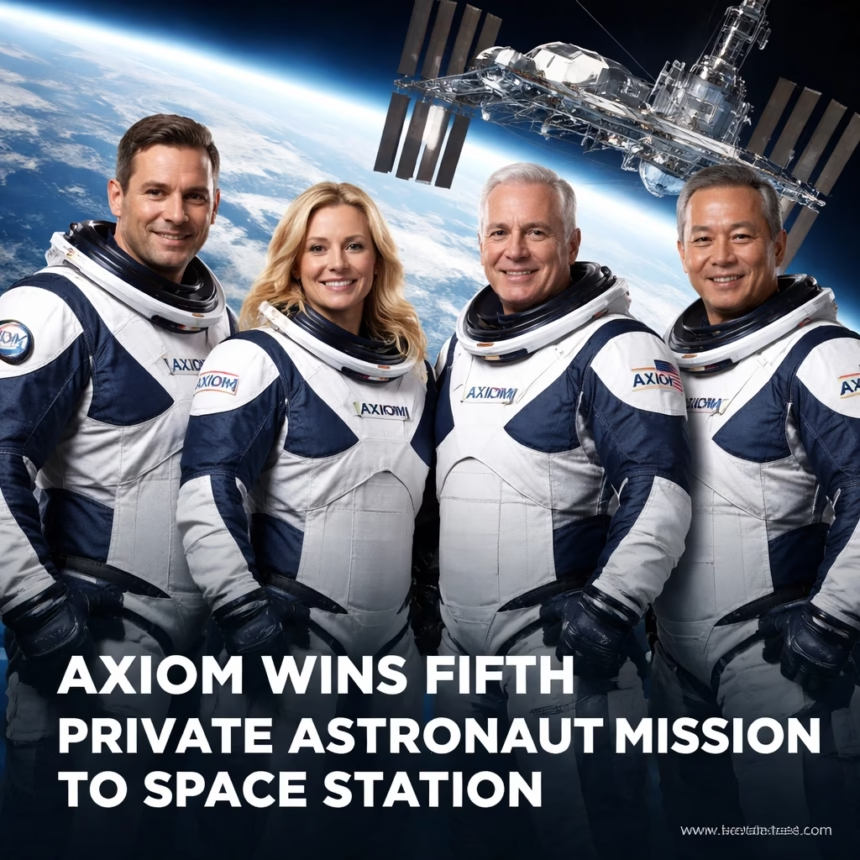
Axiom Space has officially secured its fifth private astronaut mission to the International Space Station (ISS), marking a significant milestone in the rapidly expanding commercial space sector. This upcoming flight, designated Ax-5, underscores the growing demand for access to low-Earth orbit and Axiom's pivotal role in facilitating such endeavors. The mission is tentatively slated for a future launch, continuing a steady cadence of private spaceflight operations.
The announcement solidifies Axiom's position as a leader in commercial space services, providing comprehensive, end-to-end missions to the orbiting laboratory. This continued partnership with NASA reflects a broader strategic shift towards greater commercial utilization of the ISS and the development of a robust low-Earth orbit economy.
Background: The Ascent of Commercial Spaceflight
The concept of private citizens or commercially sponsored researchers flying to space has evolved dramatically over the past two decades. Initially, "space tourists" like Dennis Tito paid significant sums to fly aboard Russian Soyuz spacecraft to the ISS in the early 2000s. These were largely bespoke arrangements, distinct from the structured commercial missions seen today.
A pivotal shift occurred with NASA's embrace of commercial partnerships. Recognizing the need to reduce costs and stimulate innovation, the agency initiated programs like the Commercial Orbital Transportation Services (COTS) and later the Commercial Crew Program (CCP). These programs fostered the development of private cargo and crew transportation systems, notably SpaceX's Dragon and Boeing's Starliner.

Axiom Space emerged as a key player in this evolving landscape, specifically focusing on private astronaut missions (PAMs). Founded in 2016, the company's vision extends beyond simply arranging flights; it aims to build and operate the world's first commercial space station, Axiom Station, as a successor to the ISS.
Pioneering Private Access: Axiom’s Predecessor Missions
Axiom's journey to Ax-5 is built upon a foundation of successful and planned missions. The company's inaugural flight, Ax-1, launched in April 2022, was a landmark achievement. It transported a crew of four private astronauts – Commander Michael López-Alegría (a former NASA astronaut and Axiom employee), Larry Connor, Mark Pathy, and Eytan Stibbe – to the ISS for a 17-day stay. This mission demonstrated the viability of fully private expeditions, conducting scientific research and outreach activities.
Following Ax-1, Axiom successfully launched Ax-2 in May 2023. This mission was commanded by Peggy Whitson, a former NASA astronaut and Axiom employee, alongside pilot John Shoffner and Saudi Arabian mission specialists Ali AlQarni and Rayyanah Barnawi. Barnawi made history as the first Saudi woman in space. Ax-3, commanded by Michael López-Alegría again, launched in January 2024 with a crew from Turkey, Italy, and Sweden, further diversifying international participation in private spaceflight.
More Read

A fourth mission, Ax-4, is already in the planning stages, with a crew expected to be announced and a launch targeted in the near future. The consistent cadence of these missions highlights Axiom's operational capability and the increasing maturity of the commercial spaceflight ecosystem.
Key Developments: Accelerating Commercialization
The selection of Axiom Space for its fifth private astronaut mission by NASA signifies a deepening commitment to commercializing low-Earth orbit (LEO). NASA's strategy involves leveraging private companies to manage routine access to the ISS, thereby allowing the agency to focus its resources on deep-space exploration, such as the Artemis missions to the Moon.
Under a Space Act Agreement, NASA provides Axiom with services such as crew integration, safety oversight, and access to ISS resources. In return, Axiom compensates NASA for these services and manages all aspects of its private missions, from crew selection and training to payload integration and mission operations.
Expanding Access and Opportunities
The increasing frequency of Axiom missions demonstrates a growing market beyond traditional government-sponsored astronaut programs. These missions cater to diverse clients, including wealthy individuals, national space agencies without their own launch capabilities, and research institutions seeking microgravity access.
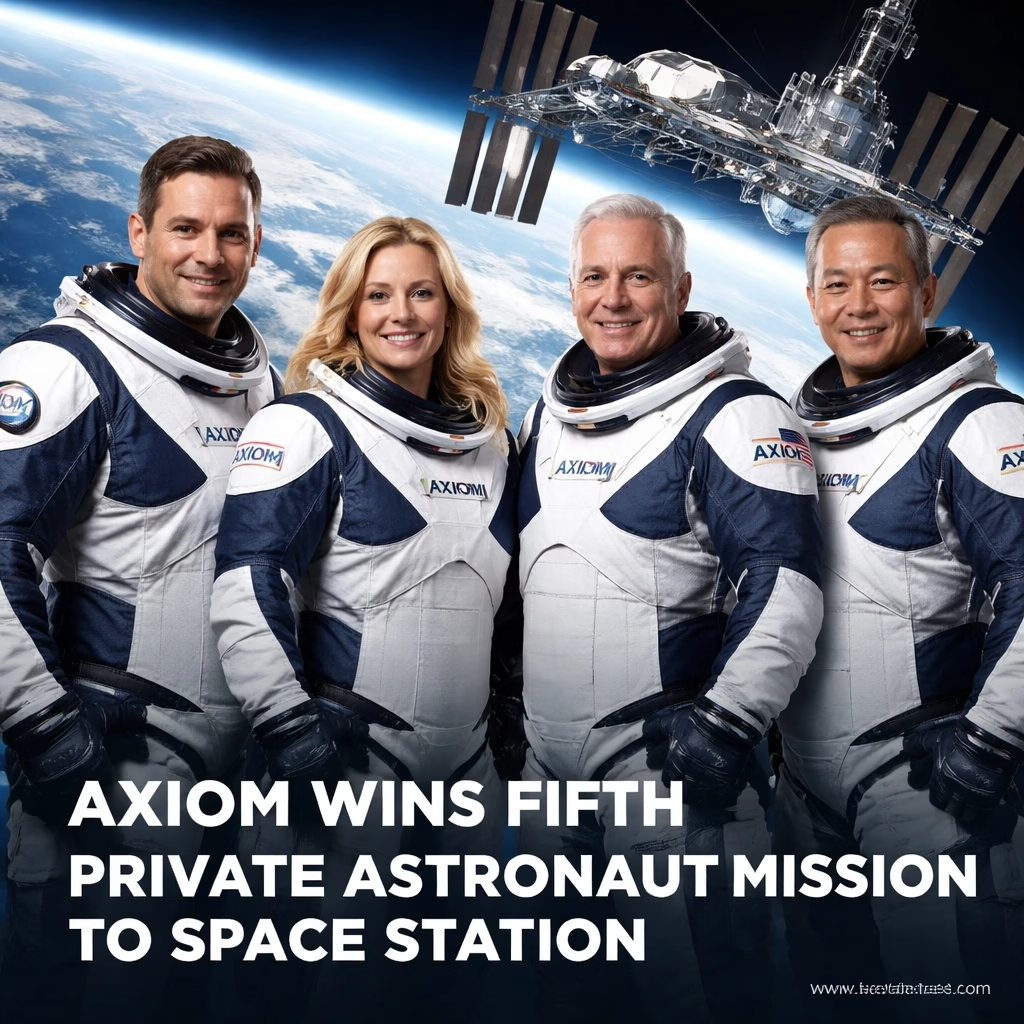
Each Axiom mission utilizes SpaceX's Crew Dragon spacecraft, launched aboard a Falcon 9 rocket from NASA's Kennedy Space Center in Florida. This reliable transportation system has been instrumental in enabling both NASA's commercial crew flights and Axiom's private expeditions, showcasing the success of public-private partnerships in space.

The selection process for these missions involves a rigorous review by NASA to ensure that all private astronaut activities are safe, do not impact ongoing ISS operations, and adhere to established protocols. This oversight ensures the continued integrity and safety of the orbiting laboratory, which remains a critical international asset.
Impact: Reshaping the Space Economy
The award of Ax-5 carries significant implications for various stakeholders, from the commercial space industry to international scientific communities.
For Axiom Space
This fifth mission reinforces Axiom's market leadership in private human spaceflight. It provides substantial revenue, strengthens its operational experience, and builds credibility as the company progresses towards its goal of establishing Axiom Station. Each successful mission serves as a stepping stone, validating its business model and technical capabilities.
For NASA and the ISS
For NASA, the repeated success of Axiom's missions validates its commercialization strategy. It demonstrates that private companies can reliably provide access to LEO, freeing NASA to concentrate on its ambitious deep-space exploration goals. Furthermore, private missions help offset the operational costs of the ISS and ensure its full utilization, bringing new research and maintenance tasks.
For the Global Space Industry
The steady cadence of private missions stimulates economic activity across the entire space supply chain. It creates jobs in manufacturing, engineering, mission control, and training. It also encourages competition and innovation among other commercial space entities vying for a share of the burgeoning LEO economy.
For Scientific Research and International Collaboration
Axiom missions bring diverse research payloads to the ISS, covering fields from human health and materials science to technology demonstrations. Private astronauts often conduct experiments sponsored by their home countries or private institutions, broadening the scope of microgravity research. This also fosters international collaboration, as seen with the participation of astronauts from various nations.
What Next: The Horizon of Commercial Space
With Ax-5 secured, Axiom Space will now proceed with crew selection, training, and detailed mission planning. The specific launch date will depend on ISS visiting vehicle traffic, crew availability, and other operational considerations, but it is expected to occur in the coming years.
Crew Selection and Training
Future Ax-5 crew members, typically comprising a mix of experienced former government astronauts (serving as mission commanders) and private citizens, will undergo extensive training. This includes emergency procedures, ISS systems familiarization, scientific payload operations, and physical conditioning, often conducted at NASA facilities and Axiom's own training centers.
The Road to Axiom Station
Beyond these missions to the ISS, Axiom's long-term vision involves deploying its own commercial space station modules. These modules are designed to initially attach to the ISS, providing additional habitable and research volume. Eventually, these modules will detach to form a free-flying commercial space station, Axiom Station, after the ISS is decommissioned, potentially around 2030.
This future commercial outpost aims to serve a broader range of clients, including space agencies, private companies, and even space tourists, offering dedicated facilities for manufacturing, research, and media production in microgravity. The experience gained from Ax-1 through Ax-5 is crucial for refining the operational procedures and customer experience that will define Axiom Station.
A New Era of Space Access
The repeated success and expansion of Axiom's private astronaut missions signify a fundamental shift in how humanity accesses and utilizes space. What was once the exclusive domain of government agencies is rapidly becoming a vibrant, commercially driven ecosystem. The fifth private mission to the ISS is not just another flight; it is a clear indicator of a future where low-Earth orbit is an accessible frontier for innovation, commerce, and exploration by a much wider array of participants.