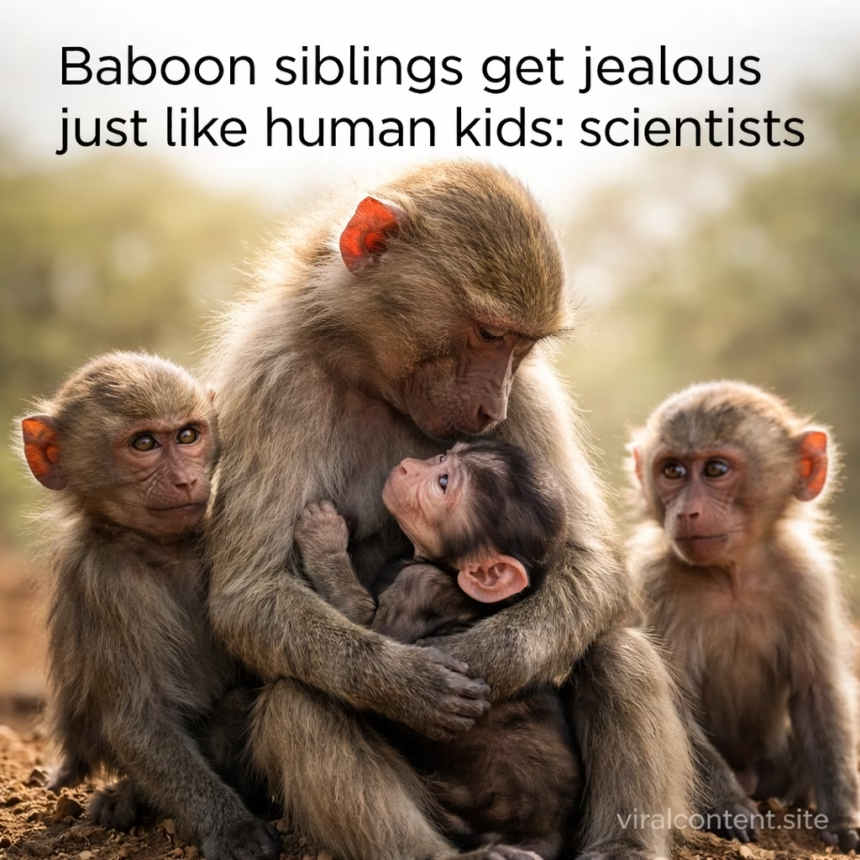
New scientific research reveals that young baboon siblings display clear signs of jealousy, mirroring competitive behaviors observed in human children. Conducted within Kenya's Amboseli ecosystem, these groundbreaking findings, recently published in a leading scientific journal, challenge long-held assumptions about the complexity of primate emotions and social structures. The study suggests that the evolutionary roots of sibling rivalry may extend far deeper than previously understood, offering fresh perspectives on the development of social cognition across species.
Background: Decades of Observation in the Amboseli
The foundation for this recent discovery lies in the Amboseli Baboon Research Project (ABRP), a long-term study initiated in 1971. Located in the Amboseli ecosystem of southern Kenya, at the foot of Mount Kilimanjaro, the project has meticulously tracked the lives of wild savanna baboons (Papio cynocephalus) for over five decades. This continuous, detailed monitoring has provided an invaluable dataset, encompassing birth, death, social interactions, genetics, and stress physiology.
Baboon societies are complex, characterized by strict dominance hierarchies and strong maternal lineages. Females typically remain in their natal groups, forming close-knit kin networks. Previous research from the ABRP primarily focused on understanding the drivers of reproductive success, the dynamics of dominance hierarchies, and physiological responses to social and environmental stressors. Studies have illuminated how social bonds influence longevity, how ecological factors shape foraging strategies, and the intricate ways baboons navigate their social world.
While the emotional lives of primates have long been a subject of fascination, direct, quantifiable evidence of specific, nuanced emotions like jealousy has been challenging to establish. Earlier observations often attributed competitive behaviors among siblings primarily to resource competition or dominance establishment rather than a distinct emotional response. The ABRP's extensive genealogical records and detailed behavioral logs, however, offered a unique opportunity to delve deeper into baboon family dynamics, particularly mother-offspring interactions following a new birth.
The shift towards investigating emotional states marks an evolution in primatological research, exploring underlying cognitive and affective processes. Researchers hypothesized that the intense maternal investment characteristic of baboon rearing, coupled with the extended period of juvenile dependency, could foster competitive emotional states among siblings, akin to human households.
More Read

Key Developments: Unveiling Jealousy Through Behavior
The recent findings stem from a focused analysis of thousands of hours of behavioral observations, specifically targeting interactions within baboon families following the birth of a new infant. Researchers observed a distinct suite of behaviors exhibited by older, weaned or semi-weaned offspring—typically between one and four years of age—when their mothers began caring for a newborn sibling. These behaviors were rigorously quantified and statistically analyzed to differentiate them from general social interactions or playful antics.
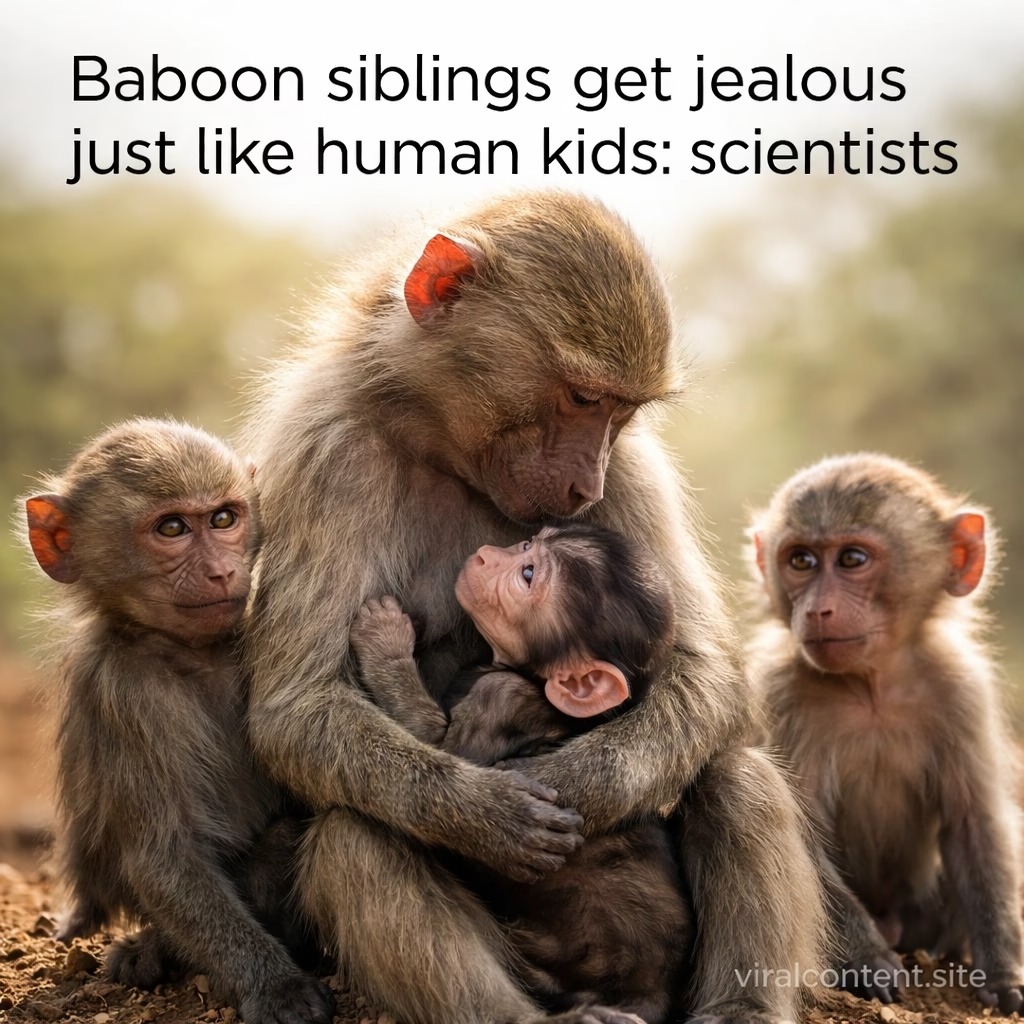
Primary indicators of jealousy included increased antagonistic behaviors from older siblings towards the new infant. These ranged from persistent nudges and attempts to separate the infant from the mother, to occasional low-intensity aggression like nipping. Crucially, these behaviors were observed to escalate when the mother was actively engaged in caregiving activities with the newborn, such as nursing, grooming, or holding.
Beyond direct aggression, older siblings frequently displayed heightened attention-seeking behaviors towards their mothers. This manifested as increased attempts to initiate grooming sessions, persistent vocalizations, or physically positioning themselves between the mother and the newborn. Older offspring sometimes attempted to displace the infant, climbing onto the mother's back or lap, demanding simultaneous attention. These actions suggest a clear competition for maternal resources, not merely physical space but also emotional investment and protective presence.
More Read

Dr. Elara Vance, lead author and a behavioral ecologist at the Princeton University Research Center for Primate Studies, explained, "When mothers actively nursed or groomed a new infant, older siblings were significantly more likely to engage in disruptive or attention-seeking behaviors. This direct response to diverted maternal attention strongly indicates an emotional state we interpret as jealousy."
The research team employed robust statistical models to control for other variables, such as the older sibling's age, sex, and the mother's dominance rank. The findings consistently pointed to the arrival of a new sibling and the subsequent shift in maternal attention as the primary trigger for these jealous displays. The study also noted a correlation between jealousy intensity and the mother's investment capacity; lower-ranking mothers, potentially struggling more, sometimes experienced more pronounced sibling rivalry.
Impact: Rewriting the Narrative on Primate Emotions
These findings have profound implications for our understanding of primate cognition, emotion, and social development. Traditionally, complex emotions like jealousy were often considered uniquely human or rudimentary in non-human primates. This research challenges that anthropocentric view, suggesting that the intricate emotional landscape of primates is far richer and more nuanced than previously acknowledged. It provides compelling evidence that the evolutionary roots of emotions central to human social life, like sibling rivalry, are shared with our closest animal relatives.
For primatology, the study opens new avenues for investigating the affective states of wild animals. It encourages researchers to look beyond purely functional or utilitarian explanations for behavior and to consider the role of internal emotional experiences. This shift could lead to a more holistic understanding of primate social dynamics, explaining conflict resolution, alliance formation, and stress responses in a new light. It also contributes to the ongoing debate about the extent of animal consciousness and self-awareness.
Beyond the academic sphere, the research holds relevance for human psychology and developmental studies. The striking parallels between baboon sibling jealousy and that observed in human children—where older siblings often react to a new baby with attention-seeking, regression, or aggression—suggest a deep, shared evolutionary heritage. Understanding these commonalities offers insights into fundamental mechanisms underlying social competition and emotional regulation in early life, potentially informing strategies for managing sibling dynamics in human families.
Furthermore, the study helps to navigate the complex line between anthropomorphism and recognizing shared evolutionary traits. Rather than projecting human emotions onto animals, the rigorous methods of the Amboseli study provide empirical grounding for attributing such emotional states. It argues for a more nuanced perspective: certain emotional responses are not exclusive to humans but are adaptive tools evolved across species to manage social relationships and resource competition within family units.
More Read

The insights could also impact animal welfare practices, particularly in captive environments. Recognizing the depth of emotional experience could lead to more sophisticated enrichment programs, addressing not just physical needs but also complex social and emotional well-being, including managing potential sibling conflicts.
What Next: Exploring the Depths of Primate Affect
The discovery of baboon sibling jealousy serves as a springboard for numerous future research directions. One immediate next step involves longitudinal studies tracking the long-term effects of sibling rivalry on both older and younger offspring. Researchers aim to investigate whether early jealous behaviors correlate with later social standing, reproductive success, or adult stress levels. This would provide crucial insights into the developmental trajectory and adaptive significance of these responses.
Another promising avenue is the exploration of physiological markers associated with these emotional states. Future research could incorporate non-invasive hormone sampling, like analyzing cortisol levels from fecal or urine samples, to determine if jealous behaviors are accompanied by measurable physiological stress responses. This would provide an even more objective and multifaceted understanding of the baboons' internal experiences.
Comparative studies with other primate species are also high on the agenda. By observing sibling dynamics in different social structures—e.g., species with less intense maternal investment or different paternal involvement—scientists can gain a broader understanding of ecological and social conditions fostering complex emotions like jealousy. This comparative approach could help identify universal principles versus species-specific adaptations.
The role of other group members, beyond the mother, in mediating sibling conflict also warrants further investigation. Do fathers, grandmothers, or other allomothers play a role in deflecting or soothing jealous behaviors? Understanding these broader social dynamics could shed light on the social scaffolding supporting emotional regulation in primate families.
Finally, researchers plan to delve deeper into individual differences. Not all older siblings display the same intensity of jealousy; some adapt more readily to a new arrival. Identifying factors predicting these individual variations—like personality traits, previous social experiences, or maternal temperament—could offer valuable insights into the interplay of genetics, environment, and development in shaping emotional responses across the animal kingdom. The ongoing work at Amboseli promises to continue unraveling the intricate tapestry of primate life, revealing ever more compelling parallels with the human experience.