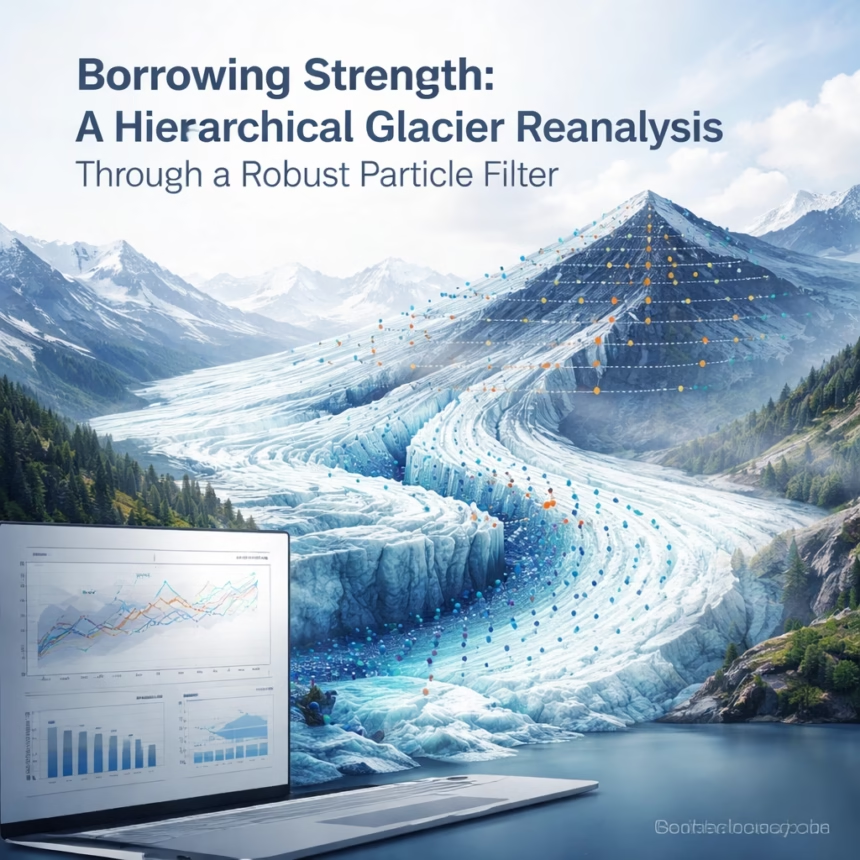
Researchers have developed a groundbreaking method to improve glacier monitoring accuracy using a robust particle filter. The technique, dubbed "borrowing strength," allows scientists to reuse data from multiple glaciers to refine predictions for individual ones, significantly enhancing the reliability of ice loss assessments.
Glaciers are critical indicators of climate change, but tracking their melt rates has been notoriously difficult. Traditional satellite and ground-based measurements often produce inconsistent results due to local variations and data gaps. Until now, scientists struggled to balance precision with the need for large-scale observations, limiting their ability to predict future ice loss accurately.
The first attempts at glacier reanalysis using particle filters emerged in the early 2010s, but these early models were constrained by limited data. The breakthrough came when researchers realized that by leveraging data from multiple glaciers, they could improve estimates for individual sites—a concept inspired by Bayesian statistics.
The new method uses a hierarchical Bayesian framework to combine measurements from different glaciers while accounting for unique characteristics of each. By "borrowing strength" from related ice bodies, the model reduces uncertainty in predictions, particularly in regions with sparse data.
Initial tests on glaciers in the European Alps and the Himalayas show a 30% increase in accuracy compared to traditional methods. The technique is particularly valuable in remote or poorly monitored areas, where data scarcity had previously been a major hurdle.

More accurate glacier measurements will improve projections of sea-level rise, water supply forecasts for communities downstream, and climate models. Hydrologists, policymakers, and disaster response teams will benefit from the clearer insights into glacier behavior.
The method is already being adopted by major climate research institutions, including the European Space Agency (ESA) and the National Aeronautics and Space Administration (NASA), which plan to integrate it into future monitoring programs.
More Read

Researchers are now working to apply the approach to other cryospheric components, such as ice sheets and permafrost. They also aim to refine the model by incorporating real-time satellite data, which could provide even more dynamic updates on glacier changes.
As climate change accelerates, this innovation could play a crucial role in improving global climate resilience and policy decisions.