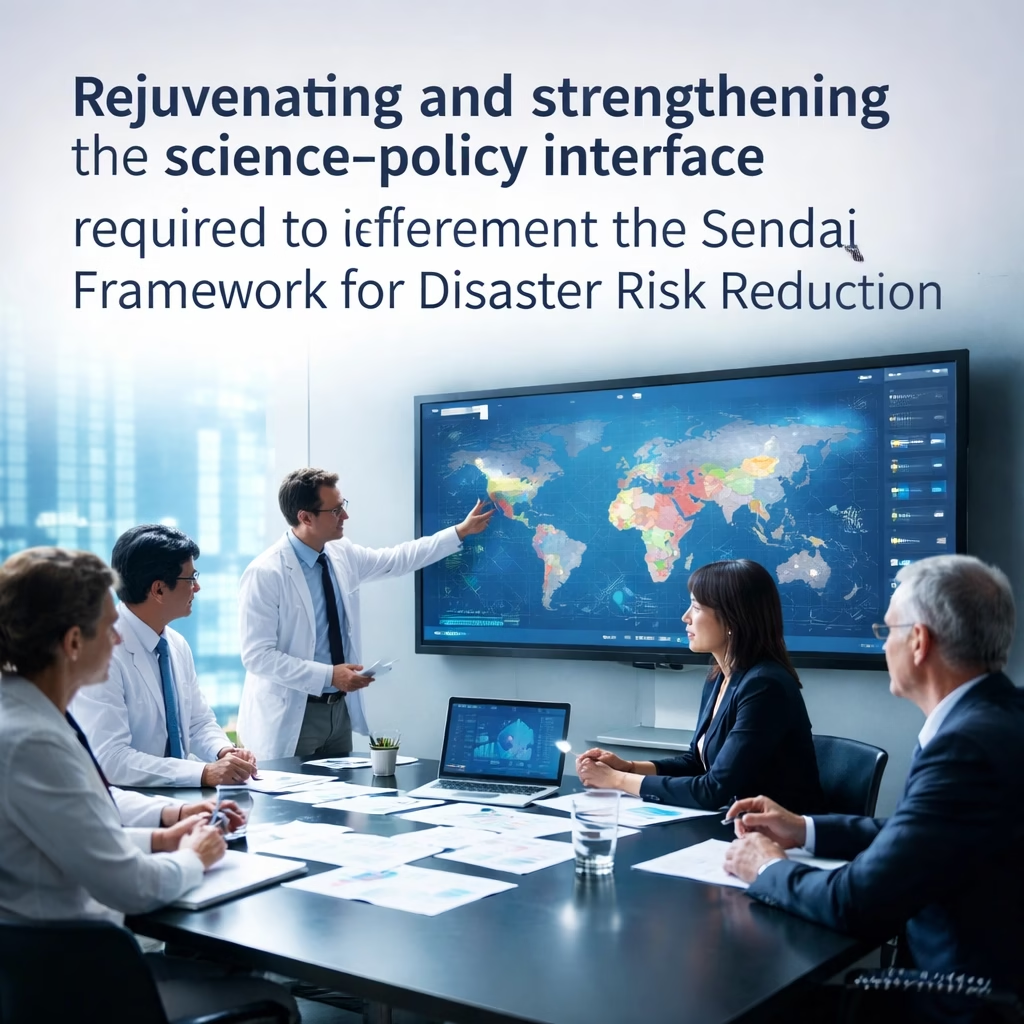
A critical call to action has emerged from the international scientific community, urging a profound rejuvenation and strengthening of the science–policy interface. This concerted push aims to accelerate the effective implementation of the Sendai Framework for Disaster Risk Reduction worldwide, particularly as global disaster risks intensify.
Background: The Foundation of Global Resilience
The Sendai Framework for Disaster Risk Reduction, adopted by UN Member States in March 2015 at the Third UN World Conference in Sendai, Japan, represents a landmark international agreement. Its primary goal is to achieve a substantial reduction of disaster risk and losses in lives, livelihoods, and health, as well as in the economic, physical, social, cultural, and environmental assets of persons, businesses, communities, and countries.
Central to the Framework's success is the effective integration of scientific knowledge into policy and practice. The science-policy interface (SPI) is the crucial conduit through which evidence-based insights inform decision-making, enabling governments and communities to develop more robust preparedness, response, and recovery strategies. However, for years, this interface has faced persistent challenges.
Historically, a significant disconnect has often existed between the scientific and policy-making spheres. Scientists frequently operate on longer research cycles, producing detailed, nuanced findings, while policymakers require timely, actionable summaries for immediate decisions. Barriers such as differing terminologies, a lack of mutual understanding regarding respective operational contexts, and insufficient dedicated platforms for dialogue have hindered effective collaboration, often leading to policies that are not fully informed by the latest scientific understanding of risk.
Despite these challenges, various initiatives have attempted to bridge this gap. The United Nations Office for Disaster Risk Reduction (UNDRR) has, for instance, supported scientific and technical advisory groups, seeking to mobilize expert knowledge. Regional platforms for disaster risk reduction have also strived to foster dialogue. Yet, the recent communication highlights that these efforts, while valuable, have not been sufficient to meet the escalating demands of a world grappling with increasingly complex and frequent hazards.
More Read

Key Developments: A Renewed Imperative for Integration
The recent "Brief Communication" underscores an urgent need to move beyond incremental adjustments, advocating for a transformative approach to the science-policy interface. This call builds upon lessons learned from the ongoing Mid-Term Review of the Sendai Framework, which has revealed persistent gaps in translating scientific understanding into tangible risk reduction actions across many nations.
The communication articulates several key areas for immediate and sustained development:
Fostering Co-design and Co-production of Knowledge
Experts are advocating for a paradigm shift from a linear model, where science simply informs policy, to a more collaborative, iterative process. This involves policymakers and practitioners engaging with scientists from the outset of research design, ensuring that questions are policy-relevant and outputs are directly usable. Co-design ensures that scientific inquiries address real-world policy dilemmas, while co-production builds trust and ownership among all stakeholders in the resulting knowledge.
More Read

Establishing Robust Dialogue Platforms
The creation and sustained funding of dedicated, institutionalized platforms for continuous dialogue between scientists, policymakers, and local communities are deemed essential. These platforms would facilitate regular exchanges, allowing for the translation of complex scientific findings into clear policy recommendations and enabling policymakers to articulate their specific information needs. Such mechanisms could range from regular expert roundtables to formalized advisory bodies embedded within national DRR agencies.
Enhancing Capacity Building Across Sectors
A dual approach to capacity building is proposed. Scientists require training in communication skills, policy processes, and understanding the operational constraints of decision-makers. Conversely, policymakers need enhanced literacy in scientific methods, risk assessment, and the implications of scientific uncertainty. This reciprocal learning fosters a shared language and a deeper appreciation for each other’s roles and contributions to disaster risk reduction.
Prioritizing Transdisciplinary Research Funding
Current funding mechanisms often favor disciplinary research. The communication calls for a significant reorientation of research funding towards transdisciplinary projects that explicitly integrate natural sciences, social sciences, engineering, and local knowledge. Such funding should support long-term collaborations that transcend traditional academic silos, directly addressing the multifaceted nature of disaster risk.
Developing Impact Metrics for the SPI
To demonstrate the value and effectiveness of a strengthened science-policy interface, there is a demand for developing robust metrics to track its impact. This includes measuring how scientific advice influences policy decisions, the uptake of evidence-based practices, and ultimately, the tangible reduction in disaster losses. Such metrics would provide accountability and justify continued investment in SPI mechanisms.
Impact: Realizing a More Resilient Future
A truly rejuvenated and strengthened science-policy interface holds transformative potential, impacting a wide array of stakeholders and significantly advancing global resilience. The primary beneficiaries are the vulnerable communities worldwide, who disproportionately bear the brunt of disasters.
More Read

For national governments and local authorities, a robust SPI translates directly into more effective and efficient disaster risk reduction strategies. Evidence-based policies can lead to better land-use planning, the construction of resilient infrastructure, the development of sophisticated early warning systems, and improved emergency response protocols. This directly contributes to saving lives and protecting livelihoods, reducing the human toll of disasters.
Economically, the impact is profound. By proactively mitigating risks through scientifically informed investments, countries can avert massive economic losses from disaster events. The World Bank estimates that every dollar invested in resilience can save up to seven dollars in post-disaster recovery costs. A stronger SPI ensures these investments are targeted and effective, optimizing resource allocation.
The scientific community itself stands to benefit from enhanced relevance and impact. By seeing their research directly applied to solve pressing societal challenges, scientists gain greater recognition and opportunities for impactful collaboration. This fosters a dynamic research environment focused on solutions-oriented inquiry.
Furthermore, a strengthened interface is critical for achieving the broader Sustainable Development Goals (SDGs). Disaster risk reduction is intrinsically linked to poverty eradication, health, education, climate action, and sustainable cities. By reducing disaster impacts, progress across multiple SDGs is accelerated, creating a more stable and equitable world.
In practice, this could mean urban planners in coastal cities utilizing cutting-edge climate models to design sea defenses that account for future sea-level rise, or agricultural policymakers implementing drought-resistant farming techniques based on agro-climatic research. It could also mean public health officials leveraging epidemiological data to predict and prepare for disaster-related health crises, preventing outbreaks and ensuring rapid medical aid.
What Next: Charting the Course for Enhanced Collaboration
The "Brief Communication" serves not merely as an observation but as a blueprint for immediate and future actions. The onus is now on a diverse array of actors to translate these recommendations into concrete operational changes, charting a course towards a more integrated and impactful science-policy landscape.
Governments at national and sub-national levels are urged to review their existing DRR frameworks and actively integrate the proposed SPI enhancements. This includes allocating dedicated budgets for transdisciplinary research, establishing formal advisory mechanisms, and fostering inter-ministerial collaboration that breaks down traditional silos between science agencies, disaster management bodies, and planning departments.
International organizations, particularly the UNDRR, are expected to play a pivotal role in facilitating this transformation. This involves developing guidelines, sharing best practices, and coordinating capacity-building efforts across member states. Upcoming regional and global platforms for DRR, such as the Global Platform for Disaster Risk Reduction, will likely serve as crucial forums for discussing progress and identifying further collaborative opportunities.
The academic and research communities are called upon to adapt their methodologies and incentive structures. This means promoting interdisciplinary collaboration, valuing policy-relevant research alongside traditional academic publications, and training the next generation of scientists to be effective communicators and collaborators with policymakers. Funding bodies, both national and international, must align their priorities with these objectives, creating incentives for solutions-oriented and transdisciplinary research.
Key milestones in the coming years will include the development of national action plans that explicitly detail how scientific advice will be integrated into DRR strategies, the establishment of new collaborative research initiatives, and measurable improvements in national disaster resilience indicators. The ultimate vision is a future where the interface between science and policy is seamless, robust, and continuously evolving, ensuring that humanity is better prepared to face and overcome the escalating challenges of a rapidly changing world.