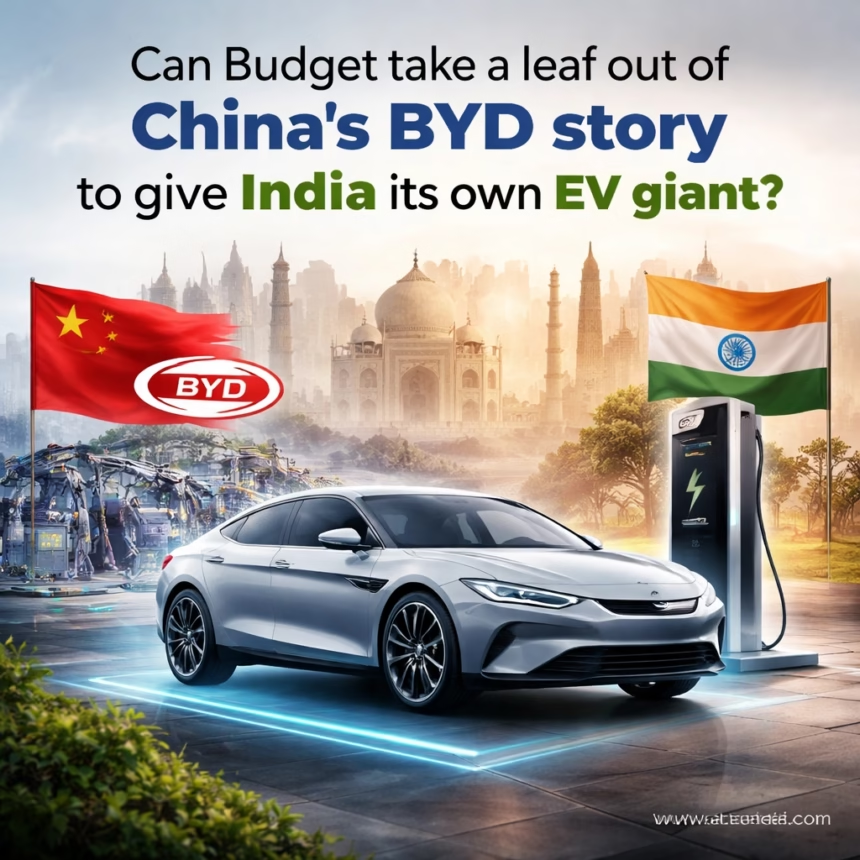
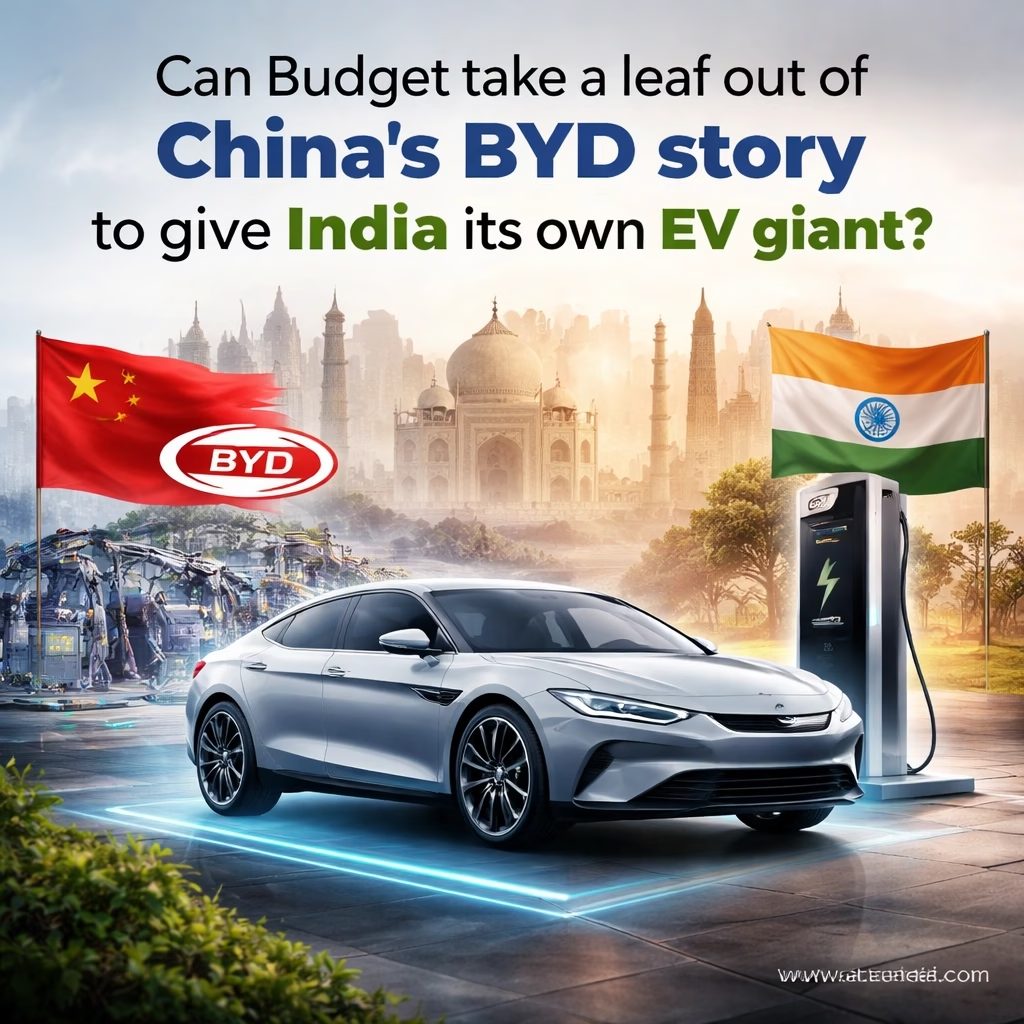
India stands at the cusp of an electric vehicle revolution, a transformation eagerly watching China's BYD, a company that surged from a modest battery manufacturer to a global EV titan. As the Indian government prepares its next Union Budget, a critical question emerges: can strategic fiscal policies and incentives replicate BYD's success story, fostering a homegrown EV giant that propels India onto the global stage? This ambition seeks to redefine India's automotive future, making electric mobility accessible and domestically robust.
Background: The Rise of BYD and India’s EV Aspirations
BYD, short for Build Your Dreams, began its journey in Shenzhen, China, in 1995 as a rechargeable battery manufacturer. Under the visionary leadership of Wang Chuanfu, it diversified into the automotive sector in 2003, acquiring Xi'an Qinchuan Automobile Company. Over two decades, BYD meticulously built a vertically integrated empire, manufacturing everything from batteries and semiconductors to electric cars, buses, and even monorails. Its strategic focus on affordability, diverse product lines, and relentless innovation allowed it to surpass Tesla in global battery electric vehicle (BEV) sales in Q4 2023, solidifying its position as a global leader.
Meanwhile, India's electric vehicle journey, though nascent, is gathering momentum. The government launched the Faster Adoption and Manufacturing of Electric Vehicles (FAME) scheme in 2015, with FAME-II following in 2019 with an outlay of approximately $1.4 billion (₹10,000 crore). This scheme offered demand incentives for electric two-wheelers, three-wheelers, four-wheelers, and buses. Complementing this, Production Linked Incentive (PLI) schemes for Advanced Chemistry Cell (ACC) battery manufacturing and the automotive sector aim to boost local production and reduce import dependency. Despite these efforts, India's EV penetration remains low, with challenges ranging from high upfront costs and range anxiety to inadequate charging infrastructure. Current domestic players like Tata Motors (with models like Nexon EV and Tiago EV), Mahindra & Mahindra (XUV400), and Ola Electric (in the two-wheeler segment) lead the charge, but a truly global-scale Indian EV giant is yet to emerge.
Key Developments: Policy Shifts and Market Dynamics
BYD's recent trajectory underscores its global ambitions. Beyond its dominant presence in China, the company has aggressively expanded into Europe, Southeast Asia, and Latin America, introducing models like the Seal, Dolphin, and Atto 3, often at competitive price points. Its focus on blade battery technology, known for safety and longevity, provides a distinct competitive edge. This global push highlights the potential for an integrated EV ecosystem to thrive internationally.
In India, policy discussions are evolving rapidly. The FAME-II scheme, initially set to conclude in March 2024, saw an extension, signaling ongoing government support. Discussions around FAME-III are underway, anticipated to come with a higher budgetary allocation and a renewed emphasis on localization, R&D, and potentially, battery swapping infrastructure. The PLI scheme for ACC battery manufacturing has already attracted significant investment proposals from companies like Reliance New Energy, Ola Electric, and Rajesh Exports, aiming to establish gigafactories within India. Furthermore, recent policy adjustments on EV imports, offering reduced duties for manufacturers committing to local production and substantial investment, indicate a strategic shift towards attracting global players while mandating domestic value addition.
More Read

Budget’s Potential Catalysts
The upcoming Union Budget presents a critical opportunity to fine-tune these policies and inject further impetus. Potential measures could include:
Tax Incentives and Subsidies: Rationalizing Goods and Services Tax (GST) rates on EVs, batteries, and charging equipment, alongside direct consumer subsidies for EV purchases, could significantly reduce the total cost of ownership.
* R&D Funding: Increased grants and tax breaks for indigenous research and development in battery technology, motor design, power electronics, and software can foster innovation similar to BYD's internal capabilities.
* Charging Infrastructure Grants: Direct funding or subsidies for the establishment of public charging stations, battery swapping networks, and residential charging points are crucial to alleviate range anxiety and improve accessibility across urban and rural areas.
* Manufacturing Ecosystem Support: Further incentives for local manufacturing of EV components, not just assembly, can strengthen the domestic supply chain and create economies of scale.
* Skill Development: Allocating funds for training programs to develop a skilled workforce for EV manufacturing, maintenance, and charging infrastructure deployment is vital for sustainable growth.
More Read

Impact: A Multi-faceted Transformation
The strategic leveraging of the Budget to foster an Indian EV giant would have far-reaching implications across various sectors.
For Consumers
A vibrant domestic EV industry, spurred by governmental support, would lead to more affordable electric vehicles, a wider range of models catering to diverse needs, and a significantly expanded, reliable charging infrastructure. This would directly address current barriers to adoption like high upfront costs and range anxiety, making EVs a more practical and attractive choice for the average Indian consumer.
For Indian Manufacturers
Domestic players like Tata Motors, Mahindra, Ola Electric, Bajaj Auto, and TVS Motor Company would find themselves in a more conducive environment for growth. Enhanced demand, coupled with support for R&D and local manufacturing, could enable them to achieve greater economies of scale, invest more in innovation, and potentially compete on a global stage, mirroring BYD's trajectory. This would also encourage new startups and MSMEs to enter the EV ecosystem, fostering competition and innovation.
For the Economy
The creation of an Indian EV giant, alongside a robust supporting ecosystem, promises substantial economic benefits. It would generate millions of new jobs across manufacturing, R&D, sales, service, and infrastructure development. A thriving domestic EV industry would also significantly reduce India's reliance on crude oil imports, improving energy security and saving billions in foreign exchange. Furthermore, it would position India as a key player in the global EV supply chain, attracting foreign investment and boosting exports.
For the Environment
Perhaps the most visible impact would be on environmental sustainability. A widespread adoption of EVs would lead to a drastic reduction in vehicular emissions, improving urban air quality and contributing significantly to India's climate change mitigation goals. It aligns with India's commitment to achieve Net Zero emissions by 2070 and transition towards a cleaner, greener economy.
What Next: Milestones on the Road Ahead
The immediate future hinges significantly on the announcements in the upcoming Union Budget. Clarity on FAME-III's scope, the quantum of financial outlay, and specific incentives for R&D and charging infrastructure will be keenly watched by the industry.
More Read

Following the Budget, the rollout and implementation of these policies will be critical. The effectiveness of PLI schemes in attracting and retaining investment for battery manufacturing will determine the pace of localization. We can expect to see increased private sector investment in manufacturing facilities, R&D centers, and charging networks as policy clarity emerges. The next few years will also be crucial for the development of a robust indigenous battery ecosystem, a cornerstone for any EV giant. This includes not just manufacturing cells but also developing expertise in raw material sourcing, battery management systems, and recycling.
Ultimately, the goal is to nurture an Indian brand that not only dominates the domestic market but also expands its footprint globally, offering technologically advanced, affordable, and sustainable electric vehicles. While the path is challenging, learning from BYD's integrated approach and leveraging strategic governmental support through the Budget can certainly lay the groundwork for India to build its own EV champion and drive towards an electrified future.