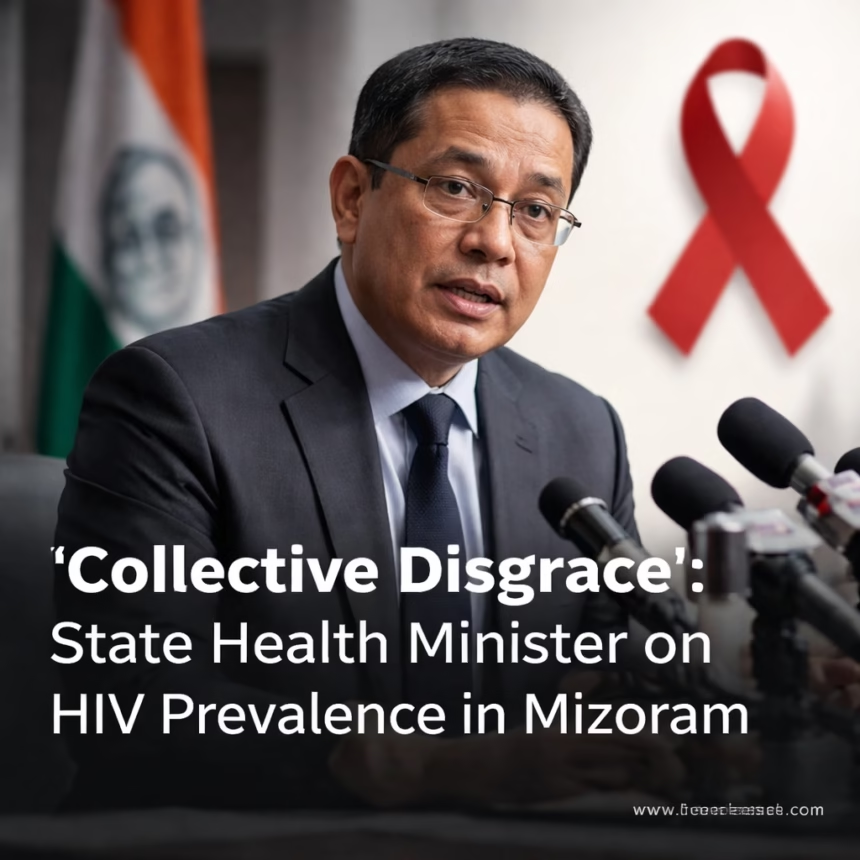
Mizoram's Silent Crisis: Health Minister Calls Soaring HIV Rates a 'Collective Disgrace'
Mizoram's Health Minister, Dr. R. Lalthangliana, recently delivered a stark assessment of the state's escalating HIV prevalence, labeling the situation a "collective disgrace." This powerful pronouncement underscores a deepening public health crisis in the northeastern Indian state, where infection rates continue to alarm health officials and communities alike, placing Mizoram at the forefront of India's HIV epidemic.
The minister's statement, made during a public address in Aizawl in late October 2023, highlighted the urgent need for a societal introspection and intensified efforts to combat the spread of the virus. His remarks reflect a growing concern over the state's persistently high prevalence, which stands significantly above the national average, demanding immediate and concerted action.
Background: A Decades-Long Battle in the Northeast
Mizoram's struggle with HIV is not a recent phenomenon but a decades-long battle rooted in its unique socio-geographic landscape. The first HIV case in the state was detected in 1990, marking the beginning of a quiet but relentless spread. Unlike many parts of India where sexual transmission has been the primary driver, Mizoram, along with other northeastern states, witnessed a distinct pattern dominated by injecting drug use (IDU).
Early Onset and Contributing Factors
The state's proximity to the 'Golden Triangle' – a major opium-producing region encompassing parts of Myanmar, Laos, and Thailand – facilitated the flow of illicit drugs. This geographic reality, coupled with a burgeoning youth population and evolving social dynamics, led to an increase in intravenous drug use. Shared needles and syringes became a critical vector for HIV transmission among this vulnerable demographic, quickly establishing a foothold for the virus within the community.
More Read

By the early 2000s, data from the National AIDS Control Organisation (NACO) began to flag Mizoram as a high-prevalence state. Initial interventions focused on harm reduction programs, including needle and syringe exchange programs (NSP) and opioid substitution therapy (OST), alongside awareness campaigns. However, the scale of the challenge often outpaced the resources and reach of these early initiatives, allowing the epidemic to entrench itself further.
Cultural factors and societal norms also played a role. A strong sense of community, while beneficial in many aspects, sometimes led to a reluctance to openly discuss sensitive topics like drug use and sexual health, inadvertently creating barriers to effective prevention and early detection efforts. This complex interplay of geography, social behavior, and public health infrastructure set the stage for the current crisis.
Key Developments: Alarming Statistics and Ministerial Scrutiny
The recent pronouncement by Dr. Lalthangliana comes amidst a backdrop of increasingly alarming statistics that paint a grim picture of the HIV epidemic in Mizoram. Data released by the Mizoram State AIDS Control Society (MSACS) and NACO consistently place the state at the top nationally in terms of adult HIV prevalence.
More Read

Alarming Statistics Revealed
As of September 2023, the adult HIV prevalence rate in Mizoram stands at approximately 2.3%, a stark contrast to the national average of around 0.22%. This means that nearly one in every 40 adults in the state is living with HIV. The cumulative number of people living with HIV/AIDS (PLHIV) in Mizoram has surpassed 27,000, a significant figure for a state with a population of just over 1.2 million.
Equally concerning is the rate of new infections. Reports indicate that over 2,000 new cases are detected annually, with a disproportionate number occurring among young people aged 15-29 years. This demographic trend signals a continued spread within the most economically active and reproductive segments of the population, posing long-term challenges for the state's development.
Minister’s Stern Warning
Minister Lalthangliana's use of the term "collective disgrace" was not merely rhetorical; it was a direct challenge to the Mizo society to acknowledge the gravity of the situation and collectively own the responsibility for its mitigation. He highlighted that despite various government programs and NGO interventions, the numbers continue to climb, suggesting that current strategies might be insufficient or not reaching their intended impact.
His speech emphasized the need to move beyond blame and stigma, urging for a unified approach involving every segment of society – from community leaders and religious organizations to educational institutions and individual families. The minister's candid remarks have sparked renewed discussions across the state, bringing the often-taboo subject of HIV/AIDS into mainstream public discourse.
Impact: Far-Reaching Consequences on Society
The high prevalence of HIV in Mizoram has profound and far-reaching consequences, affecting individuals, families, the healthcare system, and the broader socio-economic fabric of the state. The impact extends beyond mere statistics, touching upon deeply personal and societal challenges.

Vulnerable Populations and Social Stigma
While injecting drug users remain a key affected population, the epidemic has increasingly spread to the general population through sexual transmission, particularly among heterosexual couples. Women, who are often economically dependent and have less agency in negotiating safe sex, are becoming increasingly vulnerable. Mother-to-child transmission, though largely preventable with proper interventions, continues to contribute to new pediatric cases.
Social stigma remains a formidable barrier. Individuals living with HIV often face discrimination in employment, education, and social interactions, leading to isolation, mental health issues, and delayed access to care. This stigma not only affects those living with the virus but also their families, particularly children who may be orphaned or left in the care of relatives, facing the double burden of loss and societal judgment.
Healthcare System Strain
The burden on Mizoram's healthcare infrastructure is immense. The Anti-Retroviral Therapy (ART) centers, which provide life-saving medication, are stretched to their limits. The demand for testing, counseling, and treatment services continuously outstrips available resources, leading to potential delays in diagnosis and initiation of treatment. This strain is compounded by the need for continuous supply chain management for ART drugs and the training of healthcare professionals.
Furthermore, the economic impact is significant. Families affected by HIV often face increased healthcare expenditures, loss of income due to illness, and a reduction in productivity, trapping them in cycles of poverty. At a state level, a substantial portion of the health budget is diverted towards HIV/AIDS programs, potentially impacting other essential public health services.
What Next: A Multi-pronged Approach for the Future
In response to the escalating crisis and the minister's urgent call to action, Mizoram is bracing for a renewed and intensified fight against HIV. The path forward demands a multi-pronged approach, combining robust public health interventions with strong community engagement and policy reforms.
Strengthening Prevention and Treatment
A primary focus will be on strengthening prevention strategies. This includes scaling up targeted interventions for high-risk groups, particularly IDUs, by expanding access to harm reduction services like needle and syringe exchange programs and opioid substitution therapy. For the general population, comprehensive sexuality education and awareness campaigns, tailored to reach youth in schools and colleges, are crucial to promote safe sexual practices and reduce new infections.
Simultaneously, efforts to enhance testing and counseling services will be prioritized. Expanding access to voluntary counseling and testing (VCT) centers, integrating HIV testing into routine healthcare, and promoting self-testing options can facilitate early diagnosis. Early diagnosis is critical for prompt initiation of Anti-Retroviral Therapy (ART), which not only improves the health outcomes of PLHIV but also significantly reduces the risk of transmission.
The state government, in collaboration with NACO, aims to bolster its ART centers, ensuring an uninterrupted supply of medicines and adequate staffing. Special attention will be given to preventing mother-to-child transmission (PMTCT) through early screening of pregnant women and providing necessary interventions.
Community Engagement and Policy Reforms
Crucially, tackling the "collective disgrace" requires active community participation. Religious leaders, civil society organizations, and local community groups are being urged to play a more proactive role in disseminating accurate information, challenging stigma, and fostering an environment of support and acceptance for PLHIV. Peer education programs, especially among youth and key affected populations, are vital for effective outreach.
Policy reforms may also be on the horizon, focusing on strengthening laws against discrimination and ensuring the rights of PLHIV are protected. Increased budgetary allocation for HIV/AIDS programs, exploring innovative funding mechanisms, and fostering partnerships with national and international health organizations will be essential to sustain long-term efforts.
Mizoram's journey to overcome this health crisis will be challenging, but the minister's candid assessment has ignited a vital conversation. The coming months will test the state's collective resolve and capacity to transform a moment of disgrace into a catalyst for change, aiming for a future where HIV prevalence is significantly reduced and those living with the virus can do so with dignity and full access to care.