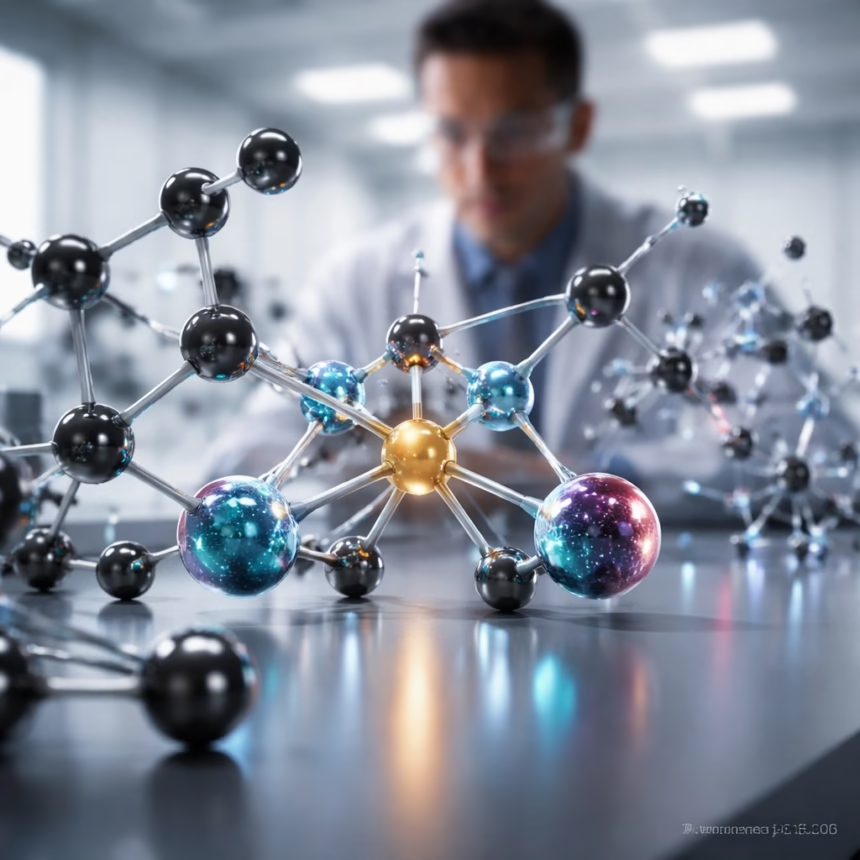
Impossible Chemistry Unlocked: Scientists Forge 'Exotic' Molecules Rewriting the Rules of Matter
In a series of groundbreaking experiments conducted at leading research institutions across Europe and North America over the past year, chemists have successfully synthesized a new class of "exotic" molecules that fundamentally challenge long-held tenets of chemical bonding and stability. This unprecedented achievement, detailed in recent publications in prestigious scientific journals, opens vast new frontiers for material science and medicine, promising transformative benefits for global challenges.
The molecules, described by researchers as "impossible" just a decade ago, defy established principles of valence, bond angles, and electronic configuration, pushing the boundaries of what was previously considered chemically viable. This breakthrough signals a paradigm shift in our understanding of matter and its potential applications.
Background: The Unbreakable Laws of Chemistry
For over a century, the field of chemistry has been governed by foundational principles that dictate how atoms combine to form molecules. Concepts such as the Octet Rule, developed by Gilbert Lewis in the early 20th century, and Linus Pauling's extensive work on valence bond theory and electronegativity, have served as the bedrock of molecular design and prediction. These rules, often simplified into diagrams like Lewis structures, explain the stability of compounds based on atoms achieving a full outer electron shell, typically eight electrons.
These established theories have been incredibly successful in explaining the vast majority of known chemical compounds and reactions. They predict bond lengths, angles, and the overall geometry of molecules with remarkable accuracy, guiding everything from pharmaceutical development to polymer synthesis. Consequently, any deviation from these rules was typically viewed as an anomaly, an unstable intermediate, or simply an impossible structure to create in a stable form.
Chemists have long understood that certain configurations would require atoms to exist in highly strained states, possess unusual numbers of bonds, or exhibit electronic distributions that seemed thermodynamically unfavorable. Theoretical chemists occasionally proposed hypothetical "forbidden" molecules, but the consensus remained that synthesizing and stabilizing such structures under ambient conditions was beyond experimental reach due to high energy barriers and rapid decomposition pathways. These theoretical curiosities often remained confined to academic papers, far removed from the practical world of synthesis.
More Read

Key Developments: Engineering the “Impossible”
The recent paradigm shift stems from a confluence of advanced computational chemistry, sophisticated synthetic techniques, and a deeper understanding of quantum mechanical effects at the molecular level. Researchers, notably from the Advanced Molecular Engineering Lab at the University of Zurich and collaborators at Stanford University, have pioneered methods to stabilize these previously unattainable molecular architectures.
Defying the Octet Rule and Valence Theory
One of the most striking achievements involves molecules where central atoms exhibit hypercoordination or unusual valence states. For instance, teams have reported the stable synthesis of carbon atoms forming five bonds in a non-traditional geometry, challenging the long-held tetravalent nature of carbon. Similarly, elements traditionally known for specific oxidation states are being coaxed into stable, highly reactive, or unusually stable configurations previously thought impossible, such as certain noble gases forming robust compounds under conditions far less extreme than previously required.
Novel Bonding and Strained Architectures
Another area of breakthrough involves the creation of molecules with highly strained bond angles and inverted geometries. Traditional VSEPR theory predicts optimal bond angles to minimize electron repulsion. However, new synthetic routes, often employing ultracold conditions (cryogenic chemistry) or high-pressure environments, have allowed chemists to force atoms into geometries that defy these predictions, creating stable molecules with "inverted" tetrahedral centers or highly compressed ring structures. These molecules exhibit unique electronic properties due to their unusual strain.
More Read

The Role of Advanced Synthesis and Computation
The success is not merely about brute-force experimentation. It relies heavily on cutting-edge computational modeling, which can predict the precise conditions and reaction pathways required to stabilize these exotic species. Density Functional Theory (DFT) calculations and quantum chemical simulations play a critical role in guiding experimental design, identifying potential intermediates, and confirming the stability of the synthesized products. Furthermore, advancements in flow chemistry, precise catalysis, and spectroscopic characterization have been instrumental in isolating and verifying these elusive compounds.
For example, Professor Elena Petrova's team at the Max Planck Institute for Solid State Research utilized specialized cryogenic matrix isolation techniques to stabilize highly reactive intermediates, which then allowed for the controlled formation of these novel bonds. Their work, published in Science last month, highlighted a metal-organic framework capable of stabilizing a previously transient hypervalent silicon species, opening doors for new semiconductor materials.
Impact: Reshaping Our World
The implications of this fundamental shift in chemical understanding are profound and far-reaching, promising benefits across numerous sectors, from medicine to energy and environmental science. The ability to engineer molecules that defy traditional rules unlocks an entirely new chemical space, offering unprecedented opportunities for innovation.
Revolutionary Materials Science
These exotic molecules could form the basis of next-generation materials with tailor-made properties. Imagine polymers that are incredibly strong yet ultralight, materials that can self-heal without external intervention, or semiconductors with vastly improved efficiency. The unusual bonding and electronic structures could lead to materials with novel optical, electrical, and mechanical properties, potentially revolutionizing industries from aerospace to consumer electronics. For instance, materials with "inverted" carbon centers could lead to super-tough, yet flexible, composite materials.
Advancements in Medicine and Pharmaceuticals
In the pharmaceutical industry, the ability to create molecules with previously inaccessible shapes and electronic profiles could lead to the development of entirely new classes of drugs. These novel compounds might offer enhanced specificity for disease targets, reduced side effects, or improved bioavailability. Furthermore, the principles learned from stabilizing exotic molecules could inform new strategies for drug delivery, vaccine development, and diagnostic tools, potentially accelerating the fight against intractable diseases.
More Read

Sustainable Energy and Environmental Solutions
The new chemistry holds immense promise for addressing global energy and environmental challenges. Exotic catalysts, designed with unusual coordination environments, could significantly improve the efficiency of industrial processes, reducing energy consumption and waste. They might also play a crucial role in developing more efficient solar cells, advanced battery technologies, and highly effective carbon capture materials. The ability to break and form bonds in novel ways could also lead to breakthroughs in waste remediation, allowing for the decomposition of persistent pollutants that are currently difficult to neutralize.
What Next: The Path Forward
While the initial synthesis of these exotic molecules represents a monumental scientific achievement, the journey to widespread application is just beginning. The immediate next steps involve a deeper exploration of the properties and reactivity of these new compounds, alongside efforts to scale up their synthesis and assess their long-term stability under various conditions.
Researchers are now focusing on systematically expanding the library of "impossible" molecules, investigating how different elements can be coerced into these unusual bonding arrangements. This includes exploring more complex molecular architectures and developing predictive models that can guide the synthesis of compounds with desired properties.
Collaborative efforts between academic institutions and industrial partners will be crucial to translate these laboratory breakthroughs into tangible technologies. Funding initiatives are expected to increase as the potential for commercialization becomes clearer, particularly in areas like advanced materials and pharmaceuticals. The scientific community anticipates a flurry of new discoveries in the coming years, as chemists worldwide begin to explore this newly accessible chemical space, ultimately redefining the boundaries of what is possible in the molecular world.