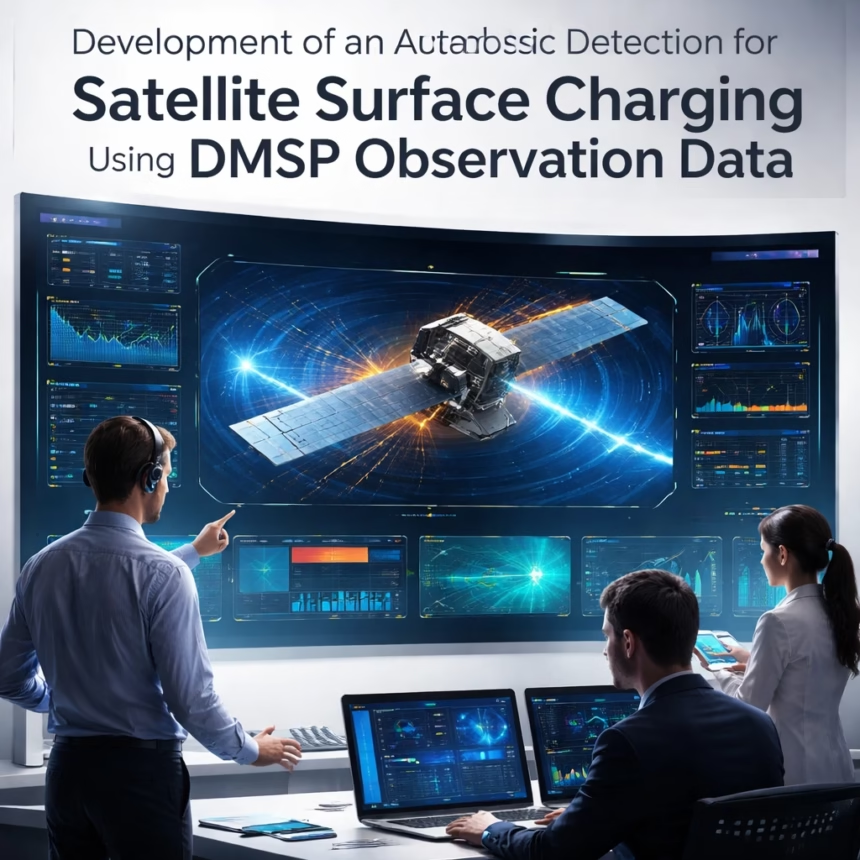
Space Sentinels: New AI System Auto-Detects Satellite Charging Threats!
Scientists have unveiled a groundbreaking automatic detection system designed to monitor and predict satellite surface charging, a critical threat to orbital infrastructure. This innovative technology leverages decades of invaluable data from the Defense Meteorological Satellite Program (DMSP) to safeguard critical orbital assets against damaging plasma events. The development marks a significant step forward in space weather preparedness, with ongoing research focusing on the intricate plasma environment surrounding Earth.
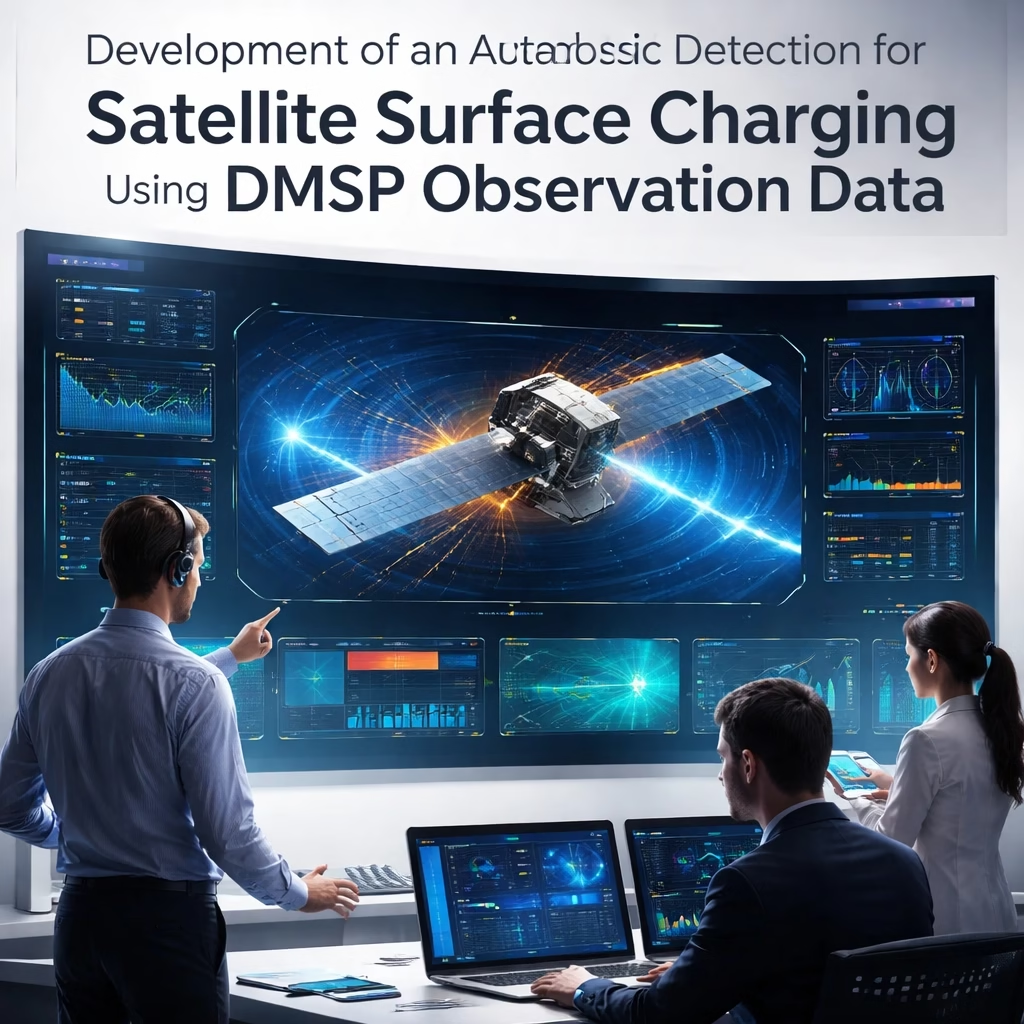
Background: The Silent Threat in Orbit
For decades, satellites have been indispensable tools for modern society, enabling global communication, precise navigation, accurate weather forecasting, and vital scientific research. However, these sophisticated machines operate in the harsh environment of space, constantly exposed to phenomena like space weather. One of the most insidious threats is satellite surface charging, a process where energetic electrons from the Earth's magnetosphere accumulate on the spacecraft's exterior.
This accumulation of charge can lead to electrostatic discharge (ESD), essentially a miniature lightning strike across the satellite's surface. Such discharges can damage sensitive electronic components, cause phantom commands, trigger resets, or even lead to complete mission failure. Historical incidents, such as anomalies experienced by telecommunications satellites in geostationary orbit (GEO) during geomagnetic storms, underscore the severity of this problem. For instance, the Anik E1 satellite experienced multiple anomalies linked to surface charging events in the mid-1990s, highlighting the vulnerability of these crucial assets.
More Read

The DMSP Legacy: Eyes on the Plasma Environment
The Defense Meteorological Satellite Program (DMSP) has been a cornerstone of space weather observation for over four decades. Operating in polar orbits, DMSP satellites (specifically F13, F15, F16, F17, and F18) have carried a suite of instruments crucial for monitoring the space environment. Key among these are the Special Sensor J (SSJ/4 and SSJ5) electrostatic analyzers, which measure precipitating electrons and ions, and the Special Sensor Ion and Electron Spectrometer (SSIES), which provides in-situ measurements of thermal plasma density, temperature, and drift velocity.
These instruments have continuously collected vast amounts of data on the energetic particle fluxes and plasma characteristics in low Earth orbit (LEO) and the auroral zones. This treasure trove of information has been instrumental in understanding the dynamics of the magnetosphere and ionosphere. Until recently, identifying potential charging events from this data often required extensive manual analysis by expert researchers, making real-time, proactive warnings challenging.
Key Developments: Automating the Watchdog
The new automatic detection system represents a significant leap from retrospective analysis to proactive monitoring. Developed by a consortium of researchers at institutions like the Space Environment Research Center (SERC) and collaborating university labs, the system employs advanced machine learning algorithms to process DMSP data streams in near real-time. The core innovation lies in its ability to rapidly identify specific plasma signatures known to precede or indicate hazardous surface charging conditions.

The system ingests data from multiple DMSP satellites, including electron differential flux, ion density, and spacecraft potential measurements. By analyzing these parameters across various energy ranges and spatial locations, the algorithms can detect patterns indicative of "killer electron" events – periods of high-energy electron enhancement that pose the greatest risk for surface charging. Initial validation trials, utilizing historical DMSP data correlated with known satellite anomalies, have demonstrated a high accuracy rate in identifying charging-prone environments.
Algorithm Design and Data Fusion
At the heart of the system are sophisticated neural networks trained on a meticulously curated dataset spanning over two decades of DMSP observations. These networks are designed to recognize subtle correlations and thresholds that human analysts might miss. For instance, a sudden drop in ambient plasma density coupled with an increase in energetic electron flux is a classic signature of a charging environment. The system can now autonomously flag such conditions.
Furthermore, the system incorporates data fusion techniques, combining observations from different DMSP satellites to create a more comprehensive picture of the global plasma environment. This provides a wider spatial coverage and allows for better tracking of plasma boundaries and energetic particle injections, which are often precursors to severe charging events in geostationary orbit, even though DMSP operates in LEO. The system essentially uses LEO observations as an early warning proxy for conditions affecting higher orbits.
Impact: Safeguarding Critical Infrastructure
The implications of this automated detection system are far-reaching, offering unprecedented protection for a wide array of orbital assets. Satellite operators, both commercial and governmental, stand to benefit immensely. For a major telecommunications provider, timely warnings mean the ability to proactively manage transponder loads, reconfigure power systems, or even temporarily power down non-essential components to mitigate risk. This can prevent costly service interruptions and extend the operational lifespan of multi-million dollar satellites.
Military and intelligence agencies, heavily reliant on continuous satellite operations for reconnaissance, communication, and navigation, will see enhanced resilience in their space-based assets. Uninterrupted data links and reliable GPS signals are paramount for national security, and this system provides a crucial layer of defense against space weather disruptions. Moreover, the reduction in anomaly rates translates directly into significant cost savings, avoiding expensive troubleshooting, repairs, or premature satellite replacements.
Empowering Proactive Mitigation
Beyond simply detecting threats, the system empowers operators with actionable intelligence. Instead of reacting to an anomaly after it occurs, they can now implement proactive mitigation strategies. This might include adjusting satellite orientation to minimize exposure to charging particles, initiating power cycling procedures to dissipate accumulated charge, or temporarily switching to redundant systems. Such capabilities transform space weather preparedness from a reactive measure into a predictive, preventative discipline, enhancing the overall reliability and robustness of the global space infrastructure.
What Next: Towards a Predictive Space Weather Grid
The current automatic detection system is just the first step in a broader vision for comprehensive space weather management. Researchers are already planning several key advancements. The immediate next phase involves further refining the algorithms, incorporating more advanced deep learning techniques, and integrating data from additional satellite constellations beyond DMSP, such as NOAA's POES series and ESA's Swarm mission.
A major milestone will be the development of robust predictive capabilities. While the current system excels at real-time detection, future iterations aim to forecast charging risks hours or even days in advance. This will involve coupling the detection system with sophisticated physics-based models of the Earth's magnetosphere, allowing for simulations of how solar wind conditions propagate through the space environment and influence energetic particle populations around Earth. The goal is to develop a "charging threat index" that provides a quantitative, easy-to-understand risk assessment for satellite operators.
Longer-term goals include the integration of this system into a global, interconnected space weather prediction and mitigation network. This collaborative effort could involve international partners, sharing data and insights to create a unified front against the challenges posed by space weather. Ultimately, the aim is to ensure the continued, uninterrupted operation of the vital satellites that underpin modern civilization, making space a safer domain for all humanity.