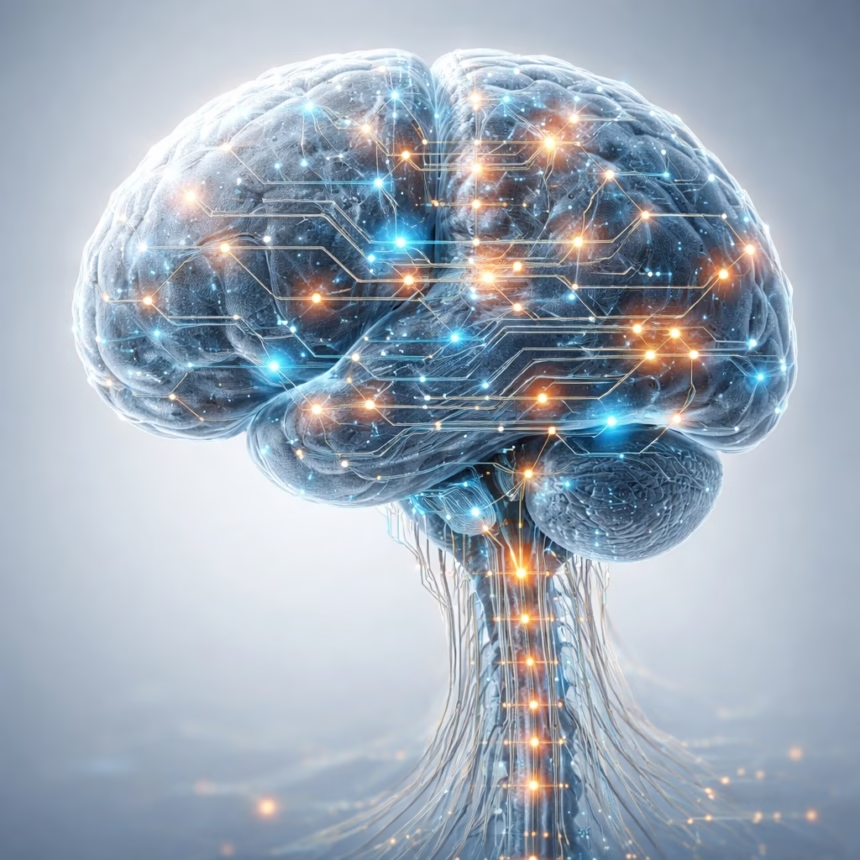
For decades, the brain reigned supreme as the undisputed command center of the human body. However, a growing body of research, spanning leading institutions worldwide, is now fundamentally reshaping this understanding. Recent breakthroughs highlight an intricate, distributed network of control circuits extending across the entire brain-and-cord connectome, challenging traditional notions of neurological hierarchy and opening new frontiers in medicine.
Background: A Century of Shifting Paradigms
The concept of a centralized brain governing all bodily functions has been a cornerstone of neuroscience since the early 20th century. Pioneers like Santiago Ramón y Cajal illuminated the neuron's structure, paving the way for understanding discrete brain regions responsible for specific tasks. This "localization of function" model largely dominated, portraying the spinal cord primarily as a passive conduit for signals.
The late 20th century saw the rise of systems neuroscience, acknowledging complex interactions between brain areas. Yet, the emphasis remained heavily cortical. The advent of projects like the Human Connectome Project (launched in 2010) and the U.S. BRAIN Initiative (2013) marked a pivotal shift, aiming to map the brain's complete wiring diagram. These ambitious endeavors, alongside advances in imaging and genetic tools, began to reveal a far more integrated and dynamic communication system than previously imagined, with the spinal cord emerging as a surprisingly active participant.
Key Developments: Unveiling the Distributed Network
Recent years have brought a cascade of discoveries demonstrating the spinal cord's profound capacity for local processing and its active role in complex behaviors. Researchers have identified specialized neural circuits within the spinal cord itself, capable of intricate computations independent of direct brain input.
The Spinal Cord’s Hidden Intelligence
Studies using advanced optogenetic and chemogenetic techniques have pinpointed "mini-brains" within the spinal cord. For instance, experiments at institutions like the Salk Institute have shown that specific spinal interneurons can generate rhythmic patterns crucial for locomotion, even after being disconnected from the brain. This intrinsic capability suggests that the spinal cord doesn't merely relay commands but actively contributes to the generation and modulation of movement, adapting to sensory feedback in real-time.

Bidirectional Communication and Feedback Loops
Further research, often utilizing high-resolution functional MRI (fMRI) and diffusion tensor imaging (DTI) at centers like the Max Planck Institute, has illuminated robust bidirectional communication pathways. It's not just the brain sending orders down the cord; the spinal cord constantly sends information back, influencing cortical activity and shaping higher-level decisions. These feedback loops are critical for fine-tuning motor control, modulating pain perception, and regulating autonomic functions such as breathing and bladder control.
Distributed Control of Autonomic Functions
Beyond movement, the distributed nature of control extends to vital autonomic processes. Research published in 2022 by a consortium including Stanford University demonstrated that circuits in the thoracic spinal cord play a more significant role in cardiovascular regulation than previously understood, processing signals and initiating responses with surprising autonomy. This distributed control architecture offers a more resilient and adaptable physiological system.
Impact: Redefining Health and Human Potential
The paradigm shift towards understanding distributed control circuits carries profound implications across medicine, technology, and our fundamental grasp of human physiology.

Revolutionizing Spinal Cord Injury Rehabilitation
For individuals with spinal cord injuries (SCI), the new understanding offers unprecedented hope. Instead of solely focusing on repairing severed connections to the brain, therapies can now target and enhance the intrinsic processing capabilities of the spinal cord below the injury site. Clinical trials, underway since 2020 at centers like the EPFL in Switzerland, are exploring epidural stimulation techniques to activate dormant spinal circuits, enabling partial recovery of voluntary movement and standing in some patients.
New Avenues for Chronic Pain Management
Chronic pain, a debilitating condition affecting millions, is increasingly understood as a dysfunction within distributed neural networks. By mapping the intricate interplay between brain and spinal cord pathways in pain processing, researchers are developing novel neuromodulation strategies. These could involve precise stimulation of spinal circuits or targeted pharmacological interventions to rebalance abnormal activity, moving beyond generalized opioid treatments.
Advancements in Neuroprosthetics and BCIs
The development of more intuitive and functional neuroprosthetics stands to benefit immensely. By understanding how distributed circuits control natural movement, engineers can design brain-computer interfaces (BCIs) and prosthetic limbs that integrate more seamlessly with the body's inherent control mechanisms, offering users more natural and fluid control over artificial limbs.
Inspiration for Artificial Intelligence
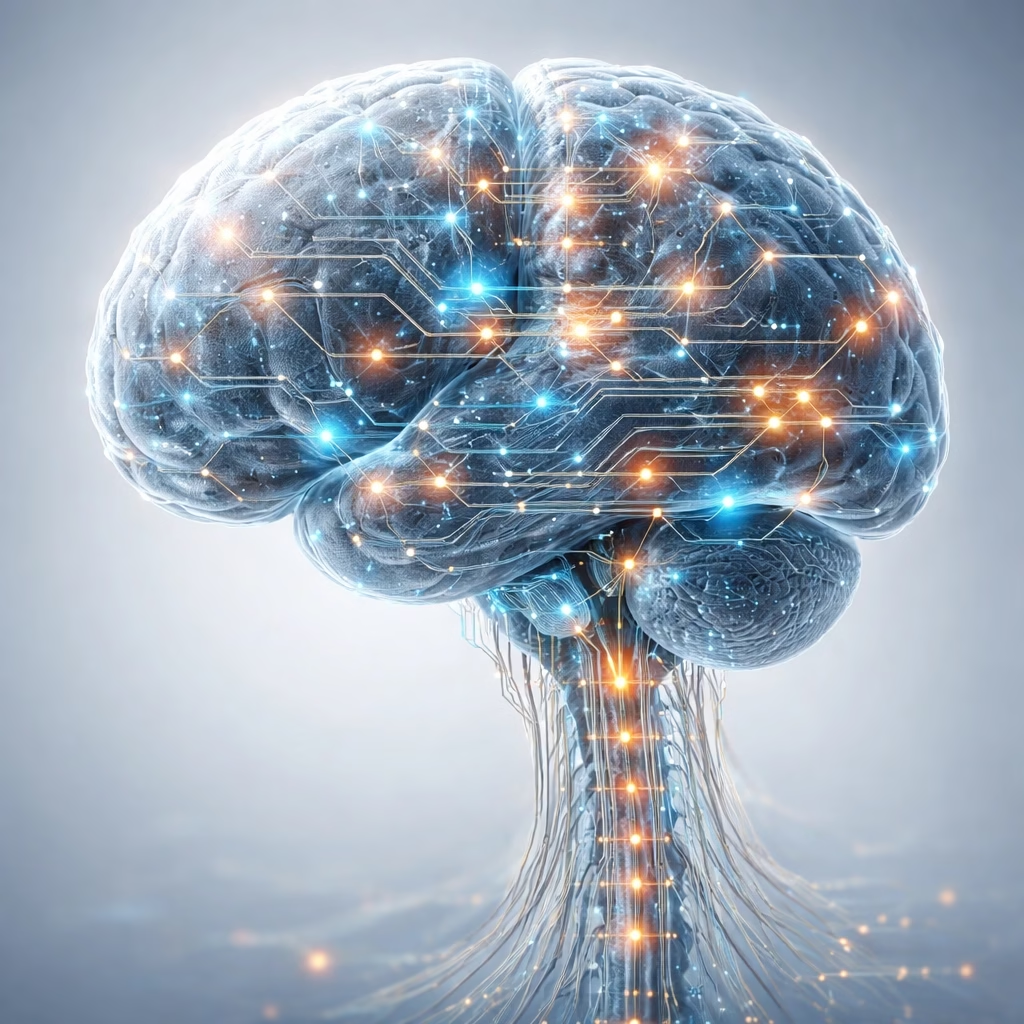
The distributed, fault-tolerant architecture of the brain-and-cord connectome provides a powerful model for advanced artificial intelligence and machine learning. Emulating these biological principles could lead to more robust, adaptable, and energy-efficient AI systems capable of complex decision-making and motor control.
What Next: The Horizon of Integrated Neuroscience
The journey into the distributed connectome is just beginning. The coming decade promises even more transformative discoveries and applications.
More Read

Mapping the Functional Connectome at Unprecedented Resolution
Future research will focus on mapping complete functional connectomes at a cellular and even subcellular resolution. This will involve integrating vast datasets from electron microscopy, advanced functional imaging, and single-cell sequencing to create comprehensive "wiring diagrams" that detail not just connections but also their activity patterns across the entire brain-cord axis.
Developing Closed-Loop Neuromodulation Therapies
A major milestone will be the development of sophisticated closed-loop neuromodulation devices. These systems will continuously monitor neural activity in both the brain and spinal cord, dynamically adjusting stimulation or drug delivery to optimize function in real-time, personalized for each patient's unique neurological profile. Such therapies are expected to move from research to clinical trials within the next five to ten years for conditions like chronic pain, movement disorders, and autonomic dysregulation.
Personalized Medicine and Diagnostic Tools
Understanding individual variations in distributed control circuits will pave the way for highly personalized medicine. Diagnostic tools will emerge that can identify subtle network dysfunctions before overt symptoms appear, allowing for earlier, more effective interventions. This era of integrated neuroscience promises a future where the body's entire neural landscape is leveraged for health and human enhancement.

![[UPDATED] PM orders immediate crackdown on illegal businesses run by foreigners](https://viralcontent.site/wp-content/uploads/2026/06/422c6a20-a360-41de-bdf1-425a87f7049f-150x150.avif "422c6a20-a360-41de-bdf1-425a87f7049f - Viral Content Site")