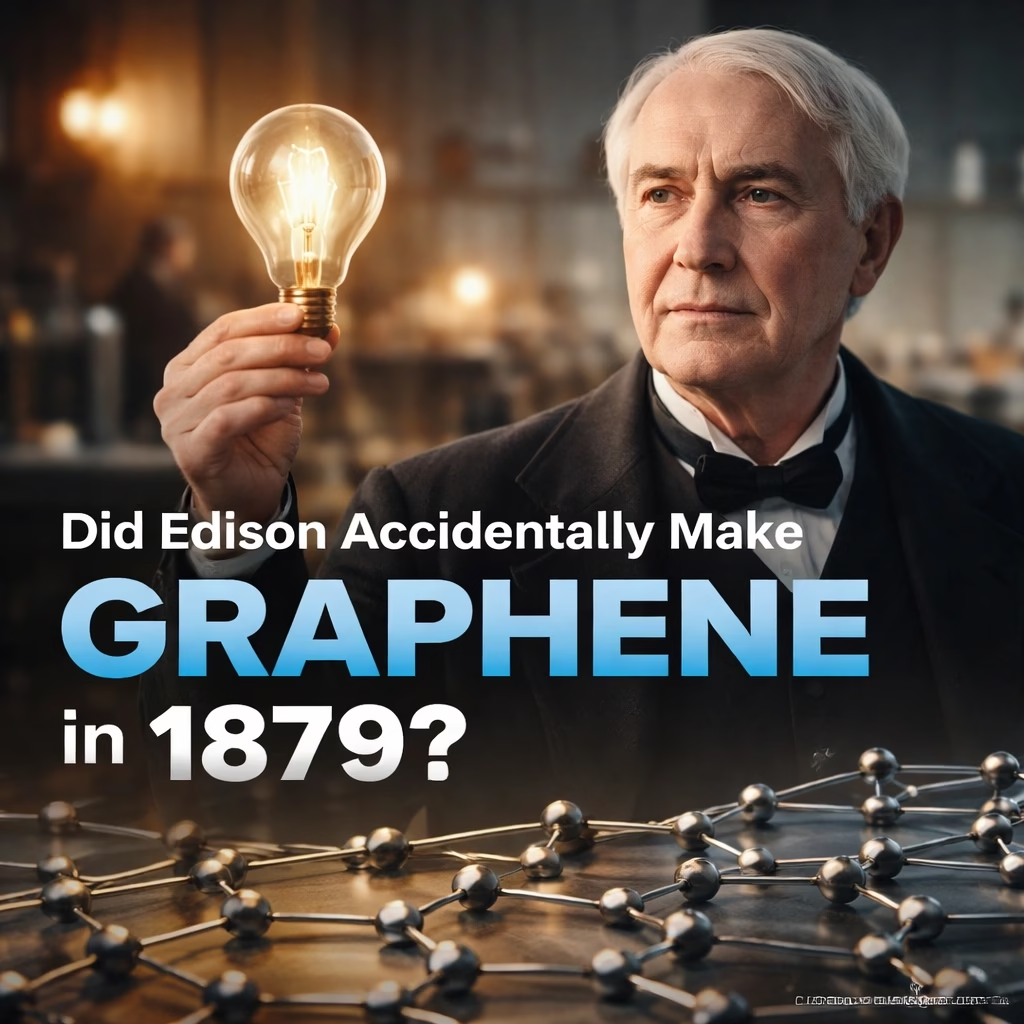
Did Edison Accidentally Make Graphene?
An intriguing hypothesis suggests that Thomas Edison, in his pioneering development of the incandescent light bulb, may have inadvertently created graphene as early as 1879. This potential accidental discovery reportedly occurred in his Menlo Park laboratory, within the carbonized filaments that revolutionized illumination.
Background: From Carbon Filaments to Graphene’s Unveiling
The late 19th century saw intense competition to develop a practical electric light. Thomas Edison's breakthrough came with the use of carbonized organic materials for filaments. After experimenting with various substances like paper and cotton, he found success with carbonized bamboo fibers in 1879. This process involved heating the organic material in an oxygen-free environment (pyrolysis), converting it into a pure carbon structure capable of glowing for hundreds of hours when electrified.
Over a century later, in 2004, Andre Geim and Konstantin Novoselov at the University of Manchester isolated a single atomic layer of carbon, naming it graphene. This two-dimensional material, arranged in a hexagonal lattice, is exceptionally strong, conductive, and transparent. Their discovery earned them the Nobel Prize in Physics in 2010.
The connection between Edison's work and graphene lies in the carbonization process. Pyrolysis of organic materials like cellulose (from bamboo) at high temperatures can transform them into graphitic carbon. Under specific conditions, and potentially aided by the extreme heat and electrical current within the filament, single or few-layer graphene flakes could have formed within the carbon matrix. Edison's focus was longevity and resistance, but the atomic-level transformations were complex.

Key Developments: Re-evaluating Historical Processes
The hypothesis of Edison's accidental graphene has gained traction due to advancements in material science and analytical techniques. Researchers are now examining historical manufacturing methods for unforeseen material discoveries.
Scientists theorize that the rapid heating and cooling cycles during filament production, combined with the specific precursor materials and oxygen-free environment, could have created conditions favorable for graphene formation. While direct, non-destructive analysis of Edison's original 19th-century filaments remains challenging, modern experiments have attempted to replicate his carbonization methods.
More Read

Studies involving the pyrolysis of organic precursors similar to those Edison used (e.g., bamboo, cotton) under historical conditions have shown that such processes can indeed yield nanoscale graphitic structures, including few-layer graphene, within the resulting carbon. These findings provide strong theoretical and experimental support for the possibility, though definitive proof from an original Edison artifact is still sought.
Impact: A New Perspective on Invention and Material Science
The notion that Thomas Edison might have inadvertently produced graphene offers significant implications for the scientific community and the history of innovation.
This hypothesis recontextualizes Edison's genius, highlighting that practical invention often involves complex material science phenomena not fully understood at the time. It suggests that his empirical methods, focused on practical outcomes, may have inadvertently touched upon fundamental material properties that would only be formally recognized much later.
For material scientists, this historical insight could inspire new, potentially simpler and more sustainable methods for graphene production. If biomass carbonization can yield graphene, it opens doors for environmentally friendly synthesis techniques, reducing reliance on more complex or energy-intensive processes. It encourages a deeper look into "accidental" discoveries within established technologies.
The discussion also raises questions about the definition of "discovery." While Edison's process might have created graphene, he did not recognize, isolate, or characterize it. The Nobel-winning work of Geim and Novoselov was critical in formally identifying and understanding the material's unique properties.
What Next: Exploring Historical Secrets and Future Innovations
The intriguing possibility of Edison's accidental graphene continues to drive scientific curiosity and points toward future research and potential milestones.

Future investigations will likely include more precise replication of Edison's carbonization processes, optimizing parameters for graphene yield. Researchers may also explore advanced, non-destructive analytical techniques to potentially examine historical artifacts, offering definitive evidence if feasible without compromising preservation.
A significant long-term impact could be on sustainable graphene production. If biomass-derived carbonization proves to be an efficient method, it could lead to cost-effective and eco-friendly ways to manufacture this advanced material, perhaps utilizing agricultural waste, much like Edison used bamboo.
The topic is expected to remain a subject of academic discourse and public fascination. It serves as a compelling reminder that the past often holds hidden clues for future innovation, and that groundbreaking materials can emerge from unexpected corners of scientific and historical inquiry.