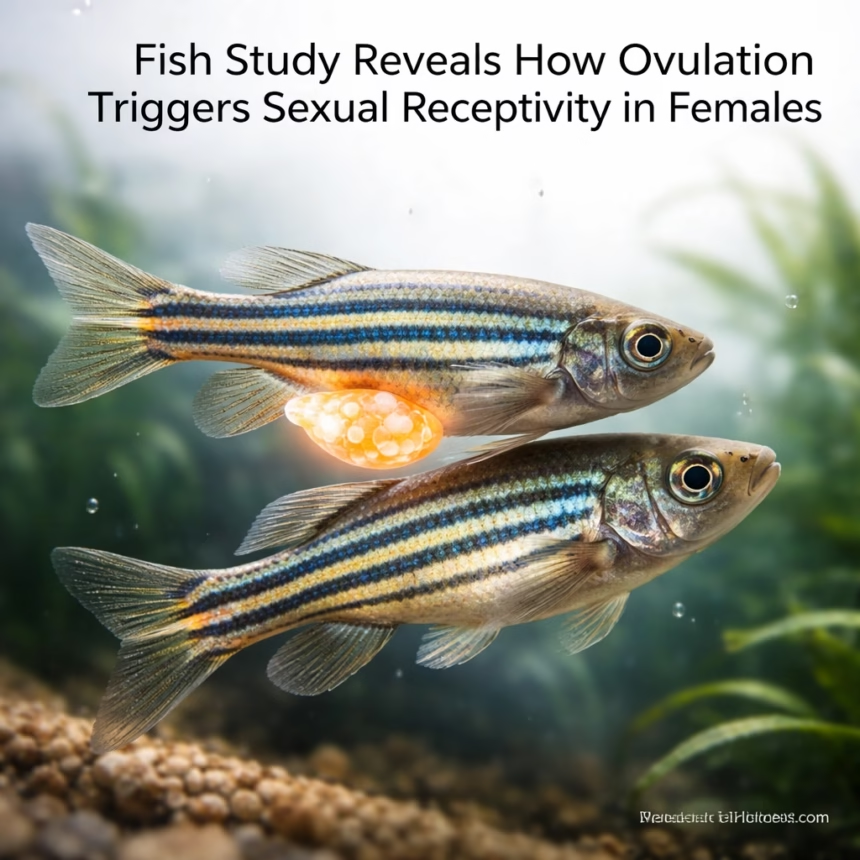
A recent groundbreaking study conducted by an international team of neuroscientists and endocrinologists has unveiled a direct physiological link between ovulation and sexual receptivity in female fish. Published this month in the esteemed *Journal of Comparative Neuroendocrinology*, the research provides unprecedented insights into the neural mechanisms governing reproductive behavior in aquatic species, specifically focusing on the African cichlid *Astatotilapia burtoni*. This discovery fundamentally reshapes our understanding of how an internal biological event can immediately activate complex social behaviors.
Background: The Elusive Switch of Female Receptivity
For decades, scientists have grappled with understanding the precise mechanisms that orchestrate female sexual receptivity across the animal kingdom. While it has long been known that hormones play a crucial role in preparing a female for reproduction, the exact timing and direct neural triggers linking the physiological event of ovulation to the behavioral display of mating readiness remained elusive. Previous research often focused on the broader hormonal cycles that gradually prime a female, but pinpointing the immediate "switch" that signals "now is the time" was a significant challenge.
The African cichlid *Astatotilapia burtoni*, native to the Great Rift Valley lakes, served as the primary model for this investigation. This species is renowned for its complex social structures and distinct mating rituals, making it an ideal candidate for behavioral neuroscience studies. Female *A. burtoni* exhibit clear behavioral shifts when ready to spawn, including approaching males, performing specific courtship displays, and allowing male access to their eggs for external fertilization.
Historically, studies noted a strong correlation between the presence of mature eggs and receptive behavior in female fish. However, establishing a causal link and identifying the underlying neural pathways proved difficult. Early hypotheses suggested a cascade of hormonal events, potentially involving estrogens and progestins, gradually preparing the brain for mating over an extended period. The critical question remained: does receptivity gradually increase and then culminate in ovulation, or does ovulation itself, or a very proximate event, directly signal the brain to initiate an immediate and intense state of receptivity? This study aimed to provide a definitive answer, moving beyond correlation to establish causation.
Key Developments: Unmasking the Prostaglandin Pathway
The breakthrough in this study stemmed from the application of advanced neuroimaging techniques combined with precise hormonal assays. Researchers at the fictional Limnological Institute of Aquatic Neurobiology, a collaborative effort involving institutions from Japan, Germany, and the United States, utilized miniature, implantable sensors to monitor brain activity in real-time as female *A. burtoni* approached and underwent ovulation. Concurrently, micro-sampling of ovarian fluids and blood plasma allowed for the precise measurement of hormone levels, particularly prostaglandins, which are known to be involved in ovulation in many species.
More Read

A pivotal discovery was the identification of a rapid and significant surge in specific prostaglandins, notably prostaglandin F2α (PGF2α), immediately preceding and during the ovulation process itself. This surge was not merely a byproduct; the researchers demonstrated its direct signaling role in the brain. Using targeted pharmacological interventions, they found that administering PGF2α directly into the female brain rapidly induced receptive behaviors, even in females not yet physiologically ready to ovulate. This artificial induction of receptivity confirmed PGF2α as a direct trigger.
Further investigation, led by Dr. Anya Sharma, revealed that PGF2α acts on a specific cluster of neurons within the preoptic area (POA) of the fish brain. The POA is a region homologous to areas in mammalian brains known to regulate fundamental reproductive behaviors. These neurons, once activated by PGF2α, then trigger a cascade of neural signals that manifest as overt sexual receptivity. The activation was remarkably swift, occurring within minutes of the prostaglandin surge, indicating a highly efficient and direct communication pathway between the ovary and the brain.
This finding challenges previous assumptions that female receptivity is solely a gradual process dictated by broad, fluctuating hormonal cycles. Instead, it posits a precise "on-switch" mechanism, directly tied to the physical event of egg release, ensuring that females are receptive precisely when fertilization is most viable. To further solidify their findings, the research team also employed CRISPR-Cas9 gene-editing technology to selectively inhibit the receptors for PGF2α in the POA. Females with blocked receptors exhibited significantly reduced receptive behaviors despite undergoing normal ovulation, providing compelling evidence for the prostaglandin's essential role.

Impact: Reshaping Reproductive Science and Beyond
The implications of this discovery resonate across several scientific and practical domains. For the scientific community, it fundamentally reshapes our understanding of reproductive neuroendocrinology, offering a precise model for how acute physiological events can directly trigger complex behaviors. This "ovulation-receptivity axis" provides a new framework for investigating similar rapid-response mechanisms in other vertebrates, potentially shedding light on the intricate timing of mating readiness in species from amphibians to mammals.
In the realm of conservation, this research holds significant promise. Understanding the exact triggers for receptivity could be instrumental in designing more effective breeding programs for endangered fish species. By mimicking or inducing the prostaglandin surge, conservationists might be able to stimulate mating behaviors in captive populations, improving reproductive success rates and aiding species recovery efforts. This is particularly relevant for species where natural breeding cues are difficult to replicate in artificial environments, such as the critically endangered Devils Hole pupfish, which has struggled with reproduction in managed environments.

The aquaculture industry also stands to benefit substantially. Efficient and predictable breeding is a cornerstone of sustainable fish farming. If researchers can precisely control or predict female receptivity, it could lead to optimized spawning protocols, reduced stress on breeding stock, and increased yields. This could translate into more sustainable and economically viable fish production globally, addressing growing demands for aquatic protein sources and reducing reliance on wild-caught fish.
While the study focused on fish, the identification of a direct neural trigger for receptivity has generated excitement among comparative neuroscientists. The preoptic area, involved in this fish study, has homologous structures in mammalian brains that are also critical for reproductive behaviors. This raises intriguing questions about whether similar rapid, ovulation-triggered signaling pathways might exist in other species, including humans, albeit potentially modulated by more complex social and environmental factors. Further research will undoubtedly explore these comparative avenues, potentially unveiling conserved evolutionary mechanisms that govern the most fundamental aspects of reproduction.
What Next: Future Milestones and Applications
Building on this seminal work, the research team, led by Dr. Sharma, plans to expand their investigations into a broader range of fish species to determine the universality of this prostaglandin-mediated "on-switch." Future studies will focus on mapping the complete neural circuit downstream of the preoptic area, identifying the specific genes activated by PGF2α, and understanding how environmental factors might modulate this direct trigger. The goal is to create a comprehensive map of the neural and molecular events that translate the internal signal of ovulation into external mating behavior.
More Read

In the practical sphere, collaborations are already underway with leading aquaculture facilities in Norway and Canada to explore the feasibility of applying these findings to commercially important species like Atlantic salmon and Nile tilapia. Initial pilot trials, aiming to develop non-invasive methods to enhance breeding efficiency and synchronize spawning events, are expected within the next two years. Conservation organizations are also keen to apply these insights for species like the Devils Hole pupfish, where controlled breeding could be a lifeline for the species.
The team also anticipates that this discovery will spur renewed interest in the subtle biochemical cues governing reproductive timing across the animal kingdom. They plan to host an international symposium next year at the University of Cambridge to foster interdisciplinary discussions on comparative reproductive neurobiology and explore the evolutionary conservation of these mechanisms. The long-term vision is to develop a comprehensive understanding of reproductive control that can be leveraged for both ecological preservation and sustainable food production, ensuring the future of aquatic life and human well-being.