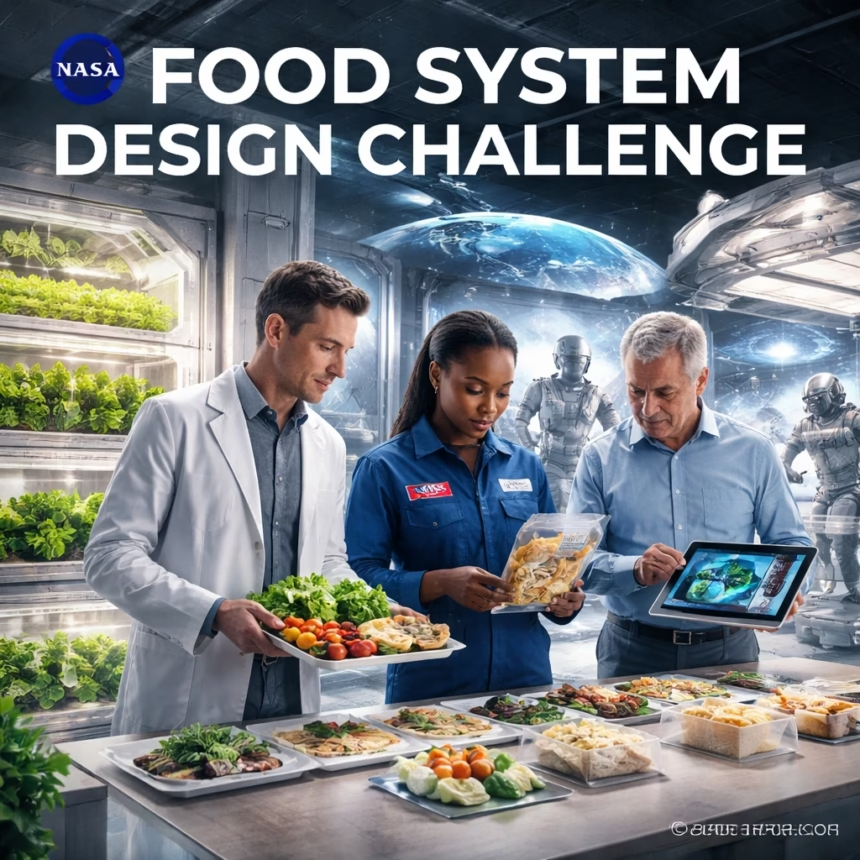
Forget Freeze-Dried: NASA's Radical Challenge to Reinvent Space Food
NASA has launched a groundbreaking global initiative, the Food System Design Challenge, inviting innovators worldwide to revolutionize how astronauts will eat during future long-duration missions to the Moon and Mars. This ambitious program, spearheaded by the agency's Advanced Exploration Systems division, seeks sustainable, autonomous food solutions crucial for deep-space exploration and potential off-world settlements.
The challenge, administered in collaboration with the Methuselah Foundation, aims to foster novel approaches to food production, processing, and delivery that move beyond current resupply models, addressing critical needs for nutritional stability, crew well-being, and resource efficiency.
Background: The Deep Space Sustenance Imperative
For decades, space food has primarily consisted of pre-packaged, shelf-stable meals, meticulously developed and resupplied from Earth. While effective for shorter missions aboard the International Space Station (ISS) and previous endeavors like the Apollo program, this model becomes untenable for journeys lasting hundreds, or even thousands, of days.
A round-trip mission to Mars, for instance, could span over two years. The sheer volume and mass of traditional food supplies required for such a duration would be prohibitive, consuming valuable cargo space and incurring immense launch costs. Moreover, the nutritional quality of many pre-packaged foods degrades over time, posing significant health risks for astronauts far from Earth's medical facilities.
Evolution of Space Cuisine and its Limitations
Early space food, famously exemplified by John Glenn’s applesauce in a tube, evolved into the more palatable, if still limited, freeze-dried and thermostabilized meals of the Space Shuttle era. The ISS currently offers a broader menu, including fresh fruits and vegetables periodically delivered by resupply missions, but variety remains constrained, and the psychological impact of monotonous diets is a known concern for crew morale.
NASA’s Johnson Space Center in Houston, Texas, has long been at the forefront of space food research, developing techniques for packaging, preservation, and nutritional analysis. However, the current challenge represents a fundamental shift: moving from merely preserving food to actively producing it in space. This paradigm change is driven by the Artemis program’s goal of sustainable lunar presence and the ultimate objective of human missions to Mars.

Key Developments: Seeking Autonomous, Sustainable Solutions
The Food System Design Challenge is structured in phases, encouraging a progression from conceptual designs to functional prototypes. Phase 1, which concluded in early 2023, attracted over 250 diverse proposals from universities, startups, and independent innovators across the globe. These initial submissions explored a wide array of potential technologies, from advanced hydroponics and aeroponics to novel microbial bioreactors and insect farming.
The winning teams of Phase 1 showcased innovative concepts, including integrated vertical farms designed for microgravity, systems utilizing algae and fungi for protein and nutrient synthesis, and closed-loop waste recycling mechanisms that convert astronaut waste into fertilizer or feedstock. These early successes underscored the potential for truly autonomous food production systems.
Phase 2: Prototyping and Integration
Currently, the challenge is in its more rigorous Phase 2, which requires teams to develop functional prototypes and detailed system designs. The focus has sharpened on integrated solutions that can address multiple aspects of the food system: production, processing, preparation, waste management, and nutrient recovery. Participants are tasked with demonstrating how their systems could operate with minimal crew intervention, energy consumption, and water usage, all while producing a diverse, nutritious, and palatable diet for a crew of four astronauts over a three-year mission.
Specific emphasis is placed on technologies that can withstand the harsh conditions of space, including radiation exposure, microgravity, and limited resources. Solutions must also consider the psychological benefits of growing fresh food, offering astronauts a connection to nature and a sense of purpose beyond their primary mission tasks. Collaborations with organizations like the Canadian Space Agency and various academic institutions are fostering a broad international effort to tackle these complex problems.
More Read

Impact: Feeding Astronauts and Benefiting Earth
The immediate and most direct impact of a successful Food System Design Challenge will be on the health and performance of future astronauts. Reliable access to fresh, nutritious food will mitigate issues like bone density loss, muscle atrophy, and immune system degradation often associated with long-duration spaceflight. Furthermore, the psychological boost derived from varied, palatable meals and the act of growing food itself cannot be overstated, contributing significantly to crew morale and mental well-being during extended isolation.
Beyond the confines of spacecraft, the innovations fostered by this challenge hold immense potential for terrestrial applications. The pursuit of highly efficient, closed-loop food systems for space directly addresses pressing global challenges on Earth, particularly in the realm of food security and sustainable agriculture.
Terrestrial Spin-offs and Food Security
Technologies developed for space, such as advanced controlled environment agriculture (CEA), resource-efficient nutrient delivery systems, and sophisticated waste-to-resource conversion methods, can be adapted for use in urban farming, arid regions, and disaster-stricken areas. Imagine self-sustaining food modules providing fresh produce in deserts, polar regions, or communities cut off from traditional supply chains. These innovations could revolutionize food production in challenging environments, reduce agricultural waste, and minimize reliance on long-distance transportation.
Moreover, the challenge encourages multidisciplinary collaboration, uniting engineers, biologists, nutritionists, and material scientists. This cross-pollination of ideas drives innovation that extends beyond food production, potentially impacting areas like environmental control, life support systems, and even personalized medicine through advanced nutritional monitoring.
What Next: Towards Self-Sufficient Off-World Colonies
Phase 2 submissions for the Food System Design Challenge are anticipated in late 2024. Following a rigorous evaluation process, selected teams will likely receive further funding and opportunities to test their prototypes in simulated space environments at NASA facilities, such as the Johnson Space Center's Human Exploration Research Analog (HERA) or the Kennedy Space Center's Controlled Environment Systems Lab.
The ultimate goal is to integrate successful, scalable food production systems into future deep-space habitats. Initial deployments could include the Lunar Gateway, an orbital outpost around the Moon, providing a testbed for these technologies before their critical use on a crewed mission to Mars. NASA envisions a future where astronauts are not just sustained but thrive, supported by robust, autonomous food systems that minimize reliance on Earth resupply.
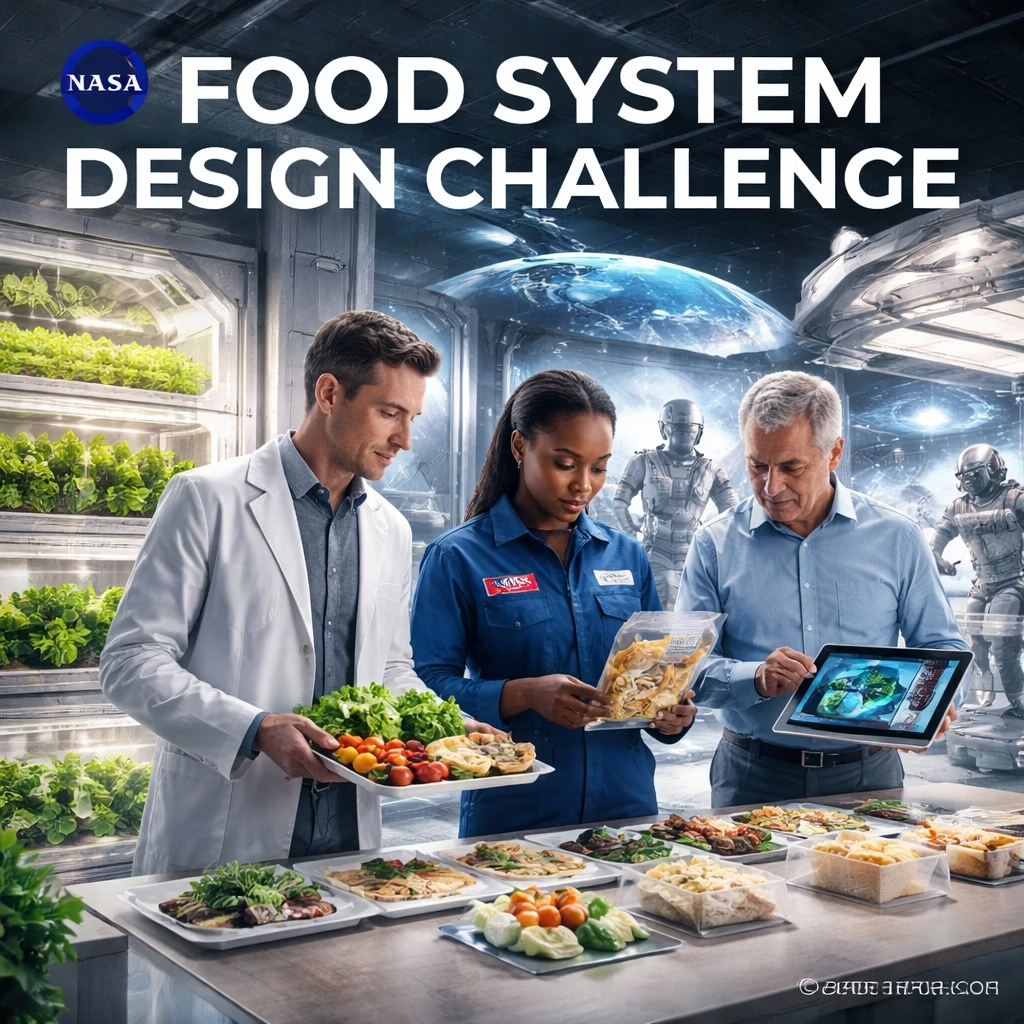
Future Milestones and Integration into Missions
Longer-term milestones include the demonstration of a near-fully autonomous food system capable of supporting a multi-year mission by the early 2030s. This would involve not only growing food but also processing, preparing, and managing all associated waste streams within a closed loop. The insights and technologies from the challenge will be critical enablers for establishing permanent human outposts on the Moon and eventually supporting the ambitious vision of self-sufficient Martian colonies.

The Food System Design Challenge represents a pivotal step in humanity’s journey beyond Earth, moving us closer to a future where deep space exploration is not just possible, but sustainable. By tapping into global innovation, NASA is laying the groundwork for a new era of space cuisine, ensuring that future explorers are well-fed, healthy, and ready to tackle the challenges of the cosmos.