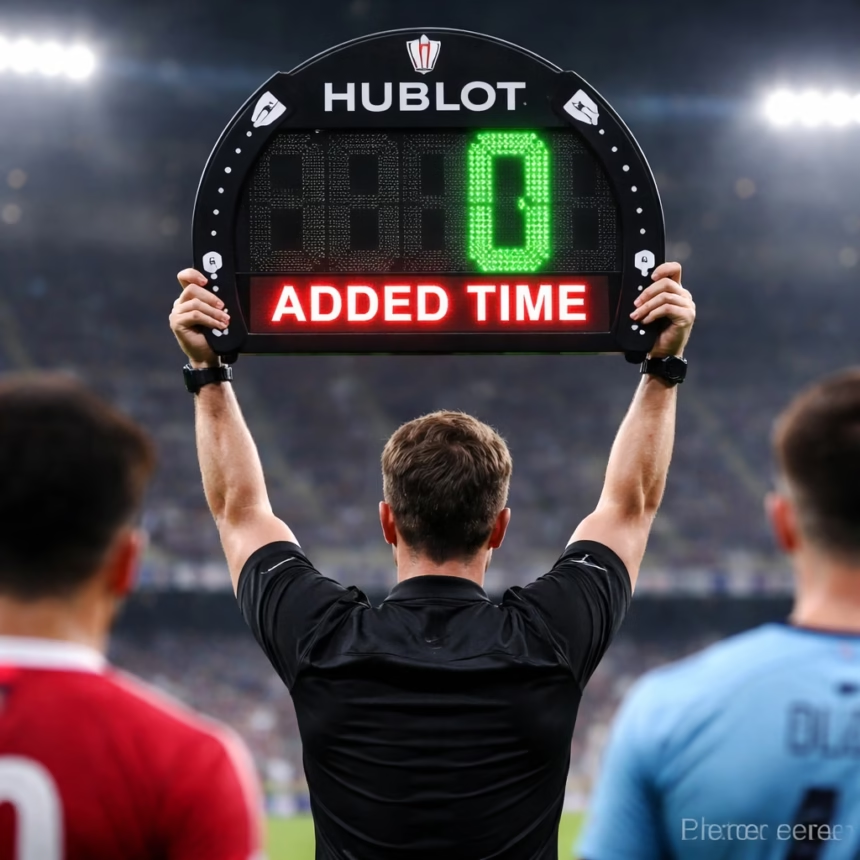
In a moment that has sent ripples through the global football community, the fourth official at Old Trafford announced an astonishing "0 minutes" of added time at the conclusion of the Premier League fixture between Manchester United and Brighton & Hove Albion on Saturday, October 26, 2024. This highly unusual declaration, delivered by Robert Jones, followed a second half devoid of significant stoppages, prompting immediate widespread discussion and analysis across media platforms and fan forums. The final whistle blew precisely on the 90-minute mark, with Manchester United securing a narrow 2-1 victory.
Background: The Evolving Landscape of Added Time
Added time, also known as stoppage time or injury time, is a fundamental component of football designed to compensate for delays during a match. Its primary purpose, as stipulated by the International Football Association Board (IFAB), is to ensure that spectators receive 90 minutes of actual play, excluding interruptions. Historically, common reasons for added time include player injuries, substitutions, goal celebrations, disciplinary actions, and, more recently, Video Assistant Referee (VAR) reviews.
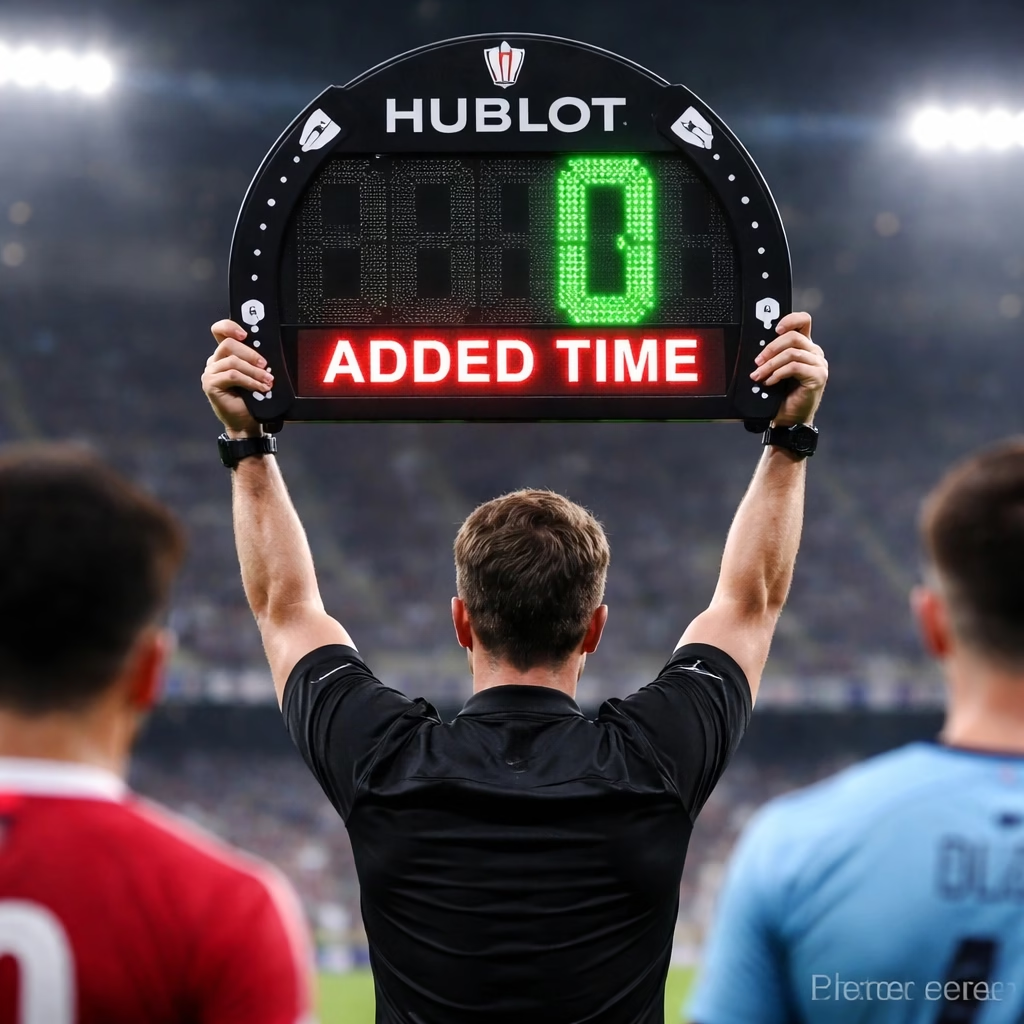
The calculation of added time has always been at the discretion of the referee, often assisted by the fourth official. However, recent years have seen a significant shift in its application. Following the 2022 FIFA World Cup in Qatar, IFAB issued revised directives encouraging referees to more accurately account for all time lost. This initiative aimed to combat time-wasting and increase effective playing time, leading to a noticeable increase in the average duration of matches across major leagues, frequently seeing 8-10 minutes of added time become commonplace. This intensified focus on accurate timekeeping made the "0 minutes" announcement at Old Trafford particularly striking.
Key Developments: An Exceptionally Fluid Second Half
The match in question, a closely contested Premier League encounter, saw Manchester United take an early lead through Rasmus Højlund in the 15th minute, only for Brighton to equalize via Kaoru Mitoma in the 38th. Bruno Fernandes then restored United's advantage just before halftime, setting the stage for a tense second half. What followed, however, was an anomaly in modern football.

Under the watchful eye of referee Anthony Taylor, the second half of the match unfolded with unprecedented fluidity. There were no major injury stoppages requiring medical attention on the pitch, nor any lengthy delays for player treatment. Crucially, neither team made any substitutions after the 65th minute, eliminating a common source of added time. The game saw minimal contentious fouls, and all disciplinary actions were handled swiftly without prolonged stoppages. Furthermore, there were no VAR interventions that required the referee to consult the pitch-side monitor or engage in extended communication with the VAR hub in Stockley Park.
Even goal celebrations, typically contributing 30-60 seconds per goal to added time, were not a factor in the second half. The ball remained largely in play, moving between the two teams with a high tempo and relatively few stoppages for throw-ins, goal kicks, or free kicks near the touchline in the dying minutes. This confluence of factors created a scenario where, according to the strict interpretation of IFAB's enhanced guidelines, virtually no time was "lost" during the second 45 minutes of play.
Impact: A Whirlwind of Reactions and Debate
The announcement of "0 minutes" of added time was met with immediate and varied reactions. Inside Old Trafford, a noticeable murmur of surprise rippled through the stands, quickly followed by a mix of confusion and disbelief. Brighton manager Roberto De Zerbi, while not openly critical, appeared visibly surprised on the touchline, as his team had been pressing hard for an equalizer in the final stages. Manchester United manager Erik ten Hag acknowledged the rarity but praised the flow of the game.
More Read

Social media platforms erupted with discussions. #ZeroMinutes quickly trended globally, with fans, pundits, and former players weighing in. Many expressed astonishment, highlighting the stark contrast to the routinely extended matches of recent seasons. Some praised the refereeing team for what they perceived as an exceptionally efficient and uninterrupted half of football, suggesting it was a testament to both teams' commitment to continuous play. Others questioned whether even the most fluid half could truly warrant zero additional minutes, citing the inherent delays of a football match, however minor.
The incident has also sparked a broader debate among football governing bodies and refereeing associations. PGMOL (Professional Game Match Officials Limited) in England is expected to review the decision as part of its standard post-match analysis. While the call appears to align with the *spirit* of IFAB's push for accurate timekeeping in a half with minimal interruptions, its rarity raises questions about consistency and interpretation. Broadcasters and commentators dedicated significant airtime to dissecting the decision, with many suggesting it could be a landmark moment in the ongoing evolution of football's time management.
What Next: Scrutiny, Clarification, and Potential Precedent
The "0 minutes" added time decision at Old Trafford is likely to serve as a significant talking point for IFAB and various national football associations in the coming weeks and months. While the refereeing team's justification, based on an almost perfectly uninterrupted second half, appears technically sound under current guidelines, its extreme rarity necessitates further discussion.
One key area of focus will be whether this incident sets a precedent. Will referees now be more inclined to announce minimal or zero added time if a half truly warrants it, or will there be an implicit pressure to always add at least a token minute or two? There may be calls for IFAB to provide further clarification on the absolute minimum amount of added time, even in the most fluid of halves, to account for inherent micro-stoppages that are difficult to quantify precisely.
The incident also reignites the debate around player welfare and the overall flow of the game. While longer added times are often seen as detrimental to player recovery, an exceptionally short match might also be viewed as an anomaly that disrupts expectations. Football stakeholders will be observing closely to see if this was a singular event, a perfect storm of circumstances, or if it signals a new, more stringent era of timekeeping that could redefine the rhythm of the beautiful game. The football world waits to see if the "unprecedented zero" remains an isolated curiosity or becomes a benchmark for future officiating.