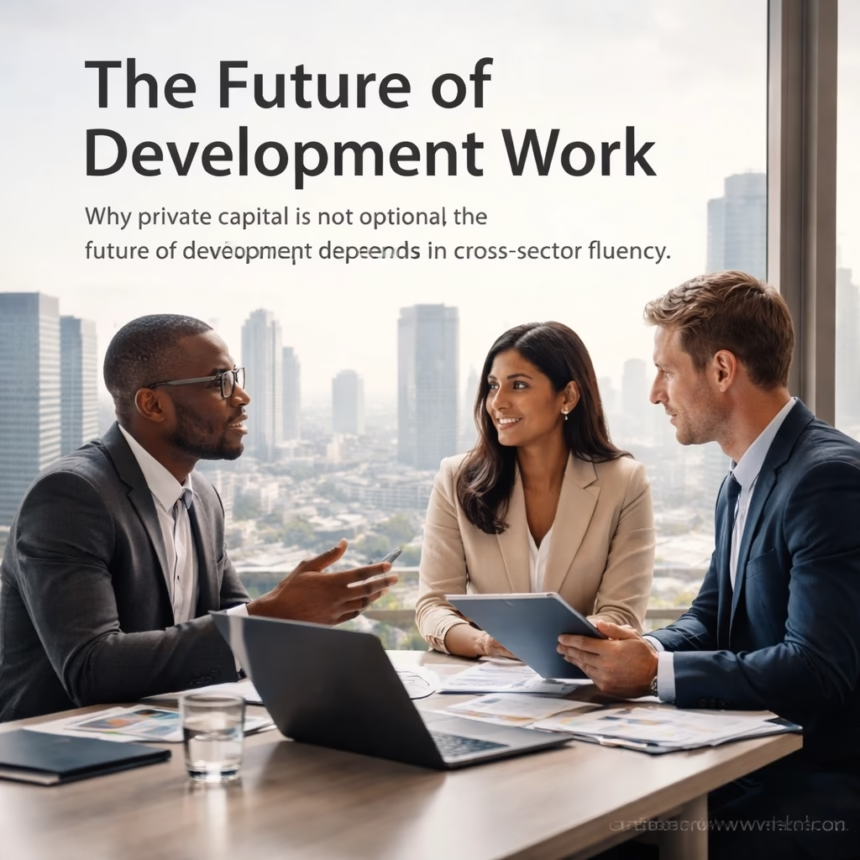
A profound transformation is underway in the landscape of global development, with private capital emerging as an indispensable force. Experts and practitioners worldwide are increasingly acknowledging that traditional aid models alone cannot meet the escalating demands of sustainable development. This shift, gaining significant momentum throughout the 2020s, signals a critical re-evaluation of how progress is funded and achieved across low and middle-income countries.
Background
For decades, Official Development Assistance (ODA), primarily government-to-government aid, formed the bedrock of international development efforts. Post-World War II, institutions like the World Bank and various bilateral agencies channeled billions into poverty reduction, infrastructure, and healthcare across developing nations. However, the scale of global challenges has increasingly outpaced ODA growth.
The turn of the millennium brought increasing awareness of ODA's limitations. Despite commitments, ODA budgets often stagnated or faced political pressures, failing to keep pace with an expanding global population and complex crises. The 2008 global financial crisis further strained public finances in donor countries, highlighting the fragility of relying solely on public funds.
A pivotal moment arrived in 2015 with the adoption of the UN Sustainable Development Goals (SDGs). These 17 ambitious goals, ranging from ending poverty to combating climate change, presented an estimated annual funding gap of $2.5 trillion in developing countries. This immense figure starkly revealed the inadequacy of ODA, which collectively hovers around $150-200 billion annually.
This realization spurred calls for innovative financing mechanisms. Concepts like "blended finance," which strategically combines public and philanthropic funds to de-risk investments for private capital, began to gain traction. Academic institutions, including Georgetown University's School of Foreign Service (SFS), started emphasizing the critical need for development professionals to possess "cross-sector fluency"—the ability to navigate and integrate public, private, and non-profit approaches.


Key Developments
The past five years have witnessed an acceleration in the integration of private capital into development strategies. Blended finance, once a niche concept, is now a mainstream approach, with organizations like the World Bank Group's International Finance Corporation (IFC) and various Development Finance Institutions (DFIs) actively structuring deals. These institutions leverage their public mandates to mitigate risks for private investors, attracting funds into sectors traditionally considered too risky, such as renewable energy in sub-Saharan Africa or digital infrastructure in Southeast Asia.
Impact investing has also surged, representing a market estimated at over $1 trillion globally by the Global Impact Investing Network (GIIN) in 2022. This segment of the private market seeks measurable social and environmental returns alongside financial gains, attracting institutional investors, family offices, and high-net-worth individuals. Funds are flowing into areas like affordable housing, education technology, and sustainable agriculture in emerging economies.
More Read

Major corporations are increasingly aligning their business strategies with development objectives, driven by Environmental, Social, and Governance (ESG) mandates and a growing recognition of emerging market potential. Companies are investing in supply chain resilience, local job creation, and sustainable resource management, often in partnership with NGOs or public sector bodies. This shift is not purely philanthropic but often driven by long-term business sustainability and market expansion.
New financial instruments, such as green bonds, social bonds, and sustainability-linked loans, are providing avenues for private investors to support development outcomes directly. For instance, the issuance of green bonds surpassed $500 billion in 2021, funding projects from clean transportation to sustainable water management in diverse geographies. This diversification of financial tools broadens the appeal and accessibility for various types of private capital.
Impact
This pivot profoundly affects every stakeholder in the global development ecosystem. For governments in developing countries, the influx of private capital offers a vital alternative to traditional aid, potentially accelerating progress on national development plans and the SDGs. However, it also demands enhanced regulatory frameworks, transparent governance, and the capacity to negotiate complex financial agreements. Nations like Rwanda and Vietnam have actively cultivated environments to attract foreign direct investment and private sector partnerships in key development sectors.
Non-governmental organizations (NGOs) and civil society groups are experiencing a dual impact. While private sector partnerships can unlock new funding streams and technical expertise, NGOs must adapt their advocacy and operational models. This often means developing business cases for their interventions, demonstrating measurable impact, and engaging with corporate partners on shared value propositions rather than solely relying on grant funding. Organizations like BRAC in Bangladesh have successfully spun off social enterprises to generate revenue and scale their impact.
The private sector, from multinational corporations to local entrepreneurs, finds new market opportunities and incentives for responsible investment. Engaging in development-aligned projects can enhance brand reputation, meet ESG commitments, and open doors to untapped consumer bases. This engagement often brings with it innovative technologies, efficient management practices, and capital that traditional aid cannot provide.
Perhaps most significantly, the professional landscape of development work is undergoing a seismic shift. Development practitioners now require a far broader skill set than before. Expertise in project management and community engagement must be complemented by financial literacy, risk assessment, market analysis, and negotiation skills. Universities and training programs, like those at Georgetown SFS, are actively redesigning curricula to equip future leaders with this "cross-sector fluency," enabling them to bridge the language and operational gaps between public, private, and philanthropic actors.

Ultimately, the beneficiaries of development efforts—individuals and communities in low and middle-income countries—stand to gain from potentially faster, more sustainable, and scalable solutions. Access to reliable energy, quality education, healthcare, and economic opportunities can expand. However, there are also risks, including the potential for market failures to exacerbate inequalities, the displacement of local economies, or a focus on profit over the most vulnerable. Careful regulation and robust impact measurement are crucial to ensure equitable outcomes.
What Next
The trajectory towards deeper integration of private capital in development is set to continue and intensify. Experts anticipate several key milestones and trends in the coming years.
Continued innovation in blended finance structures will likely unlock new investment classes and further de-risk challenging sectors. This includes expanding into areas like climate adaptation, biodiversity conservation, and fragile states, which have historically struggled to attract private funds. Development Finance Institutions will play an even more crucial role in pioneering these models.
There will be a growing emphasis on channeling private capital not just through large international funds but directly to local private sector entities in developing countries. This approach aims to build indigenous economic capacity, foster entrepreneurship, and ensure that development gains are locally owned and sustained. Initiatives supporting small and medium-sized enterprises (SMEs) will be critical.
Policy and regulatory reforms in developing countries will become paramount. Governments that successfully streamline investment processes, strengthen legal frameworks, protect property rights, and combat corruption will be best positioned to attract significant private capital inflows. International bodies will likely offer more technical assistance in this area.
The evolution of development education will accelerate. Universities will continue to adapt their programs to produce graduates who are not only passionate about social impact but also adept at financial engineering, public-private partnerships, and sustainable business models. Professional development for existing practitioners will also become a priority, bridging current skill gaps.
Finally, the twin crises of climate change and increasing global instability will drive further demand for private capital. Climate finance, in particular, will see substantial growth, with private funds essential for transitioning to green economies, building resilient infrastructure, and mitigating environmental risks. Data-driven decision-making and robust impact measurement frameworks will also be refined to ensure accountability and demonstrate the tangible returns, both financial and societal, of private sector engagement in development. The ability to articulate and prove impact will be key to sustaining this critical shift.