Tech Titans' AI Arms Race Outpaces Nation's Budget
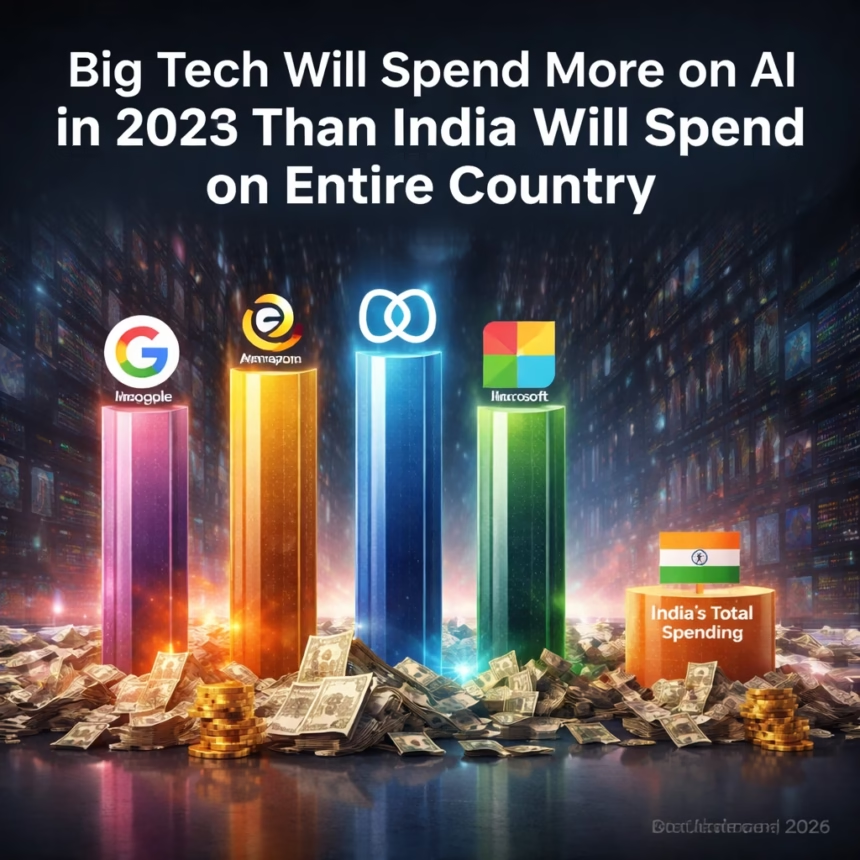
The global race to dominate Artificial Intelligence is escalating dramatically. Major tech companies – Google, Amazon, Meta (formerly Facebook), and Microsoft – are projected to invest more in AI research and development in 2026 than the entire nation of India anticipates spending on its annual budget. This represents a significant shift in global economic power and technological focus.
Background: A Rapidly Accelerating Investment
The investment in AI has been steadily climbing for years, but the pace has accelerated sharply since 2022. Initially, investments centered on foundational research and basic AI applications. However, recent advancements in generative AI – exemplified by models like OpenAI’s GPT series and Google’s Gemini – have ignited a massive influx of capital. Governments worldwide have recognized the strategic importance of AI, but the private sector is currently leading the charge in terms of financial commitment.
India’s current annual budget, announced in February 2024, totals approximately ₹10 trillion (roughly $120 billion USD). Projections indicate that Google, Amazon, Meta, and Microsoft combined will invest upwards of $120 billion in AI-related initiatives by 2026. This projection comes from industry analysts at firms like Gartner and McKinsey, who have been closely tracking the trend.
Key Developments: A Focus on Generative AI and Infrastructure
Recent developments are fueling this surge in investment. The rapid proliferation of large language models (LLMs) like GPT-4 and Gemini has created immense opportunities for new products and services. These models power chatbots, content creation tools, and a wide range of other applications. Companies are vying to develop even more powerful and efficient AI models.

Beyond model development, significant investment is being directed towards building the necessary infrastructure to support AI. This includes specialized hardware like GPUs (Graphics Processing Units), cloud computing resources, and data centers. Amazon Web Services (AWS), Microsoft Azure, and Google Cloud are heavily investing in AI-optimized infrastructure to attract AI developers and businesses.
Furthermore, there's a growing emphasis on AI safety and responsible AI development. Companies are allocating funds to research methods for mitigating potential risks associated with advanced AI systems.
Impact: Shifting Economic and Technological Landscapes
This massive investment in AI will have a profound impact on various sectors. The tech industry itself will experience significant growth, creating new jobs and business opportunities. However, the impact will extend far beyond the tech sector. Industries like healthcare, finance, transportation, and manufacturing are expected to be transformed by AI-powered automation, data analysis, and decision-making.
More Read

The disparity in AI investment between major tech companies and nations like India raises concerns about technological dependence. While India is actively developing its own AI capabilities, the scale of private sector investment in the West presents a considerable challenge. This could impact India’s ability to compete globally in key sectors and potentially widen the digital divide.
Job displacement is another potential consequence. AI-powered automation is likely to displace workers in certain roles, requiring significant investment in retraining and upskilling programs.
What Next: The Road to AI Dominance
The next few years will be crucial in determining which companies will emerge as leaders in the AI space. Competition will intensify, driving further innovation and investment. Expect to see increased focus on edge AI – deploying AI models on devices rather than relying solely on cloud computing – and the development of more specialized AI applications.
Key Milestones to Watch
2025: Widespread adoption of generative AI in enterprise applications, including customer service, marketing, and software development.
2026: Release of more powerful and efficient AI models, potentially surpassing human-level performance in certain tasks.
2027-2028: Development of truly autonomous AI systems capable of operating with minimal human intervention.
The regulatory landscape surrounding AI will also evolve rapidly. Governments will grapple with issues such as data privacy, algorithmic bias, and the ethical implications of AI. This regulatory environment will significantly influence the direction of AI development and deployment.


Competition will not be limited to the US and Europe. China is also investing heavily in AI, and other countries like Japan and South Korea are making significant strides. The global AI race is far from over, and the outcome will shape the future of technology and society.