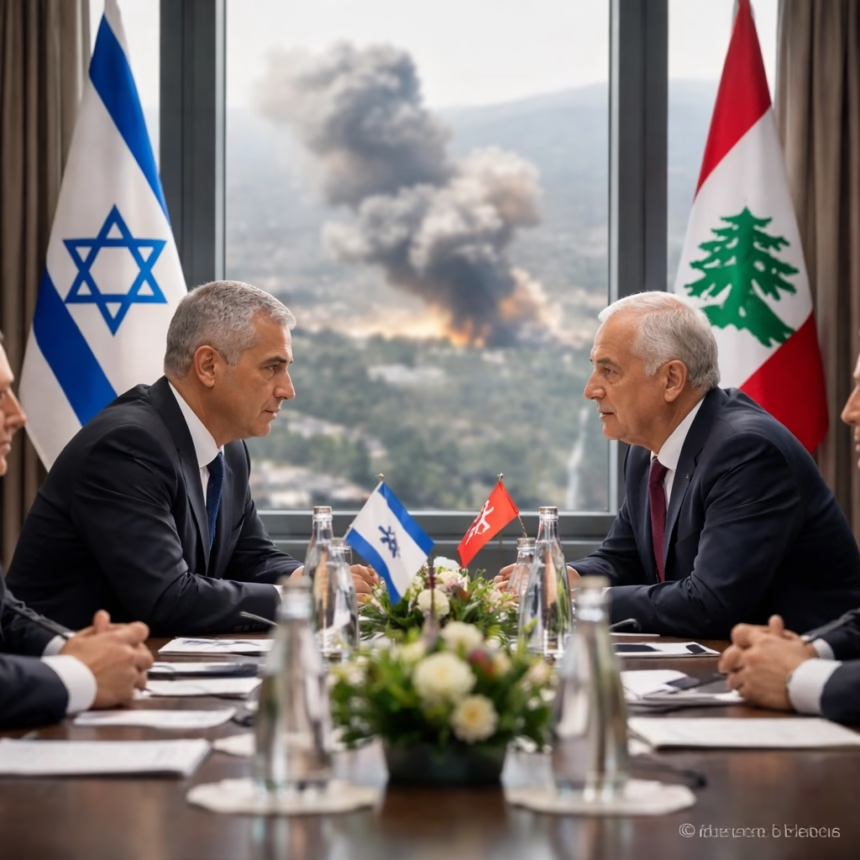
Reports from Israeli daily Haaretz indicate that Israel and Lebanon are exploring the possibility of indirect talks, even as intense cross-border fighting with Hezbollah continues to escalate along their shared frontier. This potential diplomatic overture emerges amid a backdrop of heightened regional tensions and a devastating conflict in Gaza, prompting speculation about a de-escalation pathway in the volatile north. The reported discussions, if they materialize, would represent a significant, albeit fragile, attempt to mitigate a spiraling conflict that threatens wider regional stability.
Background: A Century of Unresolved Tensions
The relationship between Israel and Lebanon has been characterized by decades of animosity, marked by numerous conflicts and a persistent state of war. There are no formal diplomatic ties between the two nations, with any interactions typically occurring through international mediation.
Historical Flashpoints and Hezbollah’s Emergence
The roots of the current friction run deep, tracing back to the 1948 Arab-Israeli War. Lebanon, hosting a significant Palestinian refugee population, became a frontline state. The 1970s saw an escalation with the Palestine Liberation Organization (PLO) establishing a strong presence in southern Lebanon, leading to Israeli incursions. The 1982 Lebanon War, launched by Israel to dismantle the PLO infrastructure, resulted in a prolonged Israeli occupation of parts of southern Lebanon until its unilateral withdrawal in 2000.
It was during this period, in the early 1980s, that Hezbollah (Party of God) emerged. Supported by Iran, Hezbollah rapidly transformed into a powerful Shiite political party and militant group, effectively operating as a state within a state in southern Lebanon and Beirut. Its stated primary objective was resistance against Israeli occupation, but its influence and arsenal grew exponentially, becoming a formidable military force equipped with advanced weaponry.
The 2006 Lebanon War and UN Resolution 1701
The most recent full-scale conflict occurred in 2006, sparked by Hezbollah’s cross-border raid that killed Israeli soldiers and captured two. The ensuing 34-day war resulted in widespread destruction in Lebanon, significant casualties on both sides, and a massive Israeli ground offensive. The conflict concluded with UN Security Council Resolution 1701, which called for a full cessation of hostilities, Israel’s withdrawal from Lebanon, and the disarmament of all armed groups in Lebanon (implying Hezbollah). Critically, it mandated that no armed forces other than the Lebanese Armed Forces (LAF) and UNIFIL (United Nations Interim Force in Lebanon) be present south of the Litani River. However, Hezbollah largely ignored the disarmament clause, maintaining and expanding its military presence in the south.
More Read

The Current Escalation Post-October 7th
The current escalation began on October 8, 2023, the day after Hamas’s devastating attacks on southern Israel. Hezbollah initiated rocket and anti-tank missile attacks on Israeli military positions and civilian communities along the border, framing its actions as solidarity with Palestinians in Gaza. This immediately triggered retaliatory Israeli airstrikes and artillery fire into southern Lebanon.
Since then, the border has witnessed daily exchanges of fire. Hezbollah has launched rockets, drones, and anti-tank guided missiles, targeting Israeli towns like Kiryat Shmona, Metula, and various military outposts. Israel has responded with precision airstrikes, artillery barrages, and drone attacks, striking Hezbollah infrastructure, launch sites, and operatives deep within Lebanese territory. Both sides have suffered casualties, including civilians and combatants, and tens of thousands of residents on both sides of the border have been displaced.
Key Developments: The Path to Dialogue
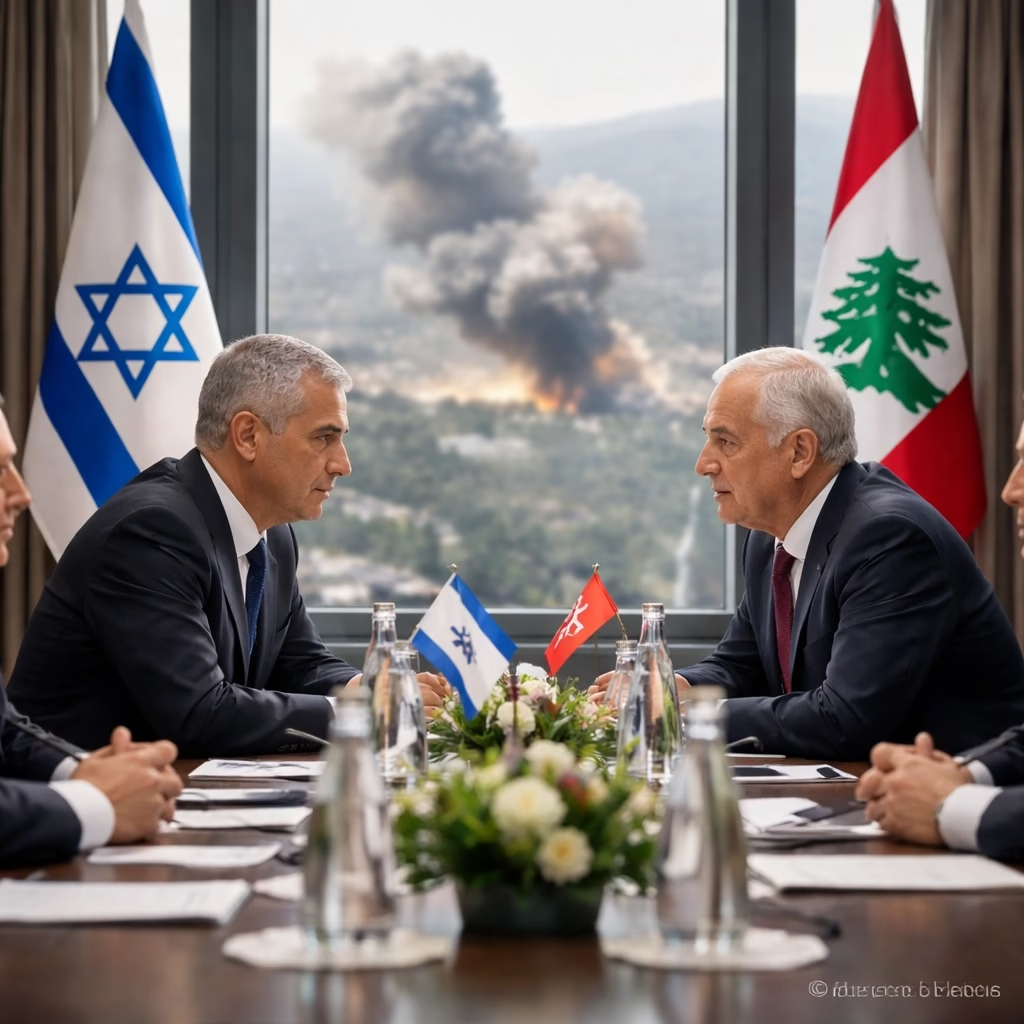
The Haaretz report suggests a significant shift, indicating that behind the scenes, diplomatic efforts are intensifying to prevent a full-blown war. These potential talks are reportedly indirect, facilitated by third-party mediators, primarily the United States.
The Haaretz Revelation and US Mediation
According to the Haaretz article, the discussions revolve around US proposals aimed at de-escalating the conflict. Veteran US envoy Amos Hochstein, who successfully mediated the maritime border demarcation agreement between Israel and Lebanon in 2022, is reportedly central to these efforts. His involvement signals a serious diplomatic push, leveraging previous successes to build a framework for dialogue on more contentious land issues.
The core of the proposed talks is believed to focus on the full implementation of UNSC Resolution 1701. Israel's primary demand is the withdrawal of Hezbollah's elite Radwan Force and other military assets from the immediate border area, pushing them north of the Litani River. This would create a buffer zone, allowing displaced Israeli residents to return home safely.
Lebanese and Israeli Positions
Lebanon, facing a profound economic crisis and deep internal political divisions, has a complex position. While the Lebanese government officially seeks stability and the full implementation of Resolution 1701, Hezbollah exerts significant influence, often acting independently of the state. Any agreement would require at least tacit approval from Hezbollah, which has tied its actions on the border to the cessation of hostilities in Gaza. Lebanese officials have often linked Resolution 1701 implementation to the full demarcation of disputed land borders, including the Shebaa Farms and the village of Ghajar.
Israeli officials, while not publicly confirming the talks in detail, have consistently stated their readiness to use military force if diplomatic solutions fail to secure their northern border. Prime Minister Benjamin Netanyahu and Defense Minister Yoav Gallant have repeatedly warned that Israel will not tolerate Hezbollah's presence near its border and that a military solution remains an option.
Potential Agenda Points
Beyond the immediate de-escalation, potential talks could address:
* Land Border Demarcation: Resolving long-standing disputes over several points along the Blue Line, including the Shebaa Farms, Kfar Shuba hills, and the northern part of Ghajar village.
* Security Arrangements: Establishing robust mechanisms to prevent future cross-border attacks and ensure the safety of civilian populations.
* UNIFIL’s Role: Potentially enhancing or redefining the mandate and capabilities of the UN peacekeeping force.

Impact: A Region on the Brink
The ongoing conflict has had a devastating impact on both sides, displacing tens of thousands and exacerbating existing humanitarian and economic crises.
Humanitarian Toll and Displacement
In Israel, approximately 60,000 to 80,000 residents from northern communities have been evacuated or have fled their homes, transforming once-vibrant towns into ghost cities. The economic life of the region, heavily reliant on agriculture and tourism, has been severely disrupted. In Lebanon, the UN estimates that over 90,000 people have been displaced from southern villages, with many homes and agricultural lands destroyed by Israeli strikes. Both sides have reported civilian casualties, fueling public anger and calls for either decisive action or de-escalation.
Economic Fallout
For Lebanon, already grappling with a catastrophic financial meltdown, the conflict adds another layer of economic devastation. The agricultural sector in the south, a key source of income, has been severely impacted. Tourism, a vital industry, has plummeted across the country. Israel also faces significant economic costs, including the expense of maintaining a large military deployment, supporting displaced populations, and repairing damaged infrastructure.
Regional Stability and International Concern
The most significant impact remains the constant threat of a wider regional war. An all-out conflict between Israel and Hezbollah could draw in Iran, Syria, and other regional actors, destabilizing the entire Middle East. The international community, particularly the United States and France, has been actively engaged in diplomatic efforts to prevent such an escalation, recognizing the catastrophic potential.
What Next: A Fragile Path Forward
The reports of potential talks represent a glimmer of hope amidst a dangerous escalation. However, numerous obstacles stand in the way of any successful agreement.
Challenges and Hurdles
* Hezbollah’s Stance: Hezbollah has explicitly stated that its actions on the border are linked to the Gaza war. A lasting de-escalation might be difficult to achieve without a broader ceasefire or resolution in Gaza.
* Lack of Trust: Decades of conflict and a complete absence of direct diplomatic relations mean a deep-seated lack of trust between Israel and Lebanon.
* Internal Lebanese Politics: Lebanon’s fractured political landscape, with Hezbollah wielding immense power, makes it challenging for any Lebanese government to commit to or enforce an agreement without the militant group’s full buy-in.
* Ongoing Hostilities: The very act of negotiating while fighting continues makes progress exceptionally difficult, as each new attack can derail goodwill.
Potential Milestones and Outcomes
The immediate next step would be an official confirmation, or at least a clearer indication, that indirect talks are indeed underway. Subsequent milestones could include:
* Agreement on a Framework: Establishing a mutually acceptable framework and agenda for the discussions.
* Limited De-escalation: Perhaps an initial agreement on reducing the intensity of cross-border fire or specific troop movements.
* Implementation of 1701: A long-term goal would be the full and verifiable implementation of UNSC Resolution 1701, particularly regarding Hezbollah’s presence south of the Litani River.
* Land Border Resolution: Addressing the disputed land points to create a more stable and recognized international border.
Failure to achieve progress could lead to a continued, and likely escalating, conflict, with potentially devastating consequences for both Israel and Lebanon, and the wider Middle East. The coming weeks will reveal whether the whispers of diplomacy can grow loud enough to drown out the roar of war.