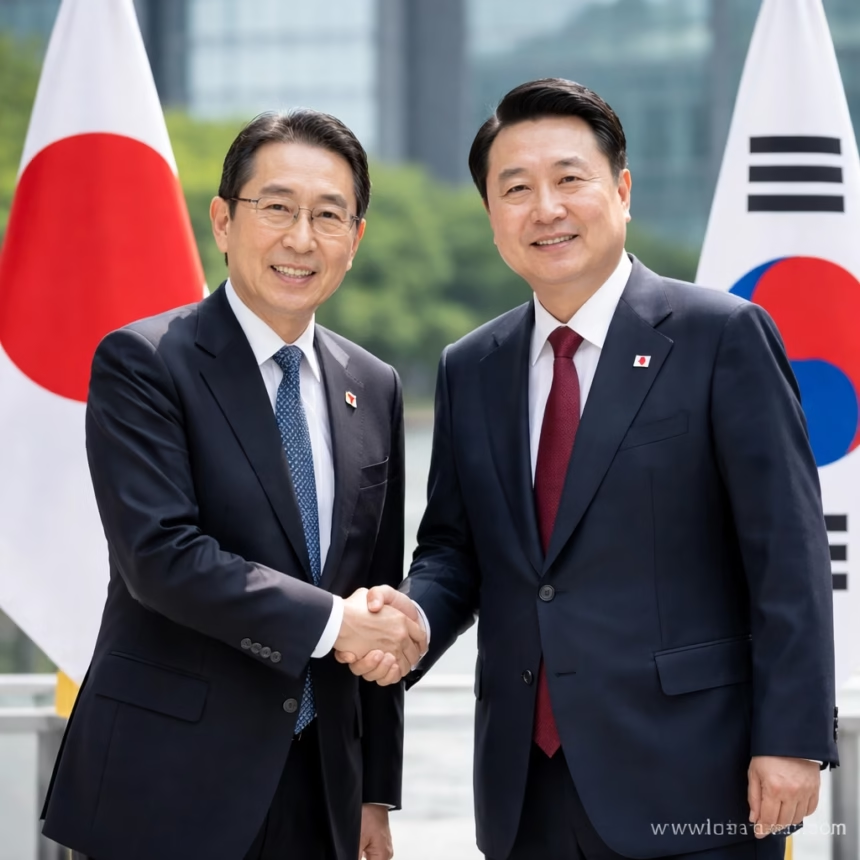
In a significant geopolitical realignment, Japan and South Korea have committed to deepening their bilateral relationship, moving past historical animosities. This renewed cooperation, solidified through high-level diplomatic engagements in recent months, is largely seen as a strategic response to evolving regional challenges, particularly the growing assertiveness of China. The two East Asian democracies aim to bolster security and economic collaboration, marking a new chapter in their often-strained history.
Background: A Century of Complex Ties
The relationship between Japan and South Korea has historically been fraught with tension, largely stemming from Japan's 1910-1945 colonial rule over the Korean Peninsula. Decades of diplomatic efforts often struggled to overcome the deep-seated resentment and differing interpretations of history.
A Legacy of Conflict
Core historical grievances include the issue of "comfort women," Korean women forced into sexual servitude by the Imperial Japanese Army during World War II, and the forced labor of Koreans in Japanese factories and mines. While Japan has offered apologies and compensation in the past, these efforts have often been deemed insufficient by Seoul and Korean civil society groups. Territorial disputes over the Dokdo/Takeshima islets further complicate relations, with both nations claiming sovereignty. These issues frequently resurface, derailing attempts at closer cooperation.
Economic Tensions and Security Dilemmas
More recently, in 2019, relations plummeted to a new low following a South Korean Supreme Court ruling that ordered Japanese companies to compensate wartime forced labor victims. Japan retaliated by imposing export restrictions on key materials vital to South Korea's semiconductor industry, citing national security concerns. This escalated into a full-blown trade dispute, prompting Seoul to threaten the termination of the General Security of Military Information Agreement (GSOMIA), a crucial intelligence-sharing pact with Japan, which was ultimately preserved under U.S. pressure.
Shifting Geopolitical Sands
The catalyst for the recent rapprochement is largely attributed to the rapidly changing geopolitical landscape. North Korea's escalating missile tests and nuclear ambitions pose an immediate and existential threat to both Japan and South Korea. Simultaneously, China's increasing military presence in the Indo-Pacific, its territorial claims in the South China Sea, and its stance on Taiwan have prompted regional anxieties. The war in Ukraine has also highlighted the importance of alliances and collective security.

The American Push
The United States has long advocated for stronger trilateral cooperation between Washington, Seoul, and Tokyo. Seeing both nations as vital allies in its Indo-Pacific strategy, successive U.S. administrations have consistently encouraged them to overcome historical disputes and forge a united front against common threats. The Biden administration, in particular, has made this a priority, viewing a cohesive trilateral partnership as essential for regional stability.
Key Developments: Bridging the Divide
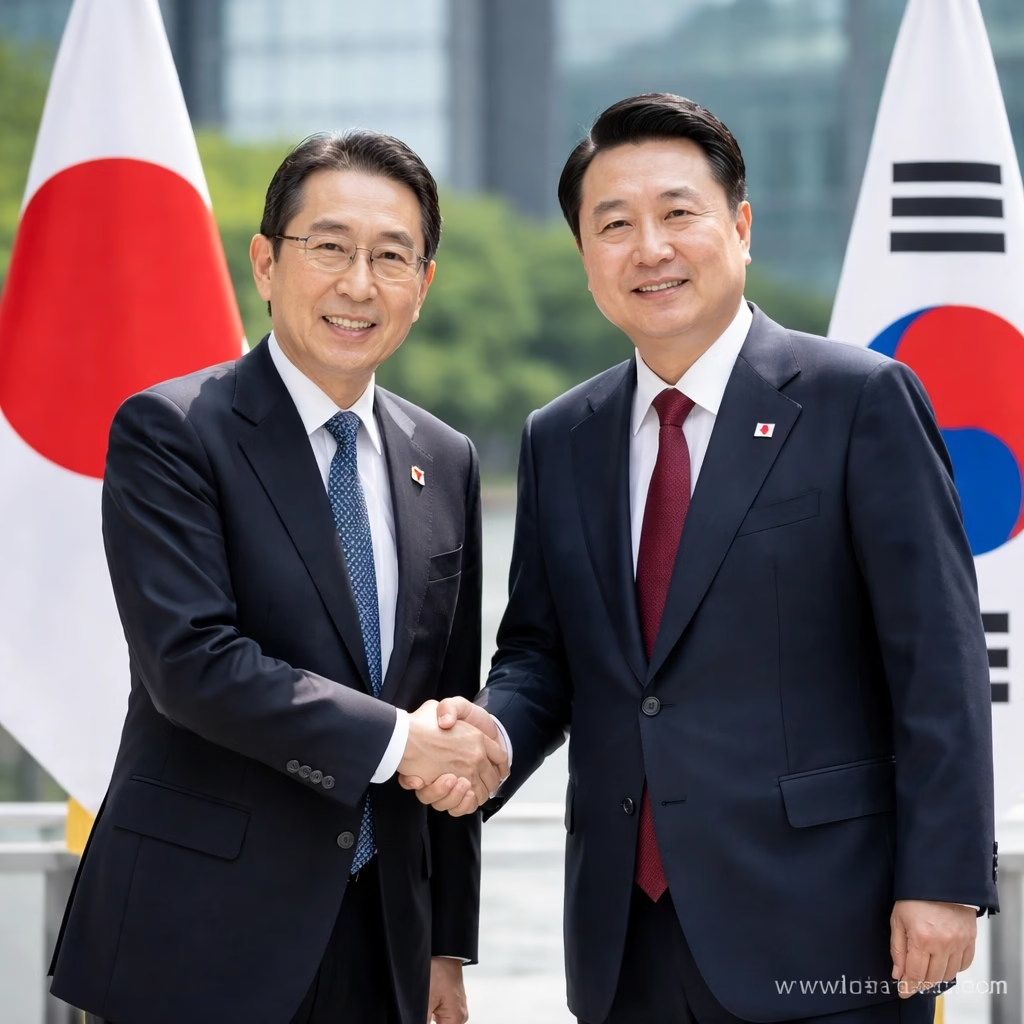
The recent shift toward rapprochement has been driven by proactive diplomacy from both sides, particularly under South Korean President Yoon Suk Yeol and Japanese Prime Minister Fumio Kishida.
Diplomatic Breakthroughs
President Yoon Suk Yeol, who took office in May 2022, signaled a strong desire to improve relations with Japan, adopting a "look to Japan" policy. In March 2023, he made a landmark visit to Tokyo, the first bilateral summit between the two countries in 12 years. During this visit, he offered a solution to the forced labor issue, proposing that a South Korean foundation compensate victims without direct Japanese corporate involvement, a move that drew domestic criticism but was welcomed by Tokyo. Prime Minister Kishida reciprocated with a visit to Seoul in May 2023, signaling a return to "shuttle diplomacy."
More Read

Security Architecture
A pivotal moment occurred in August 2023, when President Yoon, Prime Minister Kishida, and U.S. President Joe Biden convened at Camp David, Maryland, for an unprecedented trilateral summit. At this historic meeting, the three leaders agreed to institutionalize their cooperation, committing to annual summits, regular military exercises, and a real-time missile warning data-sharing system to counter North Korean threats. GSOMIA was fully reinstated, and new mechanisms for security dialogue were established.
Economic Re-engagement
Beyond security, economic ties have also seen a significant thaw. Japan lifted its 2019 export restrictions on high-tech materials, and South Korea, in turn, withdrew its complaint at the World Trade Organization. Both nations have pledged to strengthen cooperation on critical supply chains, particularly in semiconductors, batteries, and rare earth minerals, aiming to reduce reliance on single suppliers and enhance economic resilience. Investment and trade missions have resumed, fostering renewed business confidence.
Addressing Historical Grievances (or not)
While the Yoon administration's approach to the forced labor issue facilitated the diplomatic breakthrough, it remains a contentious point domestically in South Korea. The decision to pursue compensation through a domestic fund, rather than demanding direct Japanese corporate payments or a fresh apology, has been criticized by victim groups and opposition parties as a concession. However, it has allowed diplomatic channels to reopen, focusing on future-oriented cooperation.
Impact: Reshaping Regional Dynamics
The renewed Japan-South Korea relationship, particularly within the trilateral framework with the United States, carries significant implications for regional stability and global geopolitics.
A United Front Against Beijing
The most immediate impact is the strengthening of a democratic bloc in East Asia, providing a more robust counterweight to China's growing influence. Beijing views the trilateral alignment with suspicion, interpreting it as an attempt to contain its rise. This alliance could lead to increased pressure on China regarding issues like the Taiwan Strait, the South China Sea, and human rights, potentially prompting more assertive responses from Beijing.
Deterring Pyongyang
For North Korea, the united front presents a more formidable challenge. The real-time missile warning data sharing and enhanced joint military exercises between the U.S., Japan, and South Korea significantly improve their collective defense capabilities. This could complicate Pyongyang's strategic calculations, potentially deterring some provocations, though it may also prompt the regime to further accelerate its weapons development in defiance.

Bolstering the US Indo-Pacific Strategy
The United States has achieved a long-sought goal with the institutionalization of trilateral cooperation. This strengthens Washington's network of alliances in the Indo-Pacific, making its regional strategy more coherent and effective. It projects an image of democratic solidarity and shared commitment to a rules-based international order, bolstering U.S. leadership in the region.
Domestic Repercussions in Seoul and Tokyo
Domestically, the rapprochement has met with mixed reactions. In South Korea, while some appreciate the pragmatic approach to national security and economic benefits, others criticize President Yoon for seemingly downplaying historical grievances. Public opinion remains divided, with polls indicating lingering skepticism. In Japan, Prime Minister Kishida's moves have generally been supported, seen as a necessary step for regional stability, though some nationalist voices remain cautious.
Economic Dividends
Businesses in both Japan and South Korea stand to benefit significantly. The removal of trade barriers and renewed governmental commitment to cooperation fosters a more stable environment for investment and commerce. Industries like semiconductors, automotive, and advanced technology are poised for increased collaboration, potentially leading to innovation and more resilient supply chains.
What Next: Sustaining Momentum and Navigating Challenges
While significant progress has been made, the path forward for Japan-South Korea relations requires sustained effort and careful navigation of potential pitfalls.
Future Diplomatic Engagements
The institutionalization of annual summits and regular ministerial meetings (foreign ministers, defense ministers, finance ministers) will be crucial for maintaining momentum. Continued "shuttle diplomacy" and high-level dialogue will help address emerging issues and deepen trust. These engagements will also provide platforms to reinforce the trilateral framework with the United States.
Expanding Security Horizons
Expect to see an expansion of joint military exercises, moving beyond missile defense to encompass broader scenarios, including cyber security and maritime domain awareness. Further integration of intelligence sharing and potential collaboration on defense technology research and development could also be on the horizon, strengthening collective security against both conventional and unconventional threats.
Forging Economic Resilience
Collaboration on critical supply chains, particularly in advanced technologies like AI, quantum computing, and biotechnology, is likely to intensify. Both nations aim to diversify their economic partnerships and reduce vulnerabilities, especially regarding raw materials and key components. Joint initiatives in clean energy and climate change mitigation also present opportunities for cooperation.
Navigating Domestic Headwinds
The biggest challenge remains managing domestic public opinion and potential political shifts. Any perceived mishandling of historical issues or perceived concessions could reignite nationalist sentiments in either country, potentially derailing progress. Future administrations in both Seoul and Tokyo will need to demonstrate strong political will to sustain the current trajectory.
The China Factor
China's reaction will continue to shape the dynamics. Beijing may intensify its diplomatic and economic pressure on both Japan and South Korea, or attempt to sow discord between them. The two nations, along with the U.S., will need to carefully manage their communication and actions to avoid unnecessary escalation while firmly upholding their shared values and security interests. The long-term success of this renewed alliance hinges on its ability to withstand internal pressures and external challenges.