Gamma-Ray Bursts Hint at Possible Breakdown of Einstein's Relativity
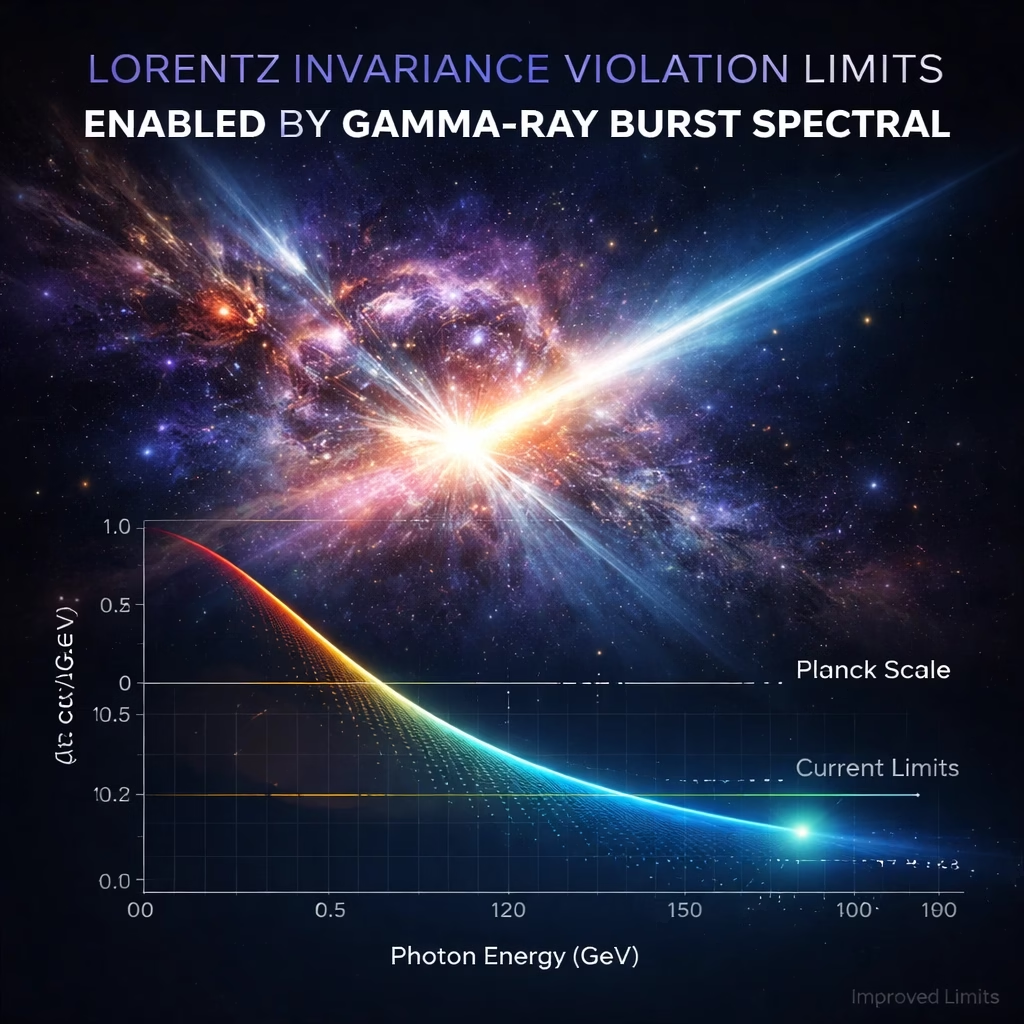
New research using data from 32 gamma-ray bursts (GRBs) suggests that the fundamental principle of Lorentz Invariance Violation (LIV) may be observable at ultra-high energies. The findings, derived from spectral-lag measurements, challenge long-held assumptions about the universality of physical laws across space and time.
Background
Lorentz Invariance, a cornerstone of Einstein's theory of relativity, posits that the laws of physics are the same for all observers, regardless of their motion or position. However, some theories in quantum gravity suggest that this principle might break down at extremely high energies, such as those observed in gamma-ray bursts.
Gamma-ray bursts are among the most energetic events in the universe, releasing more energy in seconds than the Sun will in its lifetime. They were first detected in the 1960s by military satellites monitoring nuclear tests, and their cosmic origins were confirmed in the 1990s.
Key Developments
The study, led by scientists from the University of Liège in Belgium, analyzed the arrival times of different energy photons from 32 GRBs. They focused on the spectral lag—the time delay between high-energy and low-energy photons—using data from the Fermi Gamma-Ray Space Telescope and the Swift Gamma-Ray Burst Mission.
Surprisingly, the researchers found that the spectral lag in some GRBs was smaller than expected, suggesting that high-energy photons might be traveling faster than their lower-energy counterparts. This could be a sign of Lorentz Invariance Violation, where the speed of light is not strictly constant at the highest energies.
Impact
If confirmed, these findings would have profound implications for our understanding of physics. They could provide the first experimental evidence of quantum gravity effects, a field that seeks to reconcile general relativity with quantum mechanics. However, the results are still preliminary, and further observations are needed to rule out alternative explanations.
For astronomers, this research highlights the importance of GRBs as natural laboratories for testing the limits of physical theories. Future telescopes, such as the proposed All-Sky Medium Energy Gamma-Ray Observatory (AMEGO), could offer even more precise measurements to explore these effects.
What Next
The research team plans to expand their analysis to include more GRBs and refine their models. Independent studies by other groups will also be crucial to validate—or refute—the findings. If the trend holds, it could open a new era in astrophysics, where GRBs serve as cosmic probes of fundamental physics.
In the meantime, physicists will continue to debate the implications, with some cautioning that systematic errors or unknown astrophysical processes could explain the observed anomalies. The quest to test Einstein's relativity remains one of the most exciting frontiers in science.