Solar Anomaly: Cosmic Puzzle Emerges in Sun's Core
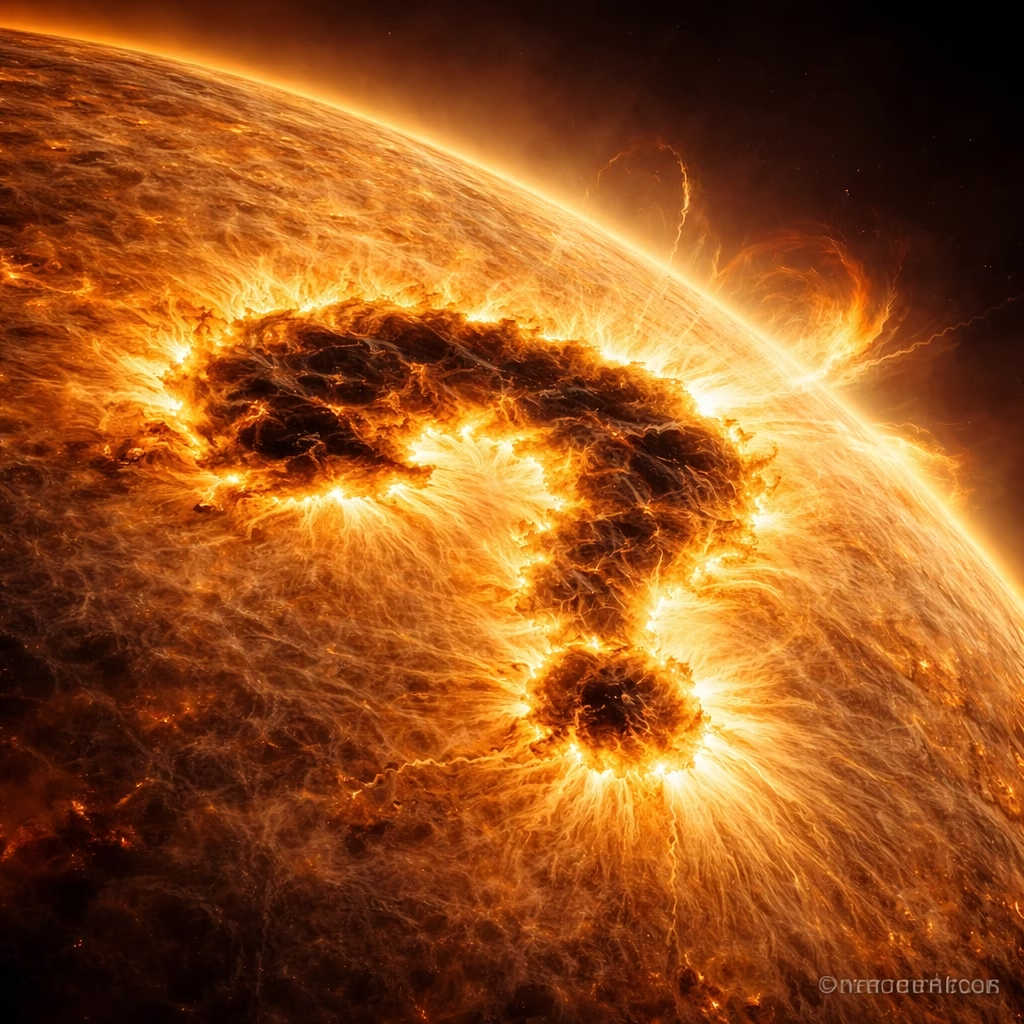
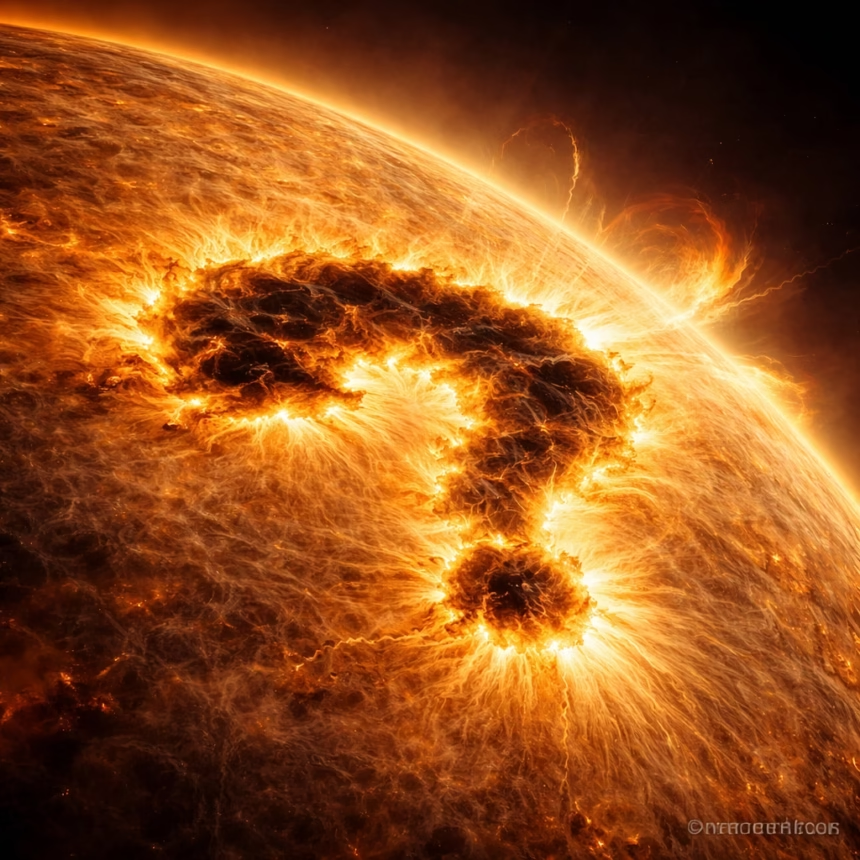
Astronomers have recently observed a peculiar formation within the Sun's core – a dark, irregularly shaped area resembling a question mark. This unusual feature, detected using advanced solar imaging techniques, has sparked considerable interest and debate amongst solar physicists.
Background: Understanding Solar Dynamics
The Sun, our nearest star, is a dynamic sphere of plasma constantly undergoing various processes. These processes, including nuclear fusion, magnetic field activity, and convective motions, influence the Sun's overall behavior and affect Earth's environment. Solar activity cycles roughly every 11 years, marked by variations in sunspot numbers, solar flares, and coronal mass ejections. Understanding these cycles is crucial for predicting space weather events that can impact satellites, power grids, and communication systems.
For decades, scientists have used a combination of ground-based and space-based telescopes to study the Sun. These observations have revealed complex structures within the Sun, including the photosphere (the visible surface), chromosphere, and corona (the outermost layer). The core, the Sun's innermost region, is where nuclear fusion converts hydrogen into helium, releasing vast amounts of energy.
Key Developments: The Emergence of the “Question Mark”
The unusual formation was first detected in late October 2024 by researchers analyzing data from the Solar Dynamics Observatory (SDO), a NASA spacecraft orbiting the Sun. Initial observations revealed a region of significantly reduced brightness compared to the surrounding solar activity. Further analysis, using higher-resolution imaging, revealed the distinct, question mark-like shape.
More Read

The formation is located within the Sun’s active region AR36647, situated approximately 50 degrees east of the Sun's center. This region exhibits heightened magnetic field complexity, which is believed to be a key factor in the formation of sunspots and other solar phenomena. However, this particular formation doesn’t neatly align with typical sunspot structures.
Researchers are particularly intrigued by the fact that the dark area isn't a traditional sunspot. Sunspots are cooler regions caused by intense magnetic fields inhibiting convection. This formation appears to be a more complex, possibly transient, structure, suggesting a novel mechanism at play. Data collected since the initial detection indicates the shape is slowly evolving, with edges becoming more defined and internal features emerging.
Magnetic Field Influence
Sophisticated magnetic field mapping reveals an unusually concentrated and complex magnetic field configuration within the region. This concentrated field is thought to be playing a pivotal role in shaping the dark area and potentially influencing its stability. The magnetic field lines appear to be converging, creating a sort of ‘magnetic funnel’ effect.
More Read

Impact: Implications for Solar Physics and Space Weather
While the "question mark" formation hasn't directly triggered any significant space weather events, its emergence presents a valuable opportunity to study the Sun’s complex dynamics. The unusual shape and associated magnetic field configuration suggest that current models of solar activity may need refinement.
Understanding how such formations develop and evolve could provide insights into the mechanisms that drive solar flares and coronal mass ejections (CMEs), both of which can have significant impacts on Earth. A CME is a massive expulsion of plasma and magnetic field from the Sun, and a flare is a sudden burst of energy. These events can disrupt satellite communications, damage power grids, and even pose a risk to astronauts.
The formation is currently not expected to directly threaten Earth. However, monitoring its evolution is crucial to understanding potential future impacts.
What Next: Ongoing Research and Future Observations
Scientists are closely monitoring the "question mark" formation using a variety of instruments, including SDO, the Parker Solar Probe, and ground-based observatories. The goal is to gather more data on its magnetic field structure, internal dynamics, and evolution over time.
Planned observations include high-resolution imaging using the Extreme Ultraviolet Imager (EUI) on the Solar Orbiter, which will provide unparalleled views of the Sun’s corona. Researchers are also running simulations to test various theoretical models of solar activity and determine whether they can explain the formation's unique characteristics.
The coming months promise to yield valuable insights into this intriguing solar anomaly. Scientists hope that by studying the "question mark," they can gain a deeper understanding of the Sun’s behavior and improve our ability to predict space weather events.
More Read

Timeline of Observations
October 26, 2024: Initial detection of the formation by SDO.
October 28, 2024: Confirmation and higher-resolution imaging.
November 5, 2024: Publication of preliminary findings by the NASA/SDO team.
Ongoing: Continuous monitoring with SDO, Parker Solar Probe, and ground-based observatories.