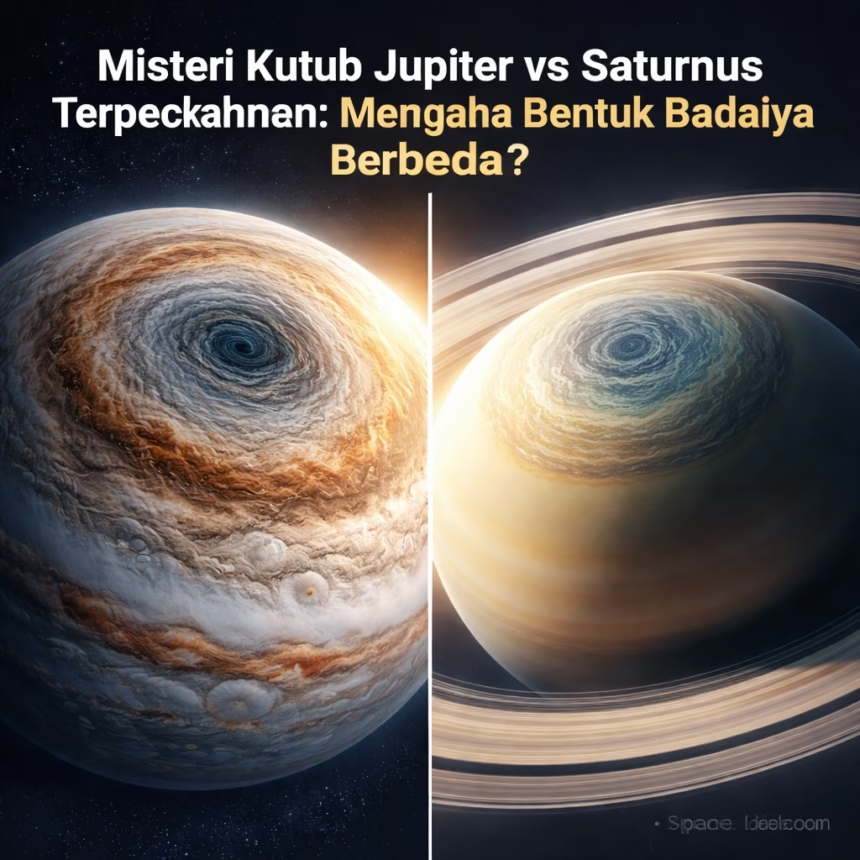
Cosmic Twins: Why Jupiter and Saturn's Storms Look So Different
For centuries, astronomers have been captivated by the swirling storms on Jupiter and Saturn. Recent research, published in *Nature Astronomy* on October 26, 2023, sheds light on why these gas giants exhibit such dramatically different atmospheric patterns. The findings offer a deeper understanding of planetary weather systems and the forces shaping our solar system.
A History of Celestial Observation
Observations of Jupiter and Saturn date back to ancient civilizations. Ancient Greeks and Romans recognized Jupiter and Saturn as powerful deities, and their movements were meticulously tracked. Through the lens of early telescopes, astronomers began documenting the prominent features of these planets – notably, Jupiter's Great Red Spot and Saturn's iconic rings and bands. Early theories attributed these features to simple rotation and convection. However, as technology advanced in the 20th century, with the advent of radio astronomy and space probes like Voyager 1 and 2 (launched in 1977), scientists gained much more detailed insights.
Voyager's close encounters provided the first detailed images of Jupiter's atmosphere, revealing its complex structure and the immense scale of the Great Red Spot. Saturn's rings were also revealed to be composed of countless particles, ranging from dust grains to ice chunks.
Unraveling the Atmospheric Differences
The key to understanding the differences between Jupiter's Great Red Spot and Saturn's bands lies in their internal heat sources and atmospheric dynamics. Jupiter, being significantly larger and denser than Saturn, generates far more internal heat. This heat fuels a powerful convection system, leading to the development of massive, long-lived storms. The Great Red Spot, a persistent anticyclonic storm larger than Earth, is a prime example of this. Its longevity – observed since at least 1831 – is attributed to its location in a region of strong upward motion within Jupiter’s atmosphere.

Saturn, while also possessing internal heat, exhibits a different atmospheric structure. Its bands are primarily driven by zonal winds – strong east-west winds that flow at different speeds at different latitudes. These winds are influenced by Saturn's rapid rotation (approximately 10.7 hours) and the planet’s layered atmosphere composed mainly of hydrogen and helium. The banding is less about a single, persistent storm and more about the interaction of these winds and atmospheric currents.
Recent models, incorporating data from the Juno spacecraft (currently orbiting Jupiter since 2016) and the Cassini mission (which concluded in 2017), have revealed that Jupiter’s Great Red Spot is also influenced by complex interactions with the planet's jet streams. These jet streams, which are powerful winds flowing east and west, play a role in both maintaining and influencing the storm’s shape and intensity.
More Read

The Role of Coriolis Force
The Coriolis force, caused by the planet’s rotation, significantly impacts the atmospheric flow on both Jupiter and Saturn. On Jupiter, this force contributes to the swirling motion of the Great Red Spot and other storms. On Saturn, it is a major driver of the zonal winds that create the distinct banding pattern.
Who Benefits from This Discovery?
While the direct impact on everyday life is minimal, this research has significant implications for space exploration and our understanding of planetary science. Improved models of planetary atmospheres are crucial for planning future missions to gas giants. A better understanding of atmospheric dynamics also helps scientists to better understand climate change on Earth, as many of the same principles apply to both terrestrial and extraterrestrial weather systems.
Furthermore, this knowledge informs our search for potentially habitable exoplanets. The atmospheric characteristics of gas giants around other stars can provide clues about their potential for harboring life.
Looking Ahead: Future Exploration
The James Webb Space Telescope (JWST) is expected to play a crucial role in future studies of Jupiter and Saturn. JWST’s infrared capabilities will allow scientists to probe the deeper layers of these planets’ atmospheres, providing a more complete picture of their internal structure and dynamics. Further data from ongoing and planned missions will refine our understanding of these cosmic giants.
Future missions might include atmospheric probes that descend into the clouds of Jupiter and Saturn, providing invaluable data on the composition and dynamics of these worlds. These probes would offer a firsthand look at the processes that shape their spectacular weather patterns.
JWST Observations
JWST observations in 2024 have already revealed new details about the composition and temperature variations within Jupiter’s atmosphere, furthering our understanding of its complex weather patterns.