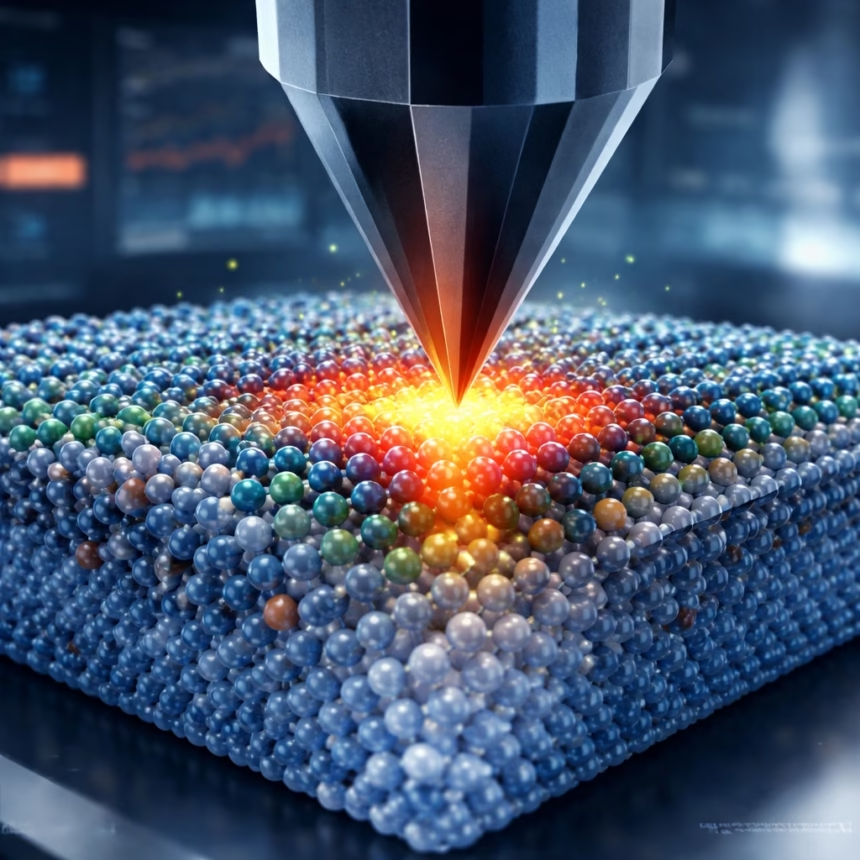
Unlocking Material Secrets: How Computers Are Cracking the Code of Hardness
Researchers at the University of California, Berkeley, have achieved a significant advancement in understanding the behavior of silicon carbide (SiC), a crucial material in industries ranging from power electronics to aerospace. Using advanced molecular dynamics simulations, the team is gaining unprecedented insights into how SiC responds to indentation – a process vital for assessing its durability. The findings, published in *Advanced Materials* on October 26, 2023, promise to accelerate material design and improve the performance of SiC-based components.
Background: The Quest for Durable Materials
Silicon carbide has long been recognized for its exceptional hardness, high thermal conductivity, and chemical resistance. Its inherent strength makes it a preferred material in demanding applications, particularly where high temperatures and mechanical stress are prevalent. Research into SiC's properties has been ongoing for decades, with early studies focusing on its crystal structure and basic mechanical characteristics. However, accurately predicting its behavior under complex, real-world loading conditions – like those encountered during indentation – has remained a significant challenge. Traditional experimental methods are time-consuming and expensive, limiting the scope of investigation.
Key Developments: Molecular Dynamics to the Rescue
The recent breakthrough hinges on the refinement of molecular dynamics (MD) simulations. MD is a computational technique that simulates the motion of atoms and molecules over time, based on fundamental physical laws. The Berkeley team developed a new, highly accurate force field – a set of equations describing the interactions between atoms – specifically tailored for SiC. This force field allows for more realistic modeling of the material's response to indentation forces. The improved simulation capabilities enable researchers to probe deeper into the mechanisms of crack initiation and propagation within the SiC lattice under stress.
Crucially, the simulations incorporate the effects of defects – imperfections in the crystal structure – which are common in real-world SiC materials. Previous simulations often simplified the material, neglecting these defects. By including them, the team observed a more nuanced and accurate representation of SiC's indentation behavior. The simulations were performed using high-performance computing resources at the Lawrence Berkeley National Laboratory's BayeStat cluster, enabling the modeling of large-scale atomic systems.
More Read

Impact: Boosting Innovation Across Industries
The improved understanding of SiC’s indentation behavior has broad implications. Companies involved in power electronics, such as Infineon Technologies and Wolfspeed, are heavily reliant on SiC for producing more efficient and durable power devices. Better material design, informed by these simulations, could lead to smaller, more powerful, and longer-lasting electronics for electric vehicles, renewable energy systems, and industrial equipment. In the aerospace sector, SiC is used in high-temperature components, and enhanced durability is critical for ensuring safety and reliability. Improved simulations can help engineers optimize SiC designs for these harsh environments.
What Next: Towards Predictive Material Design
The Berkeley team is now focusing on extending the simulations to explore the effects of different SiC compositions and processing techniques on its mechanical properties. They aim to develop a predictive model that can accurately forecast the indentation behavior of SiC materials under various conditions. This would allow engineers to virtually test different designs and identify the optimal material parameters before committing to expensive physical experiments. Future research will also explore the application of MD simulations to predict the performance of SiC in more complex scenarios, such as under dynamic loading or exposure to corrosive environments. The team plans to collaborate with industry partners to validate the simulation results with experimental data and translate the findings into practical applications.
Further Details: The Role of Defects
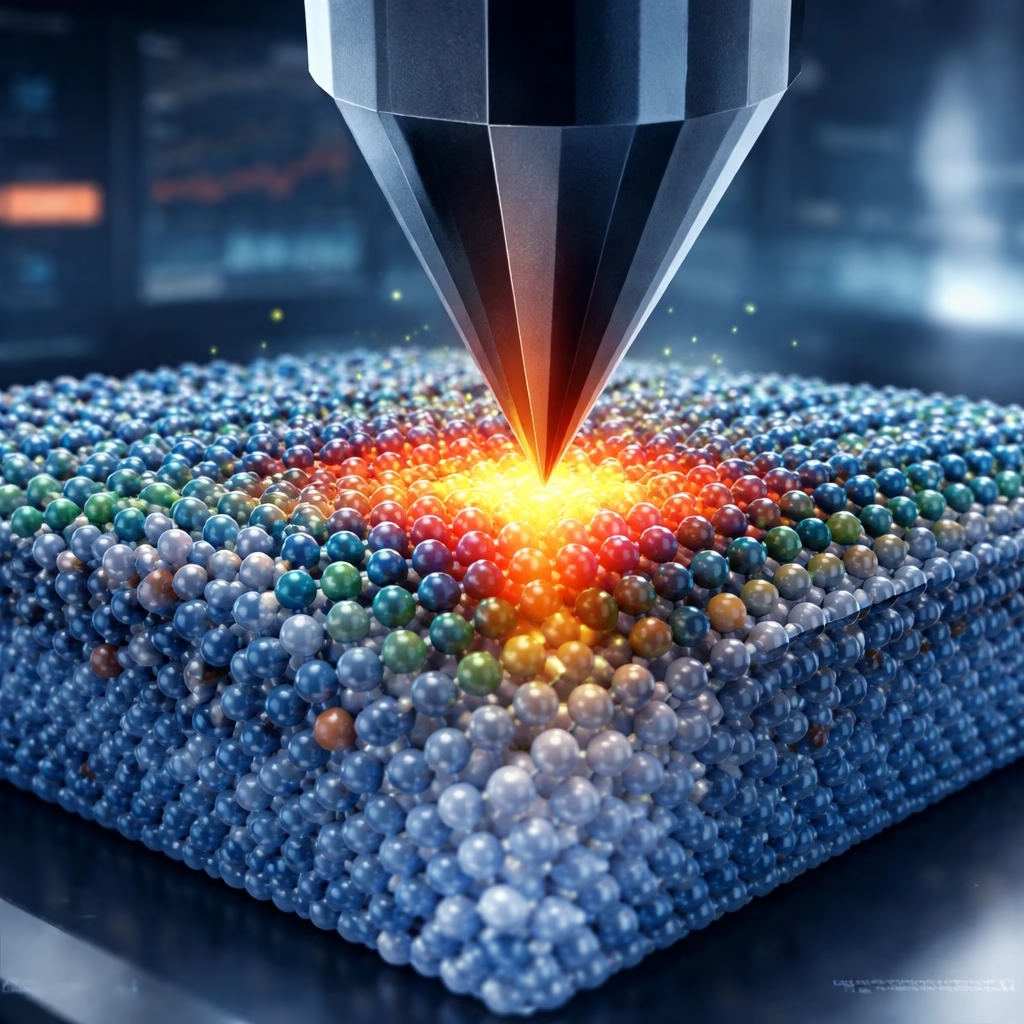
The inclusion of defects in the MD simulations proved crucial. Silicon carbide, like all real materials, contains imperfections such as vacancies (missing atoms) and dislocations (line defects in the crystal structure). These defects act as stress concentrators, influencing how the material deforms and fractures under indentation. The simulations revealed that the presence and distribution of defects significantly affect SiC’s hardness and resistance to crack propagation.
More Read

Future Research Directions
Beyond indentation, the team intends to apply their refined MD methodology to investigate other mechanical properties of SiC, including fracture toughness and creep resistance. They are also exploring the use of machine learning techniques to accelerate the simulation process and improve the accuracy of the force field. The goal is to create a comprehensive computational toolkit for designing and optimizing SiC materials for a wide range of applications.